


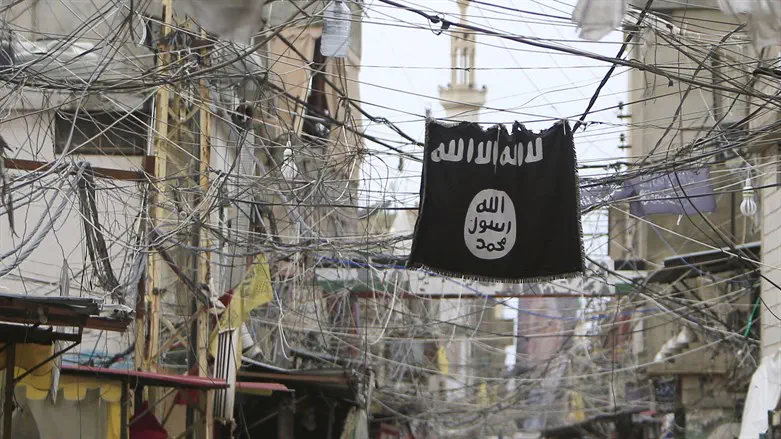
A senior Islamic State (ISIS) terrorist leader was captured late Wednesday in a joint operation carried out by Syrian security forces and the US-led international coalition against terrorism near Damascus, the Anadolu news agency reported.
The detainee, identified as Taha al-Zoubi, also known by his nom de guerre Abu Omar Tibiya, served as the organization’s “governor of Damascus”. He was seized along with several of his aides.
According to Syria’s state television channel Al-Ikhbariyah, citing a source from the Interior Ministry, “as a result of the operation carried out by coalition forces and internal security units, ISIS’s so-called Damascus governor was captured.”
Brigadier General Ahmad al-Dalati, head of Internal Security in the Damascus Countryside, told Syria’s official SANA news agency that after a prolonged period of surveillance, the General Intelligence Directorate under the Interior Ministry, working in coordination with coalition forces, launched a joint operation targeting an ISIS cell in the Muaddamiyah district.
Al-Dalati said that during the raid, al-Zoubi and some of his aides were captured while wearing explosive vests, ending one of the most focused counterterror operations in the Damascus region in recent months.
ISIS overran large swathes of Syria and Iraq in 2014, proclaiming a "caliphate" in land it controlled.
Several military offensives, including ones backed by a US-led international coalition, have since seen ISIS lose most areas it once controlled, including the loss of their de facto capital in Raqqa, Syria.
However, ISIS sleeper cells remain in the area and continue to carry out deadly attacks in Syria and Iraq. The US deploys troops in Syria as part of its effort to defeat ISIS in the region.
In late November, forces from US Central Command (CENTCOM) and the Syrian Ministry of Interior located and destroyed more than 15 sites containing ISIS weapons caches in southern Syria.
Earlier this week, CENTCOM forces struck more than 70 ISIS targets at multiple locations across central Syria with fighter jets, attack helicopters, and artillery. The Jordanian Armed Forces also supported with fighter aircraft.
The operation came in response to the killing of two US service members and one civilian in an ISIS ambush in Palmyra.