

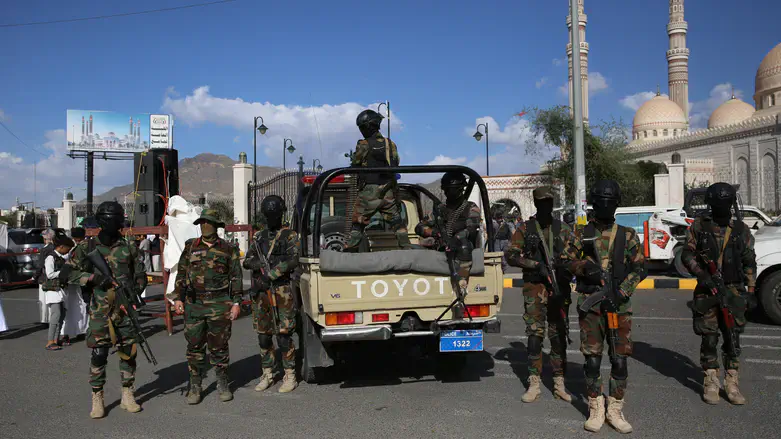
Yemen’s Houthi rebels and the country’s internationally recognized government agreed Tuesday to a prisoner exchange involving nearly 3,000 individuals, among them seven Saudis, reported the Associated Press. If completed, it would mark the largest prisoner swap in 11 years of war.
The breakthrough agreement followed nearly two weeks of negotiations in Muscat, Oman’s capital, a key mediator in Yemen’s conflict. Officials from both sides confirmed the deal but shared few details about next steps, as international observers pressed for swift implementation to advance peace efforts.
Abdulqader al-Mortada, a negotiator for the Houthi delegation, said on X that “we signed an agreement today with the other party to implement a large-scale prisoner exchange deal involving 1,700 of our prisoners in exchange for 1,200 of theirs, including seven Saudis and 23 Sudanese.”
Saudi Arabia’s ambassador to Yemen, Mohamed AlJabir, said the Kingdom had worked with the UN on the deal, which was signed under the auspices of the United Nations and the International Committee of the Red Cross (ICRC). “The Yemeni parties have agreed on a mechanism to expedite the detainee exchange process,” AlJabir was quoted as having told state broadcaster al-Ekhbariya.
Majed Fadail, a government delegation member at the Muscat talks, told AFP that the exchange “will be the largest” deal of its kind and said “the exchange of lists and names will take place from now and no later than in one month.” He added that two of the seven Saudis are air force pilots, and that Mohamed Qahtan, a prominent Sunni Islamist leader allied with the Saudi-backed government and detained by the Houthis since 2015, would be among those released.
Meanwhile, UN human rights chief Volker Turk appealed to the Houthis to “immediately and unconditionally” release dozens of UN staff detained over recent years.
The Houthis have accused some of the detained UN workers of espionage and collaboration with Israel - allegations that remain unproven.
The group has repeatedly claimed to have captured “Israeli spy networks” in Yemen, though no independent evidence has ever corroborated those claims.
In late November, a Houthi-run court in Sanaa sentenced 18 Yemeni aid workers employed by United Nations humanitarian agencies to death over spying for Israel.
The sentencing followed Israeli airstrikes in August on Sanaa, carried out in response to Houthi missile and drone attacks toward Israel. The strikes killed dozens of Houthi officials, including 12 “ministers” and the group’s Military Chief of Staff, Muhammad Abd Al-Karim al-Ghamari, who was wounded and eventually succumbed to his wounds.
The Houthi movement controls the capital Sanaa and most of Yemen’s north, while the internationally recognized government holds much of the south. The war, ignited in 2015 between the Iran-backed Houthis and a Saudi-led coalition supporting the government, has claimed hundreds of thousands of lives and left vast numbers detained.
A UN-brokered ceasefire, though expired, has largely held since 2022, but direct talks to finalize an enduring peace have yet to yield a comprehensive accord.