

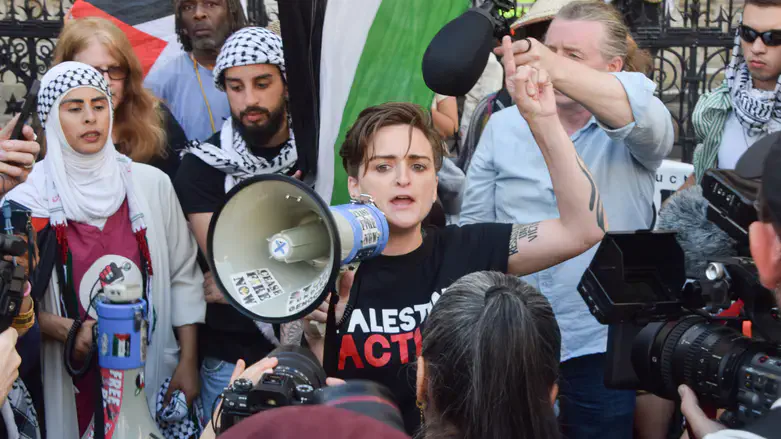
Lawyers for the UK government on Tuesday defended the ban on activist group Palestine Action under anti-terror laws, as three days of hearings concluded at the High Court in London, AFP reported.
The government’s legal team argued the decision to criminalize the organization, announced in July, was proportionate following an “escalation” in its activities. Membership or support for the group is now a serious criminal offense punishable by up to 14 years in prison.
Protest organizers Defend Our Juries said the ban has already led to at least 2,300 arrests. UN human rights chief Volker Turk, the Council of Europe, and several NGOs criticized the move, warning of “excessive limits” on the right to protest.
Palestine Action co-founder Huda Ammori challenged the ban before a three-judge panel. Giving evidence, Stephen Kosmin, representing the interior ministry, defended “the proportionality of the policy,” saying it was needed “in order to protect the public” and “maintain national security.”
The government outlawed the group days after activists protesting the Gaza war broke into an air force base in southern England, causing an estimated £7 million in damage to two aircraft.
Founded in 2020, Palestine Action describes itself as a “direct action” network opposing what it calls British “complicity” with Israel, particularly in relation to arms sales.
The group also previously defaced a painting of Lord Balfour at Trinity College Cambridge, spraying the portrait with red paint and slashing it.
In another incident, Palestine Action members stole two busts of Israel’s first President, Chaim Weizmann, from a glass cabinet at Manchester University.
The government noted during the hearings that “proscribed organizations are deprived of the oxygen of publicity as well as financial support.” Interior ministry lawyer Natasha Barnes added the ban “has not prevented people from protesting in favour of the Palestinian people or against Israel’s action in Gaza.”
Part of the hearings took place behind closed doors, with restrictions imposed on journalists. A ruling will be handed down at a later date.