


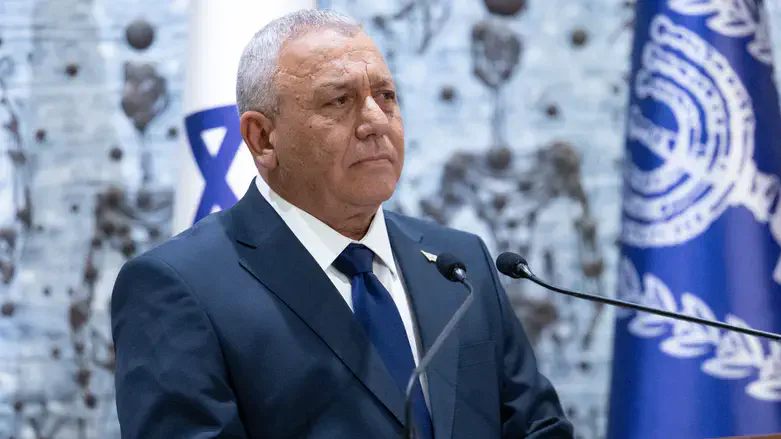
Political figures believe Yashar! chairman Gadi Eisenkot could complete the formation of a government within one to two weeks through a two-stage process in which United Torah Judaism would join the coalition first, followed by Shas, giving the government a majority of 61 Knesset members.
Under the scenario being discussed, the government would initially be sworn in with the support of 55 Knesset members, including those from United Torah Judaism. Shas could initially remain outside the government, but its designated ministerial portfolios would be reserved for it, in the expectation that it would join the coalition shortly afterward.
A central element of the plan is that Jewish lawmakers would constitute a majority of those voting to approve the government, while the Arab parties are expected to abstain.
The Arab parties would not be part of the coalition, no coalition agreements would be signed with them, and no commitments would be made to them as part of the government's formation. Once Shas joins, the coalition is expected to have a majority of 61 Knesset members without needing the Arab parties to abstain.
Alongside the potential progress in the talks, questions remain over the conscription of haredi yeshiva students and the ability to reconcile the haredi parties' demands with the military's requirements and the legal position. The possibility that the Supreme Court could intervene in any arrangement reached by the parties also remains open.
Another question concerns the position of Together chairman Naftali Bennett, who favors a unity government with Likud on the condition that Eisenkot serve first in a rotation agreement. Eisenkot is believed to have no intention of giving up the first turn as prime minister in any alliance between the two.
Despite the remaining obstacles, the assessment is that the talks could lead to the formation of a government within the next two weeks, without the need for another election.