
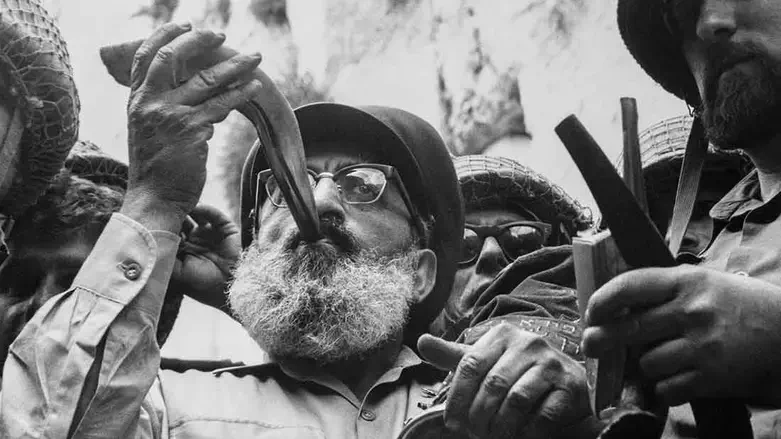
Rabbi Elisha Wolfson, head of the Temple Mount Yeshiva, has responded to remarks by Rami Goren, son of former Chief Rabbi of Israel Rabbi Shlomo Goren, on the Arutz Sheva podcast, in which he said his father opposed the routes commonly used by Jewish visitors to the Temple Mount today.
Rabbi Wolfson sought to clarify the matter, arguing that Rabbi Goren's halakhic position was broader than portrayed in the interview.
Rabbi Wolfson began, "First of all, it was truly heartwarming and inspiring to hear Rami speak about his father", but immediately added, "What would Rabbi Goren say about what is happening today? He would be elated, filled with immense joy, and would support it in ways that are impossible to describe".
According to Rabbi Wolfson, Rabbi Goren attached great importance to opening the Temple Mount to Jewish prayer and even said, "One must be prepared to sacrifice one's life so that the Temple Mount will be open to Jews".
Rabbi Wolfson explained that a distinction must be drawn between Rabbi Goren's halakhic ruling, as presented in his books and letters, and the instructions he gave when seeking to establish a designated place of prayer on the Temple Mount.
He said Rabbi Goren based his ruling on the historical tradition identifying the Foundation Stone, located beneath the Dome of the Rock, as the site of the Temple. According to this approach, extensive areas of the Temple Mount can be traversed without concern about entering the Temple site.
However, when Rabbi Goren sought to establish a permanent place of prayer, he chose the southern part of the Mount so that the location would be permissible even under stricter halakhic opinions that do not rely on that tradition.
To support his argument, Rabbi Wolfson presented a public letter Rabbi Goren published in 5746 (1986), addressing the extent of the areas on the Temple Mount that may be entered.
In the letter, as quoted by Rabbi Wolfson, Rabbi Goren wrote, "The Temple occupied less than 15% of the area of the ancient Temple Mount, and the Temple Mount as it stands today is almost twice the size of the area that was sanctified during the Second Temple period".
The same letter continued, "It therefore follows that even according to Maimonides, the vast majority of the Temple Mount as it stands today may be entered according to all opinions, provided that care is taken not to enter the area of the Dome of the Rock".
Rabbi Wolfson said these statements show that Rabbi Goren did not restrict entry to the Temple Mount to its southern section alone. He stressed that, in his understanding, Rabbi Goren's ruling permits walking along the perimeter route used today, subject to particular care on the western side of the Mount: walking only on the path next to the Western Wall, without approaching the steps of the raised platform to the east.
Rabbi Wolfson concluded his remarks by calling for continued visits to the Temple Mount in accordance with the requirements of ritual purity and halakhic guidelines, "Blessed are those who ascend the Temple Mount in ritual purity, guided by Rabbi Goren, who ruled and cried out about our obligation to take possession of the Temple site and restore prayer and sanctity to this place".
Rabbi Wolfson's remarks follow an interview Rami Goren gave to the Arutz Sheva podcast, in which he presented a different account of his father's position on the routes used by visitors today.
Goren said, "My father, for example, was opposed to going where people go today". According to him, his father did permit visits to the Temple Mount, but only to areas that all halakhic opinions agree lie outside the sanctified areas.
Goren specifically mentioned the areas near the Western Wall and the southern section of the Temple Mount, which he said were added to the Mount in later periods.
By contrast, he expressed reservations about the current routes, which he argued pass through areas whose halakhic status is disputed.
He said, "Today people go inward, to the east, and that is a major problem. There is a dispute over where the Holy of Holies is, but you could reach the Holy of Holies". Asked whether his father would have opposed the way visits are commonly conducted today, he answered in the affirmative.
Later in the interview, Rami Goren recounted that, on the 20th anniversary of his father's death, activists from Temple movements approached him and asked him to join, and even lead, an organized visit to the Temple Mount in Rabbi Goren's memory. He said he declined because he believed the proposed route was inconsistent with his father's halakhic position.
He recalled, "I said, 'Guys, I can't. If you want to go, I can't go. So, to avoid any embarrassment, do whatever you want, but don't invite me'".
Goren stressed that his father's position was based on surveying and mapping conducted on the Temple Mount immediately after the Six Day War, with the participation of a military engineering unit. He said the measurements continued after the war, and the maps produced at the time have been preserved to this day.