
Eight years have passed since the morning Neve Rotem, then a soldier in compulsory service, found himself fighting for his life against a terrorist who had infiltrated his guard post in Beit El.
For several minutes, he fought with his bare hands, sustained severe blows to the head, and lost consciousness. When he woke up in the hospital hours later, no one could say with certainty what the consequences of his serious injury would be.
Today, still bearing the physical scars of the attack, Rotem has chosen to turn his personal story of survival into a mission. He meets with teenagers, yeshiva students, and national service volunteers, telling them not only about the moments when he nearly lost his life, but also about the meaning he has found in the life he was given back.
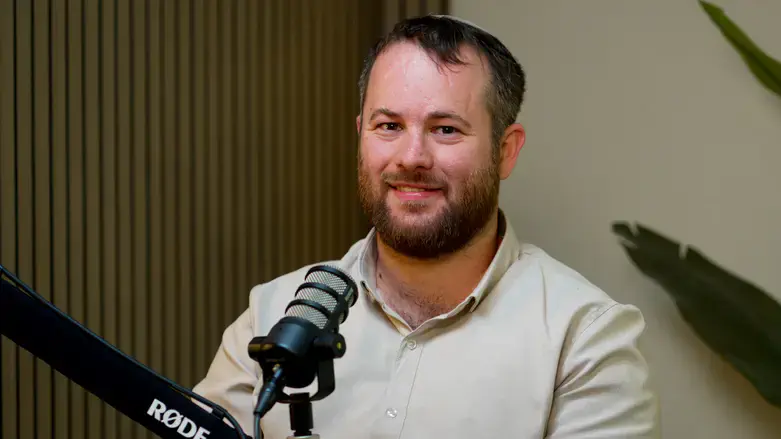
In a special interview for the podcast of the "Marching and Saluting" initiative, in partnership with Ammunition Hill and the Ministry of Heritage, marking the 5787 National Day of Appreciation for Israel's Wounded Soldiers and Victims of Terrorism, he revisits that difficult week in December 2018, which began with a shooting attack and ended, for him, in a face-to-face struggle with a terrorist.
It was Hanukkah. Following the shooting attack at the Ofra junction, in which civilians were wounded, the alert level in the area was raised. Several days later, an attack took place at the Givat Assaf junction, where two fellow soldiers from his battalion, Yuval Mor Yosef and Yossi Cohen, were murdered, and another soldier, Netanel Felber, was seriously wounded.
He recalled, "The reports gradually started coming in, and unfortunately we heard that two soldiers had been killed. We started thinking, these are friends, these are people we know."
Following the attack, Rotem and his fellow soldiers were sent to reinforce the troops in Beit El and replace soldiers who had left to attend their friends' funerals. When he arrived in the community, he tried to reassure his mother, who was worried about him because of the security situation.
He said, "I told her, Mom, I'm in Beit El; everything is fine."
The following morning, Rotem was stationed alone at a guard post along the community's perimeter fence. His job was to ensure that no one approached the fence from the nearby village and tried to attack residents' homes. At around 8:30 a.m., he noticed someone who aroused his suspicions.
He said, "I was on alert to make sure he wasn't doing anything suspicious. It looked as though he was trying to hitchhike. He passed below me, said 'Sabah al-khair,' I replied 'Sabah an-nur,' and he continued and disappeared from my line of sight."
A few minutes later, he heard a rustling sound behind him. He turned toward the entrance to the post and saw a large man lunging at him.
He recalled, "I turn around, and at the entrance to the post I see a large figure who immediately lunges at me, making a downward stabbing motion. It takes you a moment to understand what's happening, what the situation is. I'm thrown backward onto the sandbags in the post and start feeling stabbing blows to my chest, start feeling blows. In those split seconds, I realize I'm under attack".
Rotem immediately understood that he had to fight for his life. But the post was cramped, the terrorist was pressed up against him, and he could not use his weapon.
He said, "I realize he's too close to me; we're right up against each other. There's no room, and I can't use my gun, so I start fighting with my hands. As he lunges at me, he sprays pepper spray. All the while, my only goal was to create a little distance, use my gun, and end it."
During the struggle, he briefly thought the terrorist did not have a knife, because he felt blows to his chest but no stab wounds. Only later did it emerge that a broken knife had been found at the scene, apparently having broken during the attack.
The struggle continued outside the post. The two fell about two meters and rolled on the ground. The terrorist grabbed Rotem's helmet strap and tried to strangle him. Rotem managed to unfasten the strap and break free, but the terrorist continued attacking him.
He recalled, "He grabs rocks and starts hitting me in the head. At some point he gets on top of me, I try to throw him off, he hits me in the head, says some word, another blow to the head, and that's roughly where my memory cuts out."
At that moment, with none of his fellow soldiers nearby, a turn of events saved his life.
Revital Deri, a Beit El resident, was driving along the nearby road after shopping for Shabbat. She said that, for a reason she could not explain, she suddenly looked toward the area where the struggle was taking place.
Rotem recounted, "She says, I don't know why, but I look to the left. I'm driving straight ahead, and suddenly I see something. She can't work out what she's seeing. Someone is hitting someone, perhaps dealing with an animal. Suddenly she sees blood-covered hands rising, and she understands and starts shouting."
Shortly afterward, the terrorist fled, leaving Rotem seriously wounded on the ground. To this day, he does not know whether the shouting caused the terrorist to flee, or whether it was the prolonged struggle or the effects of the pepper spray.
He said, "Thank G-d, I try to count the number of miracles that happened during that incident."
Emergency responders called to the scene found Rotem suffering from a severe head injury and facial injuries. Although he remembers nothing of those hours, the paramedics told him that he had managed to speak to them and even warn them about the terrorist.
He was evacuated to the hospital in critical condition, and his family waited anxiously for developments. His injuries included trauma to his head, face, teeth, and nose. Even after medical examinations, it was impossible to determine how his ability to function would be affected.
His wife, who was studying topics related to head injuries at the time, understood the implications of that uncertainty. He said, "They told her, 'Listen, the scans look all right, but there's no way to know until he wakes up.'"
Only shortly before Shabbat began, at around 4:30 p.m., did Rotem begin to wake up.
He recalled, "Everything is very, very slow; everything moves very slowly. I'm not even opening my eyes, just beginning to wake up."
His wife held his hand and began asking him questions to check whether he understood and could respond. Because of the injuries to his mouth, he could not speak, so he answered by squeezing her hand. She asked him arithmetic questions and questions in English, and he was able to answer. At one point, he even managed to communicate an inside joke they shared.
Describing her sense of relief, he said, "If there's a sense of humor, then his mind is still with us."
During the night, as his mother and wife remained at his side, his memory gradually began to return as well. He started telling his mother about the attack, but their conversation soon became a personal discussion about life and family.
At the time, Rotem was married and the father of a four-month-old baby girl. From his hospital bed, after escaping death, he found himself talking to his mother about raising children and the future.
Despite his severe injury, rehabilitation and the challenges of coping with its consequences, Rotem did not give up his desire to continue serving in the IDF. He understood that he would not be able to return to his combat role, but was determined to find another way to contribute.
He said, "That was something I knew I wanted to continue. I had to figure out the right setting after the incident." He added, "There were several months at home, somewhat frustrating months. On the one hand, I needed them, but on the other, I had a burning desire to get back and do something."
After several months, with help from friends and after overcoming bureaucratic hurdles, he returned to service in a different capacity. He said he found great meaning in it and continues to serve in the same capacity as a reservist today.
Alongside his return to service, the daily challenges of his injury remained. Rotem describes sensitivity in various parts of his body, damage to his teeth, nose and airways, as well as psychological challenges. Nevertheless, he repeatedly emphasizes his gratitude for being alive.
In the years since the attack, he has begun sharing his story with young people. For him, it is not merely an account of a serious security incident, but an opportunity to convey a message of responsibility, meaning and continuity to the next generation.
He explained, "I think I was given an opportunity." He continued, "Especially now, after the war, we know that many people gave their lives defending the people of Israel. And I was fortunate not to. I was fortunate not to have given my life. I came close, but I'm here. I still have a purpose; I still have a mission."
He said the meetings with teenagers allow him to connect his personal story to the broader story of the Jewish people.
He said, "It's an opportunity to help young people understand the meaning of our struggle here, of the long story we are part of. I'm happy to bring my story to young people, and together, all of us in one shared story, we continue the great mission we have here."
Ahead of the National Day of Appreciation for Israel's Wounded Soldiers and Victims of Terrorism, Rotem also reflected on the change in public attitudes toward the wounded following the war. As someone wounded years earlier, he feels that public awareness and recognition of the challenges faced by the wounded have grown.
He said, "We received a warm embrace back then too, but now the awareness among the people of Israel and the support, both from the state and various organizations and from the public as a whole, I feel that recognition, and I'm grateful that we've been fortunate enough to receive it."
Eight years after that morning in Beit El, Rotem still carries the memory of the struggle and the marks of his injury. But when he stands before teenagers and describes the moments when his life hung in the balance, he wants them to remember not only what he went through, but above all what he has chosen to do since.
He concluded, "I came close, but I'm here. I still have a purpose; I still have a mission."
Watch the full interview (in Hebrew):