

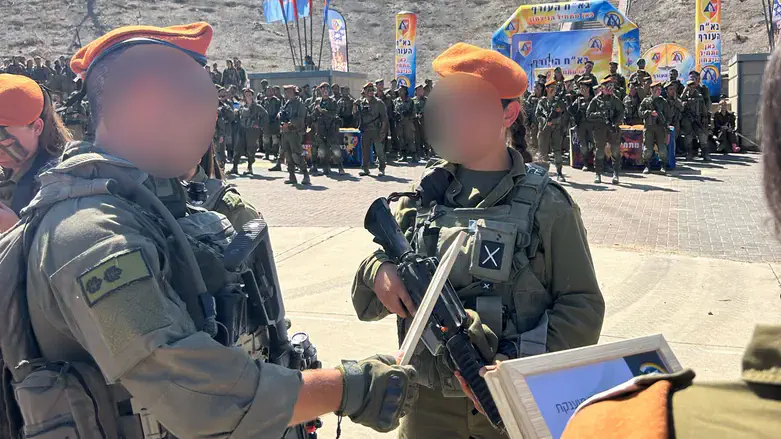
Lt. Col. A., commander of the Home Front Command's Search and Rescue Brigade training base, describes the transformation new combat soldiers undergo during their seven months of training: "They enter the training base apprehensive and uncertain, and leave highly determined, with a strong sense of responsibility and the ability to adapt socially."
As a new class of recruits joins the brigade, he speaks to Arutz Sheva-Israel National News about a program that combines combat training with rescue and lifesaving skills, and the responsibility involved in preparing soldiers for their missions.
He says the training's distinctive feature is its combination of two different operational fields: combat and defending national security on the one hand, and operating at disaster sites and rescuing trapped people on the other.
He explains, "We train combat soldiers who also know how to rescue people." He adds, "On a day-to-day basis, we are deployed on operational duties throughout the country, on a par with all the other brigades."
He says the brigade's soldiers must carry out operational missions like those serving in other combat brigades, while also maintaining the specialized skills needed for building collapses and complex rescue operations. These missions may take place within Israel, in combat zones or beyond the country's borders.
He says, "We learn both to confront terrorists and to save lives."
The new intake comprises five companies, which will begin an intensive training program designed to prepare them for the Search and Rescue Brigade's range of missions. Lt. Col. A. emphasizes that men and women serve together as combat soldiers in the brigade, and that its distinctive role requires training that combines combat capabilities with additional professional skills.
He says the training is designed to give recruits not only knowledge and skills, but also personal resilience, the ability to cope under pressure and a sense of responsibility toward their fellow soldiers.
He says, "The training program is very demanding, intensive and meaningful, and enables us to provide the State of Israel with strong, resilient combat soldiers who can handle any mission."
For Lt. Col. A., however, operational readiness goes hand in hand with the personal development of each recruit. He says that ahead of enlistment, he spoke with the soldiers' parents and explained what their children could expect in the coming months.
He recalls, "I held a talk for the recruits' parents and told them that these are seven months that change a person."
The change, he says, begins with physical ability, but does not end there. Recruits arrive at the base still dealing with uncertainty and concerns about military service, and during training they must develop independence, discipline, social adaptability and a sense of responsibility.
He says, "First of all, their physical build changes; they become stronger". He adds, "We see people entering the training base apprehensive and uncertain, and they leave highly determined, with a strong sense of responsibility and the ability to adapt socially."
Lt. Col. A. describes enlistment day as one of the most moving moments in his role. For him, meeting the parents who accompany their children as they begin their service illustrates the magnitude of the responsibility placed on commanders. He says, "It is incredibly moving. Ultimately, you understand that this is a national mission, rooted in values, to defend the State of Israel, and you see parents letting their children go to a place where there is risk. This is a deeply significant value, unique to the IDF. It inspires awe and admiration."
He says one of his main goals is to ensure that the new combat soldiers can handle complex situations, even when a mission seems particularly difficult or prolonged.
One of the messages he seeks to convey to recruits is the importance of completing a mission while adhering to the law and operational directives.
He says, "There is no mission that you do not carry out. Even if you think it is minor or does not make sense, carry out the mission to the end," emphasizing that he is referring only to lawful missions.
He says this distinction is particularly important because soldiers on operational duty may face complex dilemmas that require judgment alongside determination to complete the mission. He says, "Sometimes missions require a great deal of perseverance, painstaking work and resilience." He adds, "The ability to develop soldiers who will carry out every mission in the best possible way is one of the most important things."
He says part of the purpose of training is to put recruits in situations that require them to cope with physical and mental difficulties, so they can discover their capabilities and learn to function under strain. He explains, "The training program is challenging. It pushes you to your limits to show you that you can handle any mission and carry it out in the best possible way."
Alongside building personal resilience, Lt. Col. A. emphasizes that there is no substitute for a high level of professional proficiency. For him, the success of the training will be measured by the soldiers' ability to address the threats they encounter during their service, whether on a combat mission or while rescuing someone trapped under rubble. He says, "We also make sure that professional standards are as high as possible," adding, "Victory for our forces or rescuing a trapped person from the rubble."
He says the new intake's seven months of training are intended to give male and female combat soldiers the tools needed for both missions, and to develop the responsibility and resilience that will enable them to carry them out under complex operational conditions.