
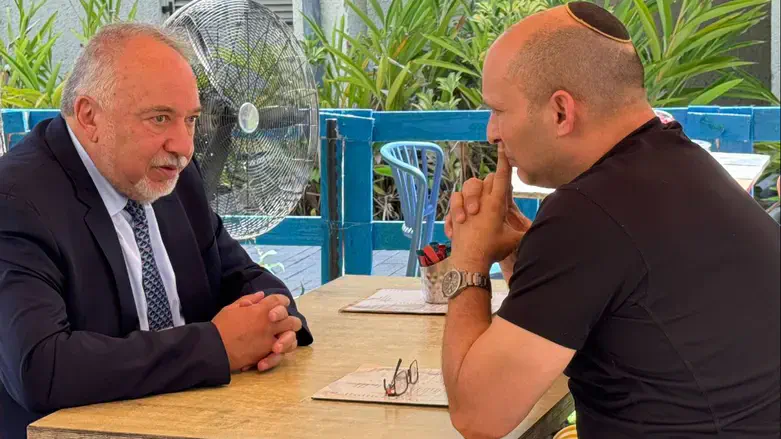
As of this weekend, at least for now, three distinct approaches are emerging among the opposition parties, each focused on a different path and a different option for forming a government.
Under the first approach, Eisenkot and the Democrats support a government that would rely on the Arab parties. For the Democrats, this is their preferred option, involving full reliance on those parties; for Eisenkot, it is a more qualified move, intended primarily to replace the current government and ensure that a different government remains in office even if several rounds of elections follow. Either way, neither party sees anything wrong with relying on the votes of lawmakers from UAL and the Joint List.
Bennett and Lieberman, by contrast, are seeking other paths. The former is focused on a unity government and a partnership with Netanyahu, prepared to sacrifice his election pledge regarding Netanyahu to uphold, at least for now, his pledge regarding the haredi parties. The latter is taking the opposite approach: a partnership with the haredi parties but not with Netanyahu, giving up the election pledge he considers less essential.
What they currently share is the principle of neither cooperating with nor relying on the Arab parties, apparently based on two considerations. First, as Lieberman rightly writes, such a government would not survive for long, certainly against a backdrop of sensitive security issues. Second, the average Israeli voter, including those who voted for Bennett or Lieberman in the last election, views such a move as crossing a red line.
But there is also a deeper political calculation here: both Lieberman and Bennett aspire, and this is probably no great secret, to lead Israel after Netanyahu. Both know very well that they cannot do so in a stable and lasting way through the center-left bloc, where they have positioned themselves in recent years.
In the current circumstances, there are only two ways to position oneself for leadership: one is to break up the religious-right bloc politically as well, bringing some of its components into a different government; this is the route Lieberman has chosen. The second is to return gradually to the bloc, perhaps by eventually joining Likud, as Gideon Sa'ar has already done with considerable success. This appears to be the path Naftali Bennett is considering.
Ironically, they probably also depend on each other: Lieberman cannot form a government without the Arab parties and without Netanyahu unless Bennett is there. Bennett cannot form a unity government without the haredi parties unless Lieberman is there. (Yes, numerically, Likud, Yashar, Smotrich and Bennett's camp add up to 61 seats, but that arrangement would not last without at least one additional party, partly because of Bennett's misguided and overly left-wing choice of candidates for his slate; Lieberman is the first and most convenient option for resolving that.)
The real question is whether the right will forgive them. If Lieberman or Bennett joins forces with the religious-right bloc, or part of it, can either expect to follow Sa'ar's path toward full reintegration into the camp, and can past grievances be forgotten? Will the thousands of posts and tweets about the Bennett-Lapid government and its members suddenly disappear, and could hundreds of thousands of right-wing voters support either man's leadership in the future?
The answer is far from straightforward: Gideon Sa'ar did manage to complete the process in full, despite being an architect of the "government of change" and his well-known history of tensions with Netanyahu. When it mattered, at a time of national crisis and genuine need, he set all other considerations aside, demonstrated responsibility and stabilized the government in recent years-a contribution that stands to his credit and cannot be erased. In the aftermath, the vast majority of right-wing voters remember him favorably.
Bennett and Lieberman are not there yet, but they are certainly at the beginning of that road: both face a moment of national testing, with the power to prevent the formation of a government dependent on the votes of Abbas or Tibi. That may not be enough on its own to wipe the slate clean, but it is certainly an essential and crucial first step toward a comeback within the right-wing camp.
Avi Grinzaig is an Israeli Haredi journalist, political commentator, and strategic communications advisor.