
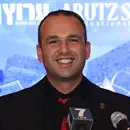
The new Knesset speaker, MK Matan Kahana of the Yashar party, delivered his inaugural address in the role, focusing on a call for civic responsibility, a change in the culture of political discourse and respect for state institutions.
Kahana said, "With a profound sense of reverence, I now assume the role of speaker of Israel's Knesset." He recalled that he was first sworn in as a Knesset member more than seven years ago and was the 1,000th member of the Knesset since the state's establishment.
Kahana opened his remarks by quoting the Mishnah in Tractate Uktzin, "The Holy One, blessed be He, found no vessel that could hold blessing for Israel other than peace." He emphasized that a commitment to civic responsibility has guided him since he entered political life.
He said that even during periods when he worked to replace the government, he made a point of praying for its success on Saturday nights and keeping the prime minister's photograph in his office, including while serving in the opposition.
He said, "We can disagree and hold opposing positions while maintaining respect for state institutions and, above all, for those who think differently."
Kahana made clear that he intends to serve as speaker for all Israeli citizens, regardless of religion, race or sex, and to allow all Knesset members to represent the positions on which they were elected, provided they act within the law.
Addressing the judiciary, he said, "I sincerely hope that the government that is formed will make the necessary changes to the system of checks and balances among the three branches of government, and will do so with broad consensus. Until that happens, and for as long as I am speaker, Israel's Knesset will comply unquestioningly with court rulings."
Later in his address, Kahana criticized the conduct of elected officials and the culture of debate in the Knesset. He said, "The eyes of Israel's citizens are on us, and in recent years we have repeatedly caused them to lower their gaze in embarrassment. When the people's elected representatives shout and curse at one another and compete over whose provocations attract more media coverage, how can we complain when provocateurs become cultural heroes and young people behave this way? It is our responsibility to change and correct this, even at the cost of fewer likes and less engagement on social media."
He cited the example of Beit Hillel, whose sages presented Beit Shammai's views before their own, and called on elected officials to make an effort to understand their opponents' positions as well.
In the personal portion of his address, Kahana spoke about his childhood on a religious moshav, his upbringing in the Bnei Akiva youth movement and his encounters with people holding different views during his military service.
He described how his fellow service members, some of whom had not previously been exposed to a religious way of life, became his close friends. Together, they took part in operations and sorties behind enemy lines. "I am a Torah-observant person who holds right-wing views, yet I also know how to understand and feel, with every fiber of my being, what my close friends on the other side of the political spectrum feel. My life's mission is to bring us together. To connect my friends from the synagogue with my friends from the squadron."
Toward the end of his address, Kahana turned to his party leader, MK Gadi Eisenkot, and praised his leadership. He said, "I have come to know you as a person of unwavering integrity, with a moral backbone forged from steel. A cool-headed, level-headed and deliberate person who has only one thing in mind, the good of the State of Israel. I believe with all my heart that the Holy One, blessed be He, placed this mission on your shoulders because you are the leader who can accomplish it. May He who makes peace in His heavens bring peace upon us and upon all Israel, and say: Amen."