

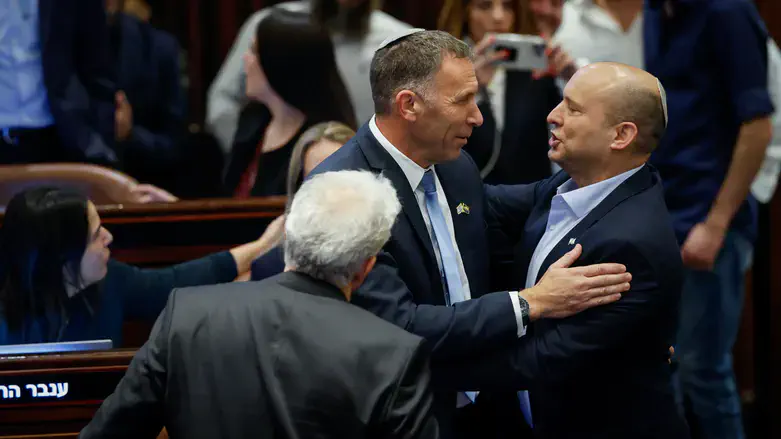
The election of Matan Kahana as the new Speaker of the Knesset on Tuesday, November 17, marks more than a change in the leadership of Israel's parliament. The vote, which saw Kahana defeat Likud MK Ofir Katz by 66 votes to 52, represents a significant shift in parliamentary control at a particularly sensitive moment in Israeli politics, as rival political blocs maneuver to determine the country's next government.
Kahana, a member of Gadi Eisenkot's Yashar party, replaces Likud MK Amir Ohana, who had served as Speaker during the previous Knesset. His election gives the bloc opposing Prime Minister Benjamin Netanyahu greater influence over the legislative process, the parliamentary agenda, and the institutional machinery through which the Knesset conducts its business.
The outcome is particularly significant because Netanyahu remains prime minister in a caretaker capacity while negotiations over the formation of a new government continue. Although the election of a new Speaker does not itself determine who will form the government, it gives the parliamentary majority a powerful institutional position from which to advance its political and legislative priorities.
The importance of the vote also highlights a frequently overlooked aspect of Israel's political system: the Speaker of the Knesset is not merely the person who presides over parliamentary debates. The position carries substantial procedural, administrative, political, and constitutional responsibilities, making it one of the most consequential offices in the Israeli system of government.
The Knesset Speaker is elected by the members of parliament from among their own ranks. Under Basic Law: The Knesset, the parliament elects both a Speaker and Deputy Speakers. The Speaker normally serves for the duration of that Knesset's term, rather than being appointed directly by the prime minister or the government.
The position is therefore institutionally distinct from the executive branch. While the prime minister heads the government and directs its policies, the Speaker oversees the functioning of the legislative branch, which is responsible for passing legislation and supervising the government.
The Speaker is also expected to represent the Knesset as an institution rather than simply serve as the representative of the political party that nominated him. Although the position is generally filled through political agreements between parliamentary factions, the office carries an obligation to act impartially toward all members of parliament.
This distinction is central to understanding the position's significance. The Speaker may enter office as a representative of a particular political faction, but his responsibilities extend to the entire parliament, including parties that opposed his election.
Control over the legislative agenda
One of the Speaker's most important responsibilities is determining how parliamentary business is organized and conducted.
The Speaker heads the Knesset Presidium, which consists of the Speaker and the Deputy Speakers. The Presidium meets regularly to determine the agenda of the Knesset plenum and approve various parliamentary initiatives.
These include urgent motions for the agenda, parliamentary questions, motions for expedited debates, and private members' bills.
This authority can have substantial political consequences. In a parliamentary system, the ability to introduce legislation is not necessarily equivalent to the ability to bring it before the legislature for discussion and a vote.
The Presidium plays an important role in determining which proposals are approved for consideration and when they are scheduled. Its decisions can influence which political issues receive parliamentary attention and which legislative initiatives advance through the Knesset.
The Presidium also possesses particularly significant authority concerning private members' bills. Under the Knesset's Rules of Procedure, it may reject a proposed private members' bill if it determines that the legislation is racist or denies Israel's existence as a Jewish and democratic state.
Consequently, control over the Speaker's office and the Presidium can influence the legislative opportunities available to different political factions, even when those factions are not part of the government.
The Speaker or one of the Deputy Speakers also presides over plenary sessions, puts proposals to a vote, and announces the results. The person occupying the chair is responsible for ensuring that parliamentary proceedings follow the Knesset Rules of Procedure and that debates are conducted in an orderly manner.
These responsibilities become particularly important during politically contentious sessions, when parliamentary factions may attempt to delay proceedings, disrupt debates, or use procedural mechanisms to prevent legislation from advancing.
The Speaker has considerable discretion in managing the proceedings, although that discretion is governed by parliamentary rules and legal principles.
The recent election illustrates the political importance of these powers. The new parliamentary majority intends to use its increased influence to advance proposals including an independent state commission of inquiry into the October 7th massacre, legislation concerning prime ministerial term limits, and the repeal of elements of the previous government's judicial overhaul.
The Speaker cannot simply enact these proposals or guarantee their passage. Nevertheless, control of the parliamentary agenda can make a substantial difference in determining whether and when legislation reaches a vote.
Oversight of the Knesset's administration and security
The Speaker's responsibilities extend well beyond legislative proceedings.
The office carries substantial administrative authority over the Knesset as an institution. The Speaker is responsible for the Knesset Administration, the Knesset Secretariat, and the preparation and implementation of the parliament's budget.
The position also involves senior appointments and oversight of the institutional bodies responsible for the functioning of the legislature. These responsibilities include aspects of the appointment processes for senior Knesset officials, including the Knesset Secretary General, the legal adviser, and the Sergeant-at-Arms, with the relevant statutory and procedural requirements applying to the appointments.
The Speaker also possesses authority concerning security and discipline within the Knesset compound. The Knesset Guard operates under the authority of the Speaker in matters of parliamentary organization and discipline, with the Sergeant-at-Arms responsible for its operational functions. This includes maintaining order within the parliamentary complex and enforcing the rules governing access and conduct on the premises.
The authority is particularly important because the Knesset is not simply an ordinary government office. It is the seat of Israel's legislative authority, and its independence and ability to conduct parliamentary business must be protected. The Speaker's administrative responsibilities also give the office influence over the institutional resources available to the parliamentary factions, including matters involving the transfer of public party-financing funds in accordance with the applicable rules.
In other words, the Speaker is not merely the chairman of parliamentary debates. The position also involves overseeing the organization, resources, and day-to-day functioning of one of Israel's central governmental institutions.
The Speaker's role in appointing parliamentary oversight bodies
Another important responsibility concerns the Knesset's internal oversight mechanisms. The Speaker appoints the members of the Knesset Ethics Committee, including its chairman, in accordance with the applicable parliamentary arrangements.
The Ethics Committee deals with complaints concerning the conduct of members of parliament and can impose disciplinary measures under the Knesset's ethical rules. This gives the Speaker influence over an important aspect of parliamentary self-regulation.
The office also has a significant relationship with the Knesset's committees, which perform much of the detailed legislative and oversight work. While the Speaker does not personally control all committee appointments, the distribution of committee positions is determined through parliamentary mechanisms in which the balance of power between factions is central. The committees are particularly important because they examine legislation in detail, summon government ministers and officials, conduct hearings, and scrutinize the implementation of government policy.
For a parliamentary bloc seeking to establish greater control over the Knesset, gaining influence over committee leadership and the Speaker's office can therefore be particularly consequential. The combination of these institutional powers helps explain why the recent contest was treated by both political camps as a major political battle rather than a routine parliamentary appointment.
A potential role as acting president of Israel
One of the less widely understood responsibilities of the Speaker is the possibility of temporarily assuming the functions of the President of the State of Israel. Under Israel's constitutional arrangements, the Speaker serves as acting president when the president is abroad or unable to perform the duties of the office, subject to the relevant legal provisions.
This is not merely a ceremonial distinction. The president has several constitutional responsibilities, including granting pardons, receiving the credentials of foreign ambassadors, and assigning the task of forming a government to a member of the Knesset following elections. When the Speaker assumes the presidency temporarily, the relevant presidential responsibilities pass to the acting president for the duration of the arrangement.
There is historical precedent for this arrangement. In 2007, Dalia Itzik, who was then Speaker of the Knesset, temporarily assumed the responsibilities of the presidency following Moshe Katsav's suspension from office. Following Katsav's resignation, she continued as interim president until Shimon Peres was elected and assumed the position. The Speaker occupies a particularly prominent place in Israel's constitutional order, with responsibilities that can extend beyond the legislature itself.
The Speaker's authority is substantial, but not unlimited Despite the considerable powers associated with the position, the Speaker does not have unrestricted authority over the Knesset. The Speaker is bound by Basic Law: The Knesset, the Knesset Law, the Rules of Procedure, and the principles governing parliamentary conduct.
One of the most important limitations is the obligation to exercise the office impartially. Although the Speaker remains a member of the political faction through which he entered parliament, he is expected to treat all parliamentary factions equally when managing the Knesset's proceedings.
The Speaker may vote in the plenum, but generally cannot serve as a member of parliamentary committees, apart from the Interpretations Committee. This restriction reflects the distinction between the Speaker's institutional responsibilities and the ordinary parliamentary activities of individual MKs.
Furthermore, decisions made by the Speaker are subject to judicial review by the Supreme Court. The court traditionally exercises considerable restraint when dealing with the internal affairs of parliament, recognizing the importance of legislative independence and the separation of powers. However, that restraint does not mean that the Speaker is immune from judicial intervention.
The most significant precedent in this regard emerged in 2020, during the political crisis surrounding the 23rd Knesset. At the time, Yuli Edelstein, who was serving as temporary Speaker following the elections, refused to schedule a vote on the election of a permanent Speaker, despite a demand signed by 61 members of parliament.
Edelstein's position was that the parliamentary process should not proceed under the circumstances prevailing at the time. The dispute reached the Supreme Court, which ruled that the Speaker could not use his procedural authority to prevent the Knesset from exercising its fundamental parliamentary powers. The court ordered Edelstein to convene the plenum and hold the vote within a specified period. Edelstein subsequently resigned rather than comply with the order. The Knesset then proceeded to elect Benny Gantz as Speaker.
The episode established an important constitutional principle: the Speaker's procedural authority cannot be used to indefinitely prevent the Knesset from exercising its democratic and parliamentary functions.
It also provides important context for the latest election. Following the 2026 elections, Amir Ohana continued serving as Speaker while the new Knesset was being organized. However, 67 MKs subsequently demanded that a vote be held to elect a new Speaker. The legal framework, informed by the 2020 precedent, allowed the parliamentary process to proceed despite the absence of a newly formed government.
The election of Kahana was therefore not dependent on Netanyahu's resignation or the establishment of a new coalition. The Knesset is an independent institution, and its members can elect their Speaker even while negotiations over the executive branch remain unresolved.
Why the Speaker's election matters before a government is formed
The timing of Kahana's election is particularly significant. Israel's parliamentary system does not require the establishment of a new government before the Knesset can begin conducting its legislative business. The Knesset remains a functioning legislative authority, even while a caretaker government continues to administer the country.
This creates an important distinction between control of the government and control of parliament. Netanyahu remains prime minister until a new government is established or another constitutionally prescribed development changes his status. However, his political bloc no longer controls the parliamentary majority.
The election of Kahana gives the opposing bloc greater influence over the legislative process during this interim period. The new parliamentary majority intends to advance legislation reversing several measures adopted by Netanyahu's outgoing coalition. Among the proposals discussed are changes to the judicial system and the establishment of a state commission of inquiry into the October 7 attacks.
The Speaker's position is relevant because it can facilitate the advancement of these proposals through the Knesset's procedural framework. Nevertheless, it is important to distinguish between facilitating legislation and controlling its outcome. Kahana cannot independently repeal legislation, pass new laws, or compel the government to implement parliamentary decisions. Legislation must still pass the required readings and satisfy the applicable parliamentary procedures. Nor does his election automatically give the opposing bloc control over the executive branch.
However, it means that the outgoing government can no longer rely on having its own representative in the Speaker's chair when navigating parliamentary proceedings. The vote also demonstrates the importance of the 120-member Knesset's internal arithmetic. Kahana received 66 votes, compared with 52 for Katz. His victory depended on the support of the political factions opposing Netanyahu's bloc, including the Arab-majority UAL and Joint List parties.
United Torah Judaism, meanwhile, supported Katz, while the political controversy surrounding cooperation with Arab parties became a central feature of the debate. Parties that may disagree on major ideological or policy questions can nevertheless cooperate on specific parliamentary decisions.
A political office with constitutional significance
The Speaker of the Knesset occupies an unusual position in Israel's system of government. The office is simultaneously parliamentary, administrative, representative, and constitutional. The Speaker manages the legislature's proceedings, oversees important aspects of its administration, represents the Knesset in relations with foreign governments and institutions, and can temporarily assume the responsibilities of the president.
At the same time, the Speaker is not the head of the government and does not possess independent legislative authority. The power to enact legislation remains with the Knesset as a whole, while the government retains its executive responsibilities. The significance of the position lies in the Speaker's ability to influence how the legislature exercises its powers.
In a political environment where the parliamentary majority is narrow or divided, procedural decisions can have far-reaching consequences. The timing of debates, approval of parliamentary initiatives, management of votes, and coordination of the Knesset Presidium can all affect the ability of political factions to advance their agendas.
Kahana's election represents an important institutional development, regardless of whether Eisenkot ultimately succeeds in forming a government. It gives the new parliamentary majority greater control over the legislative arena while Netanyahu remains in office, and establishes a new center of political authority within the state.
Ultimately, the Speaker's office is one of the mechanisms through which Israel's parliamentary system maintains its independence from the executive branch. The latest vote demonstrates that control over this position can be almost as consequential as control over the government itself, particularly during a period of political transition.