

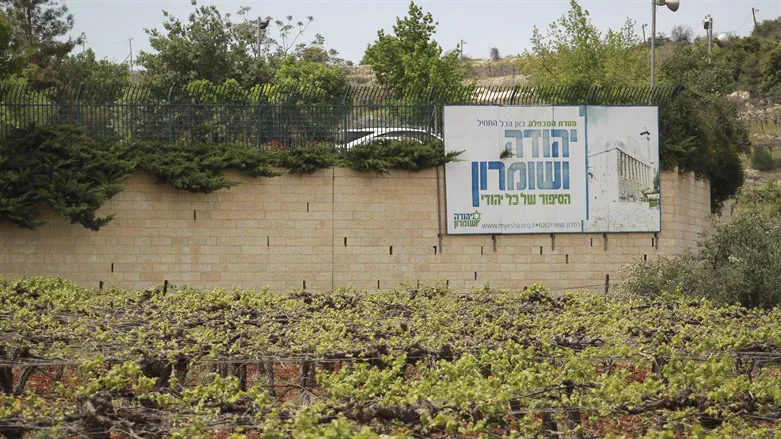
Australia announced Tuesday that it had imposed sanctions and travel restrictions on three Israelis and four organizations involved in the development of Jewish communities in Judea and Samaria, accusing them of contributing to settlement expansion and violence against Palestinians.
Australian Foreign Minister Penny Wong said the measures prohibit Australian citizens and businesses from conducting transactions with the sanctioned individuals and organizations or providing them with financial assistance.
The individuals targeted are Daniella Weiss, Itamar Yehuda Levi and Eliav Libi. The four organizations are Amana, formally known as the Settlement Movement of Gush Emunim Central Cooperative Association Ltd; the Nachala Movement; Hashomer Yosh; and Eyal Hari Yehuda Company Ltd.
All seven had previously been subjected to sanctions by Britain or other European countries.
"The sanctioned individuals and organizations have actively participated in the planning, coordination and establishment of new settlements, including raising funds, recruitment of volunteers and providing support to violent settlers," Wong's statement said.
The Australian government also announced that its sanctions would extend to a construction company for the first time.
"For the first time, Australian sanctions are targeting a construction company involved in the building of settlements. Australian businesses should not bid for construction tenders for illegal settlement developments."
Violations of the restrictions could carry substantial penalties. Australian individuals face up to 10 years in prison and fines of up to $910,000 or three times the value of the transaction, while businesses could be fined up to $3.64 million or three times the transaction's value.
The announcement followed a similar move by the British government earlier Tuesday, when Foreign Secretary Ed Miliband unveiled sanctions against eight Israeli construction and development companies operating in Judea and Samaria.
The British measures target businesses engaged in residential construction, infrastructure development, architectural services and property projects in Jewish communities across the region.
Britain also sanctioned Tzav 9, an Israeli activist movement that has organized protests and blockades aimed at preventing humanitarian aid shipments from entering Gaza.
The restrictions include asset freezes and disqualification measures affecting company directors.
The eight companies named in the British announcement are Har Hevron Development Company Ltd, Hemdat Shomron Ltd, S.A.G. (Velvel) Construction and Development Ltd, Lev HaHar Yazamut Ltd, Harey Zahav, Ariel Residential Judea & Samaria Ltd, Ami Gvirtzman Architects 2021 Ltd, and Z.F. Building Company Ltd.
Foreign Minister Gideon Sa'ar sharply criticized the British sanctions, describing them as an attack on legitimate Israeli businesses and warning that Jerusalem could respond with countermeasures.
"Israel views with the utmost gravity the additional sanctions announced today by the British Labour government," Sa'ar wrote on X. "This is a hostile act targeting private, law-abiding companies."
Sa'ar also emphasized the Jewish people's historical ties to Judea and Samaria, arguing that Jewish rights in the region have received international recognition.
"The Jewish people have the right to live in their historic homeland," he stated. "The Jewish people's historical rights in Judea and Samaria date back thousands of years and were recognized, inter alia, in the Balfour Declaration and the British Mandate."
Rejecting the possibility that international sanctions would compel a change in Israeli policy, Sa'ar declared, "Israel will not bow to external pressure or change its policies as a result."
"On the contrary, we will consider new ways to strengthen Jewish communities in Judea and Samaria and will act to protect those involved in developing and building the Land of Israel, in accordance with government decisions, from attempts to harm them."