
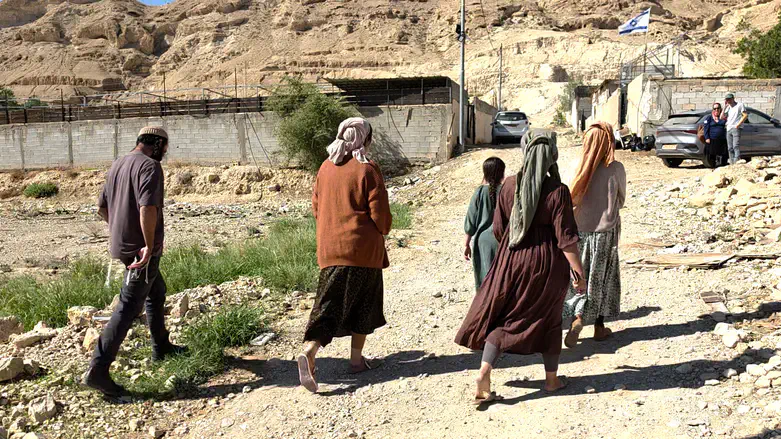
The return of Jews to live in Jericho delighted Rabbi Binyamin Tabdi, but also revived a question of Jewish law dating back to Joshua: Is it permissible to settle in a city whose rebuilding Joshua cursed after its conquest?
In a lesson devoted to the issue, the rabbi expressed his joy at Jewish settlement in the city. "This news made me very happy", he said, wishing the settlers success and blessed development in the Land of Israel.
Alongside his joy, however, the rabbi cited the verse in the Book of Joshua, "Cursed before the Lord is the man who rises up and rebuilds this city, Jericho; at the cost of his firstborn shall he lay its foundations, and at the cost of his youngest shall he set up its gates".
The rabbi explained that this was not merely a warning with no subsequent consequence in the Bible. The Book of Kings recounts how Hiel the Bethelite rebuilt Jericho, and his sons died in accordance with Joshua's curse.
On the other hand, the Bible describes people living in Jericho in later periods, including a community of prophetic disciples in the days of Elisha. This raises the question of whether the curse prohibits living in the city or specifically concerns its rebuilding.
During the lesson, Rabbi Tabdi presented a range of opinions from halachic authorities, who offered different explanations of the prohibition's scope. According to the rabbi, Radak distinguished between rebuilding Jericho, to which the curse applies, and living in the city once it has already been rebuilt.
The author of "Meshech Chochmah" offered another explanation: Once the city has been rebuilt, there is no prohibition against rebuilding it again, even if it is destroyed once more. The rabbi also cited Rabbi Moshe Feinstein's position that there is no prohibition against living in Jericho after it has been rebuilt.
He then presented the approach of Rabbi Shlomo Goren, who emphasized that the prohibition primarily concerns rebuilding Jericho as a city surrounded by walls and gates, rather than settling there.
Rabbi Tabdi cited the author of "Tzitz Eliezer", who addressed the question of Jewish settlement in Jericho and ruled that Joshua's curse should not be used as grounds for weakening efforts to keep the city under Israeli rule.
He wrote, "Joshua's prohibition provides no grounds for diminishing the attention given to the matter", while stressing that Jericho must not be rebuilt as a city surrounded by walls and gates.
Rabbi Shaul Yisraeli, by contrast, took a stricter position, distinguishing between the area of historic Jericho within the walls and the areas outside them. Under his approach, living within the ancient city is prohibited, while settlement outside the walls is permitted.
After presenting the differing views, Rabbi Tabdi clarified that he favors the more lenient approach. "I would not be as stringent as Rabbi Yisraeli in holding that there is a certain part of Jericho where it is still forbidden to live", he said. He added, "I lean more toward the views of Rabbi Goren and the Tzitz Eliezer, to be as lenient as possible on this issue while strictly refraining from surrounding the place with a wall".
The rabbi added that Maimonides' omission of the prohibition against rebuilding Jericho from his code of Jewish law is also a significant consideration in examining the issue.
Toward the end of the lesson, the rabbi also presented a spiritual explanation from the kabbalist Rabbi Moshe David Vali, according to which the prophet Elisha's healing of Jericho's waters was part of a process of spiritual rectification that the place underwent.
Rabbi Tabdi distinguished between living in Jericho, which he considers permissible, and rebuilding the city in a manner subject to Joshua's curse. He ruled that the city should not be surrounded by a wall, but clarified regarding residence there, "Living there is permitted in any case".