

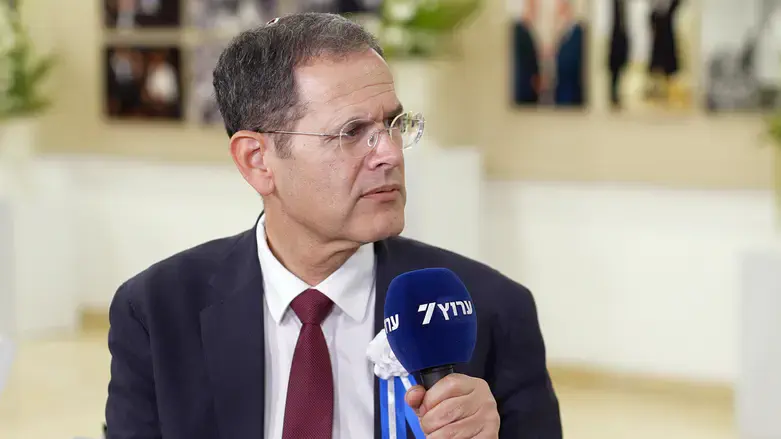
Likud MK Moshe Saada is calling on Gadi Eisenkot and Prime Minister Benjamin Netanyahu to work toward forming a unity government, while making clear that he opposes excluding right-wing parties from the coalition.
In an interview with Arutz Sheva-Israel National News at the Knesset on the day lawmakers were sworn in, Saada criticized the possibility of forming a government dependent on Arab parties, sharply attacked the opposition bloc's handling of haredi military enlistment, and expressed confidence that agreements could still be reached despite political disagreements.
Saada strongly opposed the possibility of the next government relying on the Joint List or Ra'am, which he described as "supporters of terrorism." He argued that the Joint List's positions on the war in Gaza and the release of security prisoners make cooperation with the party dangerous.
"I'm telling you, it won't happen. God willing, it won't happen," he said. "It won't happen. This is dangerous. This is a time for unity. There has been division, there has been polarization among our people. This is a time for unity."
Asked whether Likud's call for unity also includes all of Netanyahu's political partners, including the Religious Zionist Party and Otzma Yehudit, Saada said he was unwilling to abandon those who, in his view, had participated in the war effort.
"We come with everyone who fought alongside my children on the battlefield," he said.
Saada noted that members of Otzma Yehudit and the Religious Zionist Party had also participated in the fighting and argued that there was therefore no justification for excluding their parties from coalition negotiations.
"Eisenkot wants to boycott those who fought alongside him and join forces with those who fought against us. That is inconceivable to me," Saada argued.
Asked whether his position would effectively exclude the haredi parties from such an arrangement, Saada responded that haredi soldiers had also fought alongside his children.
He did not provide a definitive list of parties that should be included in the government, but emphasized that the coalition's composition should be determined by a shared set of guiding principles.
According to Saada, negotiations should begin without either side presenting all its conditions and demands in advance.
"You don't conduct negotiations by starting out and announcing your price. First, you come together, meet, and discuss," he said.
Saada added that he believes the public wants a unity government and that, from a practical standpoint, a broad government would be preferable to a narrow coalition.
He warned against holding another election, which he estimated would cost approximately four billion shekels. Saada argued that the money could instead be directed toward security and welfare, and suggested that even if the right-wing bloc gained strength in another election, the result could still be a government dependent on a narrow parliamentary majority.
"What would we end up with? Sixty-one seats. Running a government with 61 seats is complicated," he said. "I think there is an opportunity. Both sides need to be willing."
One issue on which Saada believes agreement is possible is judicial reform, particularly his proposed legislation concerning the Police Internal Investigations Department (PIID).
He said discussions with figures from the opposing political camp had convinced him that there was agreement in principle on the need for change.
"I held discussions with them. For example, take the judicial reform I led and the legislation concerning the Police Internal Investigations Department. They genuinely agree with it. They know it's the right thing to do," he said.
Saada linked his remarks to statements he attributed to Boaz Balat concerning the conduct of the State Attorney's Office and the PIID. He argued that those statements reinforced the need for reforms that would reduce the prosecution's influence over the department's operations.
Saada accused the State Attorney's Office of misconduct and argued that the PIID should be separated from structures that, in his view, allow its powers to be abused.
"This is good for the change government as well. It's good for us, too," he said of the reform he hopes to advance.
His allegations concerning the State Attorney's Office and the PIID were presented during the interview as his own positions and were not independently verified.
Despite his belief that agreements are possible, Saada criticized the leadership of the opposing political bloc.
He said that conversations with activists and grassroots political figures had revealed a strong desire for a unity government, but argued that the bloc's leadership was not paying sufficient attention to those views.
"I think the leadership over there isn't hearing the voices of the people. They've become somewhat disconnected," he claimed.
Nevertheless, he added, "I believe there is a good chance it will happen."
Asked whether a unity government could include a rotation agreement for the position of Prime Minister, Saada declined to discuss specific arrangements.
"Negotiations should take place behind closed doors," he said, stressing that the parties should first discuss the government's guiding principles and the full range of disputed issues.
He noted that Israel continues to face security challenges and argued that the current circumstances require the parties to find a way to cooperate.
Toward the end of the interview, Saada criticized what he described as negotiations between the opposition bloc and the haredi parties over military enlistment.
He accused representatives of the bloc of fiercely attacking the previous coalition's proposals during the last Knesset, while now being willing to offer the haredi parties even more far-reaching arrangements.
"They stood here in the Knesset shouting, insulting and berating people, even using inappropriate language, and they said, 'Listen, this is a draft evasion law,'" he argued.
According to Saada, the proposals now being offered by his political opponents would provide benefits even to those who do not serve in the military.
"This is hypocrisy, this is disgraceful, this is shameful, and God willing, it will not happen," he said.
Saada concluded by reiterating his call for a broad government.
"I think the people of Israel believe the time has come for unity."