

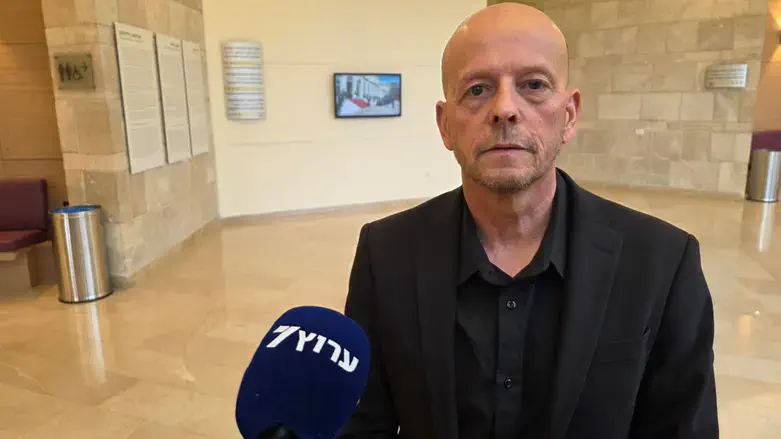
Former senior Shin Bet official Amit Assa warns that suspicions of election bribery may be only the tip of the iceberg of a far more serious affair.
In an interview with Arutz Sheva, he called for an investigation into the sources of funds allegedly transferred to voters, raised concerns about possible involvement by foreign countries and terrorist organizations, and warned of the possibility that individuals acting on behalf of Israel's enemies could enter the Knesset.
"The tip of the iceberg is the cash and fuel cards distributed to voters, 400 shekels per person, to encourage them to go to the polls and put the right ballot slip in the ballot box," Assa said.
"That's the tip of the iceberg that the police will investigate, but that's not where the problem lies. For the money to reach the hands of those distributing it, there has to be an entire infrastructure operating in an organized manner."
According to Assa, the investigation should focus not only on the suspected distribution of money itself, but also on those who established the infrastructure that enabled the transfers and the individuals behind them.
"First of all, there is the establishment of this infrastructure, and the people who operated within it are the ones who need to be investigated. Along the way, we need to understand where it came from. Follow the money. I'm going backward to identify where the funds originated, who brought them in, and who had an interest in introducing this money as election bribes."
Assa raised concerns that the money may have originated from hostile elements outside Israel and argued that investigators must determine whether it was transferred through intermediaries inside the country.
"We understand that it comes from abroad, and our suspicion, which has arisen and is supported by reports from security officials, is that foreign countries are involved - meaning an enemy state that finances terrorism and terrorist organizations. This cash comes through that chain, via Israeli nonprofit organizations and money changers."
According to Assa, the central question is who allegedly served as intermediaries between the foreign funding sources and the operatives in Israel.
"What worries me is the question of who stood between the terrorist organizations and enemy states that want to take control of the State of Israel by taking control of the Knesset - and we need to say that explicitly. When that is the problem, the matter must be treated entirely differently from the tip of the iceberg involving one bribe or another paid to voters."
Assa emphasized that beyond the criminal suspicions, the affair could also have political implications for the election results.
According to him, if findings emerge that justify invalidating the results at certain polling stations, this could affect the distribution of Knesset seats and the possibility of forming a government.
"Even a single seat shifting away from the Arab parties could change the electoral picture, so this cannot be treated as a trivial matter," he said.
Later in the interview, Assa presented the suspicions as part of what he described as a broad, ongoing effort by foreign actors to harm Israel and influence developments within the country.
According to him, this effort is also reflected in international media activity and attempts to undermine Israel's legitimacy around the world.
"This is the global industry of poison, lies, and hatred against the State of Israel, and this industry is working," he said, also mentioning the activities of the Al Jazeera network in this context.
"We will never be able to fully control this industry. We face a difficult struggle in the global banking arena, but when there is a connection between terrorist organizations and enemy states and people inside Israel, that must be thoroughly investigated," he added.
Assa intensified his warning, raising the possibility that an in-depth investigation could also lead to political figures currently serving in the Knesset or expected to serve in it.
He stressed that this was a concern requiring investigation, not a conclusion that had already been proven.
"Allegedly, these are people whom we are about to bring into the Knesset. They are the intermediaries between enemy states and terrorist organizations who facilitate the transfer of these funds into the country.
"I am choosing my words carefully, but a thorough, precise investigation without any restrictions will bring these people to justice. It could also implicate current or future Knesset members who are supposed to sit in our parliament. The implication is that we are about to seat agents of the enemy in the Knesset."
Addressing the investigation into the suspicions and cooperation between the police, Shin Bet, and Mossad, Assa said the involvement of the security agencies was essential given the possibility of connections to foreign actors.
According to him, the Shin Bet possesses investigative and operational tools unavailable to the police, and using them could be crucial to uncovering the full extent of the affair.
"There are operational tools that the Shin Bet can use that are far-reaching and require authorization. I hear that the Attorney General and the Shin Bet's legal adviser are preventing the use of these tools. That is a failure in itself. This involves connections with foreign elements hostile to the state, and it requires an investigation, even if that means investigating Knesset members," he argued.
Assa sharply criticized Attorney General Gali Baharav-Miara and legal and security officials whom he accused of restricting the investigation.
However, he did not present an official document during the interview detailing the restrictions he described.
"We have been familiar with the Attorney General's adversarial conduct toward this government for a long time. I am not surprised that she wants to halt processes within the Shin Bet - processes that the Shin Bet needs to carry out in order to uncover the truth," he said.
According to Assa, what particularly concerns him is the opposition he attributes to officials within the Shin Bet itself.
"I'm not surprised, but I am very troubled that the Shin Bet's legal adviser and senior Shin Bet officials are opposing this investigation. I would expect the Shin Bet to be galloping horses, not lazy mules."
Assa also addressed Shin Bet Director David Zini, claiming that Zini wants to advance the investigation but is encountering restrictions.
"This is also contrary to the position of David Zini, who says his hands are being tied. That means he does want to pursue this investigation with full force, but there are elements inside and outside the Shin Bet preventing him from doing so."
According to Assa, a situation in which the head of the Shin Bet wants to investigate serious suspicions but cannot use all the tools available to the organization is deeply problematic.
"I don't envy him," he said.
Assa also addressed Justice Noam Sohlberg's involvement in the electoral process and the relationship between the officials responsible for the investigation.
"As I understand it, and I'm not a legal expert, Zini is subordinate to Justice Sohlberg, and not even to the Prime Minister, in order to prevent any possibility of bias and allow him to carry out his work impartially. Sohlberg is effectively his superior in the context of the elections, so he has no choice but to follow his instructions," Assa said.
According to Assa, if findings emerge indicating a substantial violation of electoral integrity, a legal question could also arise regarding the validity of voting results at certain polling stations.
He assessed that decisions with significant implications for the election results could ultimately be brought before the Supreme Court.
"Every decision will have to receive the approval of the Supreme Court sitting as the High Court of Justice, which will be able to approve or overturn a decision, even one that allows the election results to be changed in the event of a substantial violation that could alter the outcome. Such developments could lead to new elections," he said.
Nevertheless, Assa assessed that the likelihood of reaching the point of holding new elections was low.
"I don't think we will reach that point, but if polling stations are disqualified because of their connection to bribery - which, as I said, is the easier part - thousands of votes will have an impact, because a shift of even one Knesset seat could enable or prevent the formation of a government."
Toward the end of the interview, Assa reiterated that, in his view, the suspicions of election bribery represent only a small part of the potential affair.
According to him, the focus should be on determining whether an organized infrastructure financed by foreign actors operated in Israel with the aim of influencing the elections and the composition of the Knesset.
"The more substantial issue is the infrastructure that contaminated our elections, and that must be investigated. Sohlberg should also be troubled by this and allow the Shin Bet to conduct an intensive investigation, just as he asked the Shin Bet to investigate these matters," Assa said.
Assa concluded by criticizing what he described as a discrepancy between the need to investigate the suspicions and the decisions being made before the investigation has been completed.
"What I don't understand is how the Shin Bet is unable to investigate because of the restrictions imposed on it, and how it happened that, even though Sohlberg has not received the information, he has already decided not to invalidate the elections based on information he doesn't have.
"That seems strange to me. How can you make a decision without findings?"