

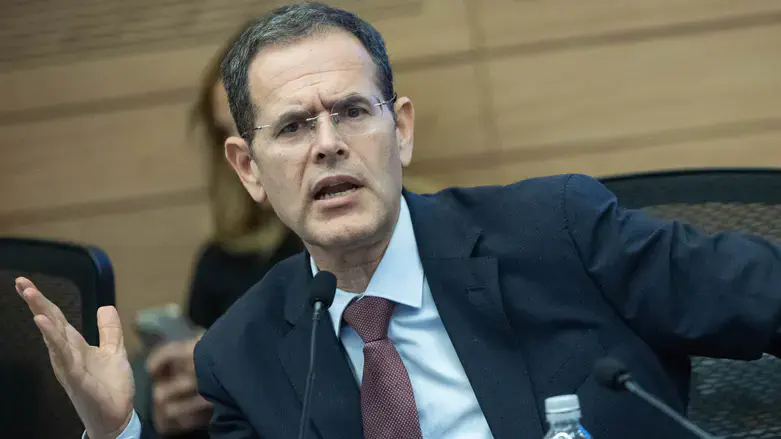
MK Moshe Saada claims that even within Gadi Eisenkot's Yashar party, there are members who oppose forming a government that relies on the Arab parties. In an interview with Arutz Sheva-Israel National News, he says he has spoken with party members who made clear that they would not support such a move, and insists that the chances of forming a so-called change government are virtually zero.
"People in Eisenkot's party tell me they will not sit with them. They say this unequivocally, so it won't happen," Saada says, declining to name the party members he is referring to. "I would recommend that Eisenkot speak with members of his own party and check whether they give him legitimacy to engage in this discussion. They know that even having this discussion is wrong and inappropriate."
Saada dismisses the possibility of forming a government with the participation or backing of the Arab parties, even following the change in the opposition bloc's position on haredi enlistment.
"It won't happen. This is an empty spin with no substance. The chances of this spin becoming reality are zero," he declares. He says his main concern is not merely the possibility of such a government being formed, but the fact that the idea is being discussed at all.
"My problem with this spin is the very existence of a discourse that normalizes sitting with supporters of terrorism. The fact that [Naftali] Bennett and Eisenkot allow such a discussion normalizes the legitimacy of supporters of terrorism," he argues.
Saada sharply criticizes the possibility of cooperation with the Ra'am party, attributing to it positions that he says are incompatible with the principles of a Zionist government.
"Apparently, neither Eisenkot nor Bennett bothered to read Ra'am's platform. They talk about occupied Jerusalem becoming the capital of Palestine, the release of all prisoners - meaning including the Nukhba terrorists - and they regard the Law of Return as racist, which effectively means abolishing recognition of Israel as the nation-state of the Jewish people. None of this will happen, but the very discussion of it is what normalizes these positions."
When reminded that Bennett previously headed a government that included Ra'am, Saada responds that the October 7 attacks changed the political reality and public attitudes toward such a partnership. He says that while forming a government with Ra'am may once have been feasible, since October 7 the public has come to understand that "they don't want to live alongside us, but in our place."
Saada believes that Yisrael Beytenu chairman Avigdor Liberman's opposition to a minority government will also prevent such a coalition from being formed. He further predicts that if another election is held, the right-wing and religious bloc could win at least 70 seats.
"The change bloc cannot form a government under any circumstances. There is only one option: a broad national right-wing government, as the prime minister is proposing, or elections. Eisenkot will have to choose between the two," he says. In his view, Eisenkot is not yet ready to make that decision, but political reality will eventually force him to do so.
"Right now, Eisenkot isn't ready. He will try to form a government, realize that it is impossible, and then have to decide whether to go to elections, in which case his party will collapse, or join a broad national government without boycotts - neither Otzma Yehudit nor anyone else should be excluded. The platform will be fully national and right-wing."
Saada believes that Yair Lapid will refuse to join a government led by Netanyahu, but says Bennett may choose a different path.
"Lapid has five people. His party has been cut by almost 80 percent. It's a party that barely exists anymore. I think he would prefer to sit in the opposition with Liberman, but we'll see," he says.
Saada also addresses the change in the opposition bloc's position on haredi enlistment. Saada, one of the leading proponents of the principle "Those who serve should receive," says he is not surprised by what he describes as a retreat from campaign promises.
"It was clear to me that the change bloc was not acting out of principle, but out of a desire to bring down the government," he says.
Saada recalls that the bill he sought to advance was based on a broad obligation to serve, which would not apply only to the haredi public but also to secular pacifists and Arab citizens. The guiding principle, he says, should be that anyone who serves the country receives benefits, regardless of their sectoral affiliation.
"They want to join forces with the haredim and the Arabs, so 'no service, no benefits' is irrelevant to them. But that won't help them, because 'no service, no benefits' is the right, moral, principled and Zionist approach. It's time to end the discriminatory policy that harms the Arab public and give benefits exclusively to those who serve. Today, the haredim and the Arabs are the ones receiving preferential treatment," he says.
Alongside his call for a broad national government, Saada acknowledges that such a move would require compromises between the parties. However, he stresses that certain issues are non-negotiable for him.
One is the continued development of Jewish communities in Judea and Samaria, which he describes as a matter of decisive security importance for Israel's survival. He says the October 7 attacks have further underscored its significance.
Saada is also convinced that judicial reform must move forward in the next government. He says he previously held talks with opposition figures in an effort to reach agreements on changes to the judicial system. According to him, understandings were reached during those discussions but did not receive backing from the political leadership.
"There is no need to explain to Matan Kahana why the judicial system needs reform. The same applies to Elisaf Peretz and others," he says.
In his assessment, the compromises required in a broad government would focus mainly on the distribution of ministerial positions rather than on issues he considers fundamental.
"But we're not there yet. First, they need to go through a process of coming around to the understanding that Netanyahu will be the next prime minister. He leads the largest party and the largest bloc," he says.
At the end of the interview, Saada reiterates his belief that Eisenkot will ultimately choose to join a broad national government because of concerns about the consequences of another election for his party.
"Eisenkot will do the math and understand that in another election, they will collapse," he says.
Saada argues that the change bloc exhausted its efforts to increase its strength during the election campaign, and raises allegations concerning campaign tactics and activities intended to influence the election results. He says that if another election is held, the public will also hold Eisenkot accountable for the possibility of cooperation with the Arab parties.
"Voters who trusted Eisenkot when he said they would not sit with the Arabs will realize they were lied to, and the public will punish them," he concludes.