

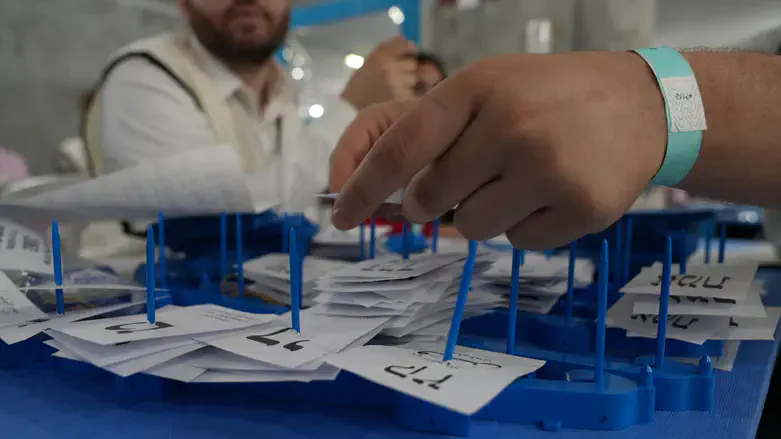
The Central Elections Committee released the final results of Israel's 26th Knesset elections early Friday morning, following the completion of the double-envelope ballot count and an initial review of the results from regular polling stations. The results remain subject to election integrity checks and possible adjustments during the verification process.
According to the results, Prime Minister Benjamin Netanyahu's Likud is the largest party in the Knesset with 27 seats, followed by Gadi Eisenkot's Yashar party with 21 seats and Together, led by Naftali Bennett, with 12.
The Joint List won 11 seats, the Democrats and Ra'am secured eight seats each, and Yisrael Beytenu, Otzma Yehudit, and United Torah Judaism each won seven seats. Shas and the Religious Zionist Party each received six seats. All other parties that contested the election failed to cross the electoral threshold.
The distribution between the political blocs gives the current coalition 53 seats, the opposition bloc 48, and the Arab parties a combined 19 seats.
Voter turnout stood at 77.9%. A total of 5,716,665 votes were counted, including 5,690,778 valid ballots and 25,887 invalid ballots. The electoral threshold, set at 3.25% of valid votes, amounted to 184,947 votes in this election.
The Central Elections Committee said it would continue reviewing polling station results over the coming days, including reexamining data, correcting typing and transcription errors, and reviewing inquiries submitted by members of the public and candidate lists. Subject to minor adjustments, the results will be submitted to the President of Israel on Wednesday, November 4.
In its statement, the committee also addressed the Shin Bet (Israel Security Agency) investigation into suspected election manipulation, which was launched at the direction of committee chairman Justice Noam Sohlberg.
Acting Director General of the Central Elections Committee, attorney Dean Livne, issued a statement on behalf of the chairman.
"Yesterday, the head of the Shin Bet presented classified intelligence to the committee chairman, which led to the opening of the investigation. With the chairman's approval, the main points had previously also been presented to Prime Minister Benjamin Netanyahu, opposition leader Yair Lapid, and Yashar party chairman Gadi Eisenkot."
Livne stressed that the intelligence prompting the investigation was highly classified and that no additional details could be released at this stage.
"I wish to emphasize: The circle of individuals privy to this intelligence is extremely limited, given its high security classification. No further details can be disclosed, but reports published throughout the day are entirely unfounded," he said.
He further clarified that the investigation was not expected to affect the election results and was not focused on any particular sector of the population.
"The investigation is taking place alongside the processes being carried out by the Central Elections Committee, and it will not affect the final results submitted to the President. Nor does it concern any particular sector."
According to Livne, once the investigation is completed, its findings will be presented to the chairman of the Central Elections Committee to assess its scope and implications. The committee will update the public on the findings as soon as possible, subject to security restrictions.
Livne concluded by thanking the committee chairman, its members and staff, as well as the security authorities, the Knesset, government ministries, and other organizations that assisted in administering the election.