

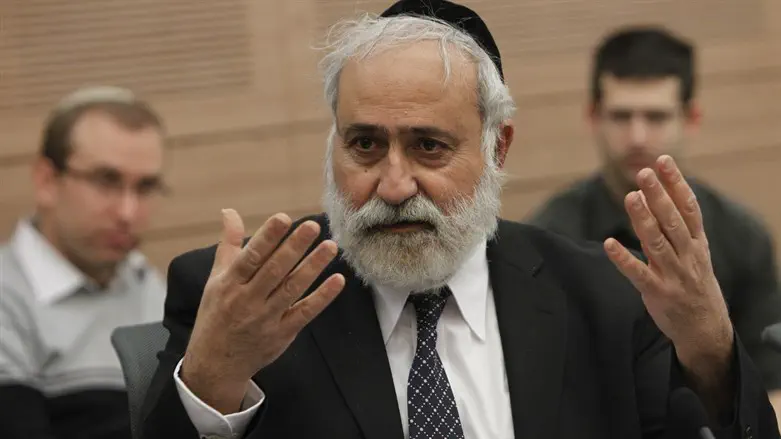
Arutz Sheva spoke with former Knesset member Nissim Ze'ev, one of the founders of the Shas Party, about the crisis facing the party following election results that have left it with the fewest Knesset seats in its history. Ze'ev does not deny the severity of the crisis, nor does he mince words when discussing the responsibility of party chairman Aryeh Deri.
"It was expected," Ze'ev said. "The atmosphere was already very tense before the elections. There was an aggressive campaign and brainwashing against draft evaders, and Aryeh [Deri] did not demonstrate much wisdom. It is written, 'Therefore, the prudent shall keep silent in that time,' but that did not happen. Perhaps he even added a little fuel to the fire."
"Instead of saying that Shas supporters serve in the army and that anyone who is not studying should enlist - which should have been his motto - we ended up losing on both sides. It looked as though Shas was against the army, and that is not true. This is a party whose members serve in the army. It is both a haredi and a Zionist party."
In practice, Ze'ev said, the party's ambiguous messaging on military conscription led rabbis and yeshiva heads who had previously supported Shas and backed the party to begin recommending that their followers vote for United Torah Judaism, represented by the Hebrew letter Gimel on the ballot.
Ze'ev estimates that approximately 20% of Shas voters switched to United Torah Judaism.
"On the other hand, communities that had been part of Shas thought the party opposed the army, and so, unfortunately, we lost both segments of the public," the former MK said.
Asked how Aryeh Deri, who is known as a shrewd politician, had fallen into this trap, Ze'ev replied: "It could be that pressure from Agudat Yisrael left him no choice but to say, 'If you think we will not work to keep Torah scholars in the yeshivas, you are mistaken. Look, I am proud of my grandchildren who are studying in yeshivas rather than serving in the army.' That statement conveyed the impression that the party was against the army, but that is not the case. Sages, be careful with your words."
Ze'ev openly challenged the increasingly widespread perception that Shas is Aryeh Deri and Aryeh Deri is Shas - essentially a one-man party.
"That is not how things are. Shas is not Deri, and Deri is not Shas. He did not even establish the Shas movement. But many people see him as the one and only central figure who controls Shas, and they say that if he is the man in charge, they are backing away. People need to understand that a party does not belong to one person who dictates every political move, including in dealings with the rabbis. It saddens and pains me that the party has fallen to seven seats, but the right conclusions must be drawn," Ze'ev said.
He recalled the period when he himself was removed from the party, after which Shas also declined to just seven Knesset seats.
In Ze'ev's view, the necessary conclusions include the need to communicate messages to the entire Israeli public rather than to one particular sector.
"The general public feels a very strong connection to Shas," he insisted. "When we consistently held 11 to 13 seats, we reached out to many different segments of the population. When I was in Shas, I would visit all the communities that saw me as a right-wing figure, someone who cared about the Land of Israel. I was part of them."
"What Ben Gvir does with a lot of noise, I used to do in a pleasant manner. The same was true of Eli Yishai, who would go with me from community to community, and we would hold rallies there," he said. "Shas is not doing that now. Shas is also absent from the Negev because it had a competitor there in the form of Rabbi Abergil. Aryeh Deri should have come to his senses, brought him into the fold, and given him a representative in the party."
"One person cannot make every decision. That is not how a movement should be run."
Ze'ev continued his analysis of the party's situation in haredi population centers, where there is resentment over its handling of the military conscription law. However, Ze'ev believes that Aryeh Deri was not to blame for the failure to pass the legislation, because it could not have been advanced against the backdrop of what he described as "the riots, drums, and dancing around the golden calf of Kaplan, which incited against the haredi public and Benjamin Netanyahu."
The war then broke out, claiming the lives of many fallen soldiers, making it an inappropriate time to raise the conscription legislation.
In Ze'ev's opinion, Deri should have given the Prime Minister a timetable of approximately one year to pass the law, taking into account the security and public circumstances.
Ze'ev estimates that a significant proportion of Shas voters moved to United Torah Judaism, some to Likud, some to Ben Gvir, and others even to Smotrich, whom they regard as more levelheaded than Ben Gvir, as Ze'ev put it.
He recounted the case of a Torah lecturer at the Musayof Synagogue, a Shas stronghold, who declared that Shas was no longer the same Shas and no longer represented the path of Rabbi Ovadia Yosef.
In addition, Ze'ev said he personally knows families containing dozens of traditional Shas voters who have reported that yeshiva heads instructed them to vote for United Torah Judaism.
Discussing Shas's unsuccessful election campaign, Ze'ev asked: "There was no proper public messaging. What kind of campaign did Shas run? We should have countered the incitement against us as a community of draft evaders. We should have said that we are not draft evaders; we are a community devoted to Torah study, and solutions must be found for those who are not studying."
"I remember Rabbi Yehuda Tzadka, the head of the Porat Yosef Yeshiva, saying that someone who does not study Torah will have to answer for it, because the blood of a soldier fighting on the front lines is worth no less than the blood of a young man who goes out to work instead of studying. Already 25 years ago, I said that we did not need legislation that would provoke antagonism, but rather administrative measures. Someone who has completed his studies and is over the age of 21 should be allowed to serve for three months and then perform reserve duty. Tens of thousands would have enlisted and would now be serving in the reserves."
Regarding those demanding that Aryeh Deri resign as party chairman, Ze'ev said:
"I am not going to tell him what to do. Aryeh Deri is smart enough. He knows how to operate and how to bring the rabbis to the point where they will beg him and say, 'Our esteemed friend, our beloved, have mercy on us and stay.' I am not saying he needs to leave, but he needs partners alongside him. Today, Knesset members cannot express themselves without his approval. What kind of leadership is that? I remember being summoned to Rabbi Chacham Shalom Cohen because I had spoken to the media. It was a complete dictatorship. You were not allowed to speak, and the rabbi would reprimand me."
In Ze'ev's view, the dictatorial manner in which the party is run is "a method that is working against him."
"He needs to correct his character traits. In 2011, he established a movement called 'HaTikun' [The Correction]. Let him make that correction now, in 2026."