

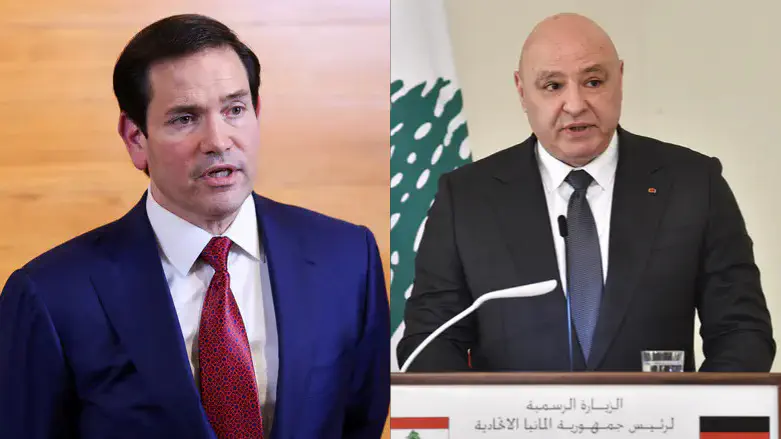
US Secretary of State Marco Rubio urged Lebanese President Joseph Aoun to ensure that hundreds of kilograms of explosives seized from Hezbollah are not returned to the terrorist organization, a State Department official said Thursday, according to Reuters.
During a telephone conversation, Rubio also called on Lebanese authorities to pursue accountability for those responsible for organizing, financing and directing the shipment.
The secretary of state "underscored that returning explosives to (Hezbollah) should be out of the question," the official said.
The conversation followed the discovery of a large quantity of explosives in eastern Lebanon last week, which a Hezbollah lawmaker subsequently acknowledged belonged to the organization.
Lebanese security personnel intercepted a vehicle carrying the explosives at a checkpoint in the Bekaa Valley and arrested two individuals traveling in it.
According to Reuters, the seizure initially prompted concerns that the explosives might have been intended for assassinations or other attacks inside Lebanon, particularly after authorities declined to disclose the vehicle owner's identity.
However, Hezbollah lawmaker Hassan Fadlallah later acknowledged the organization's involvement while speaking in the Lebanese parliament.
Fadlallah confirmed that Hezbollah was transporting the explosives, claiming that they were intended for operations against Israeli military forces stationed in Lebanese territory.
The incident comes as Lebanon faces continued pressure to disarm Hezbollah under a US-brokered security arrangement with Israel.
According to a statement issued by Aoun's office, the Lebanese president used his conversation with Rubio on Thursday to discuss the broader security situation in Lebanon and the region following recent developments.
Aoun also called on Washington to pressure Israel to stop military strikes against towns and villages in southern Lebanon.
He urged Israel to comply with the framework agreement signed between the two countries and to refrain from targeting farmers in southern Lebanon, emphasizing the importance of allowing them to reach their agricultural land safely.
The Lebanese president maintained that the country's military and security agencies were fulfilling their responsibilities under government decisions aimed at preventing armed displays, confiscating weapons and ammunition, and combating smuggling.
The discussion took place amid ongoing efforts to implement the framework agreement reached by Israel and Lebanon in June under American mediation.
The arrangement provides for a gradual Israeli military withdrawal as Hezbollah is fully disarmed.
Under the agreement, the Lebanese army is expected to assume security responsibility in designated areas, known as “pilot zones," following the withdrawal of Israeli forces.
The United States has continued facilitating negotiations between Jerusalem and Beirut over the implementation of the framework.
Hezbollah, which was not involved in the negotiations that produced the agreement, continues to oppose direct discussions with Israel.
The terrorist organization has also rejected demands to relinquish its weapons and has repeatedly violated the ceasefire, creating further obstacles to implementing the arrangement.
Israeli forces have continued carrying out strikes against Hezbollah targets in southern Lebanon in response to those violations.