
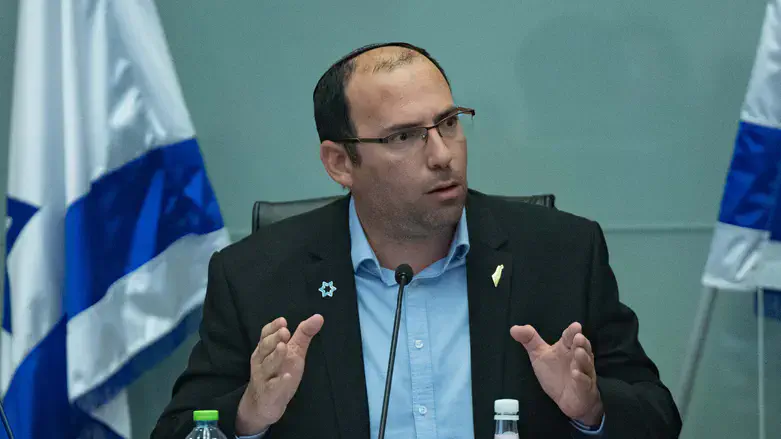
The Knesset Constitution Committee held a follow-up discussion on Wednesday on the progress of preparations that will enable the Nukhba terrorists to be put on trial. In an interview with Arutz Sheva, committee chairman MK Simcha Rothman explained how, three years after October 7, not a single Nukhba terrorist has yet been brought to trial.
Rothman, who together with MK Yulia Malinovsky, led the legislation enabling the trials, noted that the law was passed only five months ago. He said Wednesday’s meeting demonstrated that significant and extremely rapid progress is indeed being made compared with the procedural steps that would have been required had the Nukhba trials been conducted as ordinary criminal proceedings.
“In theory, some of the indictments could have been filed two or two and a half years ago, but there was a problem. First, as long as negotiations concerning the hostages were underway, a decision was made at a high level that this issue would not be dealt with while the hostages remained in Hamas captivity, and the reasons for that are understandable. There was also a gag order concerning the number of people we were holding, and proceedings could not be initiated. So during the first two years, the issue was not relevant because of the hostages."
Asked whether the relevant legislation could have been advanced during those two years so that everything would be ready immediately, Rothman answered in the affirmative. He said that both he and Malinovsky were extremely angry when they realized that no government legislation was being advanced alongside the discussions over freeing the hostages, which could have allowed a bill to be placed before the Knesset immediately following their release after the necessary preparatory work had already been completed.
“Unfortunately, that did not happen, even though we warned about it and demanded it from the very first day. We saw that nothing was moving, so we advanced our own private member’s bill, including preparatory work that is normally carried out by the government rather than the Knesset. There was cooperation between the opposition and coalition, and we passed the law in a relatively short period of time. Once the law was passed, it became possible to move forward."
“This is groundbreaking and extremely complex legislation," Rothman said, “because the State of Israel has never dealt with cases this complicated, with evidence from so many different scenes, such an enormous amount of material, and so many terrorists. Under the rules of evidence of the ordinary judicial system, if we filed an indictment, four years would pass in preliminary procedural stages before the trial even began. Then the trial itself would begin, and with appeals and so forth, it could last another 15 years. We concluded that the timetable had to be realistic so that we would actually see justice being done rather than it remaining merely theoretical. That is why we built a system through the military, which has its own procedures for conducting such proceedings."
Referring to the figures presented at Wednesday’s meeting, Rothman said: “The current estimates are that the first indictment will be filed in the first half of 2027, and the trial will begin six months later rather than four years later. In doing so, we have dramatically shortened the timetable. The proceedings themselves will also be conducted more quickly. I estimate that we will begin seeing verdicts and sentences during 2028. Under the ordinary alternative, the trial would not even have begun by 2028."
Elaborating on the progress reviewed by the committee, Rothman cited the various requirements necessary to conduct the trials.
“Because of the security complexities, buildings have to be constructed. There was a requirement that the court be located in Jerusalem, in Atarot. That involves locating a site, a planning process, and a budgeting process. With an ordinary courthouse, this would have taken much longer. In addition, personnel have to be recruited and funding allocated. Normally, this involves many years of bureaucracy. Here, things that would ordinarily take two, three, or four years have happened within five months. They are working on this at full speed, and within the next two weeks, the head of the apparatus responsible for prosecuting the Nukhba terrorists will be appointed. He will take up his position, and the expectation is that the first indictment will be filed during the first half of 2027."
Asked what that first indictment would include, whether it would target a specific individual or a group, and, if an individual, who that person would be, Rothman said those decisions would depend on whoever heads the prosecution. He added that public diplomacy considerations would naturally also factor into the issue.
“We need to establish a system for victims of crime on a scale that has never existed before, one that will provide assistance to the families and victims, and this must be handled sensitively. We cannot have a situation in which we move forward and then discover that we disclosed details through which a family learned for the first time, from the media, what was done to their loved one. There are many extremely complex aspects here, and considering all of that, the pace of progress is astounding. The people working on this are deeply committed to it and regard it as a national mission of the highest order."
Nevertheless, Rothman said he understands the public criticism, which he himself shares, over the fact that the legislation was not advanced during the two years in which the hostages were being held by Hamas, “but the echelon that made that decision was a senior one."
Addressing the question of legal representation for the terrorists, Rothman said: “The most important rule we established is that the murdered cannot be made to pay for the murderers. Therefore, the attorneys’ fees will be paid from Palestinian Authority funds, under legislation that I passed. Beyond that, there may be defense attorneys from Israel and from the Palestinian Authority, and they will represent the terrorists."
In his view, it would not be appropriate for attorneys from around the world to come to Israel to represent the terrorists.
Concluding his remarks, Rothman said: “I told the members of the administration at the beginning of the meeting that anyone familiar with these processes understands the tremendous speed and dedication with which you are working, but the public is rightly demanding that the pace be accelerated. They understand that and are committed to moving this forward - and those who aren’t, we straighten them out."