

Prime Minister Benjamin Netanyahu instructed National Security Council Director Shmuel Benezra on Sunday evening to appoint an inspector to conduct a comprehensive review of all aspects of security for foreign civilian flights arriving in Israel.
The decision follows a series of investigations and disclosures revealing serious failures in the system responsible for securing foreign aviation. The reports point to warnings that were not addressed, decisions that were never implemented, intelligence that was not properly used, and manpower shortages. They also raise questions over how crew members holding citizenship from countries without diplomatic relations with Israel were able to reach Ben Gurion Airport.
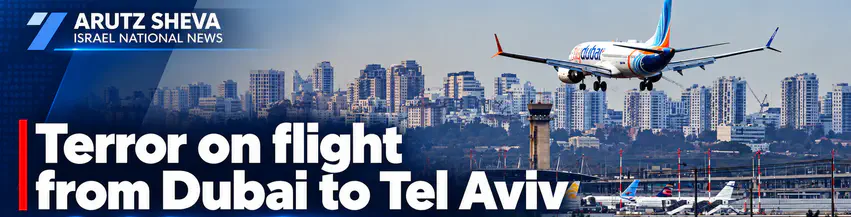
The attempted attack on a Flydubai flight highlighted the potential consequences. The aircraft's second pilot, Maimam al-Hamami, an Omani citizen suspected of holding extremist views and previously barred from flying in his home country, was able to join the airline and operate a flight to Israel. The security mechanism that was supposed to identify the risk failed to do so before he allegedly attempted to take control of the aircraft.
An internal NSC document revealed by Galei Tzahal on Sunday indicated that the Transportation Ministry had failed to implement responsibilities assigned to it regarding foreign aviation security. According to the report, ministry professionals had warned that they lacked the necessary capabilities, but responsibility remained with the ministry following a series of discussions and decisions. The NSC had also warned in March 2025 that the ministry was not operating in accordance with a cabinet decision.
One major issue involves the National Center for Passenger Assessment, which collects information on passengers and air crews arriving on foreign flights. The database contains information that can assist in identifying crew members with problematic citizenship, and the Transportation Ministry is authorized to access it as part of its responsibilities. However, according to reports, the ministry has never requested to implement access to the system.
Another problem concerns the timing of crew information. According to Channel 13, flight crew details are transferred to the system only shortly before the aircraft doors close and, in some cases, as late as 15 minutes after takeoff. As a result, information that could potentially raise security concerns may reach Israeli authorities too late for preventive screening.
A government source said this practice is common internationally and that no government body had previously requested a change. The procedures are now being reconsidered following the attempted attack.
A conversation between senior officials in the Transportation and Interior ministries, reported by Channel 12, also raised questions about how information concerning foreign crew members is handled. A Transportation Ministry official asked how authorities could identify a crew member arriving with an Emirati passport who also holds Omani citizenship. An Interior Ministry representative responded that crew members are not screened at that level and that passenger and crew lists are sometimes received only after takeoff. The official later stated that the information was passed to the relevant security agencies, saying that it had been received by the Interior Ministry, ISA, and Mossad.
The reports also indicate that the Omani pilot may not have been an isolated case. In previous years, pilots holding Iranian, Lebanese, Pakistani and other citizenships from countries without diplomatic relations with Israel reached Ben Gurion Airport. Most subsequently departed Israel after short stays.
Official figures published by Channel 13 show that dozens of Omani citizens entered Israel in recent years: 10 in 2022, 29 in 2023, nine in 2024 and 11 in 2025, with additional entries recorded this year. Oman is not classified as a hostile state, but it does not maintain diplomatic relations with Israel, and authorities believe some of those who entered may have been air crew members.
Following the attempted attack, new instructions were issued to foreign airlines. Under the updated guidelines, crew members who hold citizenship or dual citizenship in a country that does not maintain diplomatic relations with Israel will not be permitted to serve on flights to Israel.
Further disclosures indicate that concerns about the system had been raised years earlier. In June 2023, the NSC held a meeting with ISA and Mossad representatives on the transfer of intelligence information to civilian bodies. Transportation Ministry representatives said the ministry was responsible for securing foreign flights but required broader intelligence information to carry out the task. The information being provided to the ministry, they said, was insufficient.
The meeting ended with a decision for Mossad to increase its efforts to provide additional information to the Transportation Ministry. According to the report, however, the decision was never implemented.
The ISA had also warned over the years about vulnerabilities in tracking air crews and verifying passenger identities. Sources cited by Haaretz said the agency recommended transferring responsibility for overseeing foreign flights and crew lists to the Israel Airports Authority.
The disclosures paint a picture of repeated warnings from different parts of the system. Transportation Ministry officials cited insufficient intelligence, security officials pointed to weaknesses in the screening mechanism, and the issue reached senior government levels, yet the underlying problems remained unresolved.
Questions have also been raised about the staffing of the Transportation Ministry's Aviation Security, Emergency and Cyber Division, which is responsible for aviation security among other areas. According to data published by Ynet, eight employees left the division between 2022 and 2025. The number of official positions fell from 21 to 19, with six designated as part-time positions for students and senior citizens and at least two senior positions left vacant without budget allocations.
In practice, the division reportedly operates with only about 10 permanent full-time employees, despite being responsible for security and emergency systems across air, maritime and land transportation.
Former ministry officials said efforts had been made for years to upgrade the aviation security operations center and even transfer it to ISA or Mossad, but those plans never materialized.
Dani Shneer, who previously served as a senior director of the Security Division and chief security officer at the Transportation Ministry, told Calcalist that the division had been responsible for examining foreign air crews since a 2003 government decision. Airlines were required to provide crew information as part of the process for obtaining approval to land in Israel.
Shneer said the system had operated effectively in the past but argued that its current responsibilities are too broad to be handled by a limited unit within a government ministry. In his view, responsibility should be transferred to a national security body.
The identities and employment arrangements of officials overseeing the system have also come under scrutiny. Channel 12 reported that Dvir Rubinstein, identified as the manager of the Transportation Ministry's aviation security operations center, is not a government employee but works through an outsourcing arrangement. He also holds additional jobs. The ministry confirmed his employment status and said his other occupations had been legally approved and take place outside his working hours.
Haaretz further reported that Security Division chief Avi Cohen simultaneously serves as a standby security officer in an aviation security system abroad and receives separate compensation for that work. The Transportation Ministry said Cohen was authorized to hold the additional position when he took office in 2018.
The latest disclosures reinforce concerns raised in the NSC document revealed earlier Sunday. The question of responsibility has been under discussion for years. A cabinet decision in July 2021 addressed the division of responsibility for flight security, while the issue later appeared in a confidential State Comptroller report from May 2024. A team was subsequently established involving the NSC, Transportation Ministry, Israel Airports Authority, ISA, Mossad and Finance Ministry.
According to Galei Tzahal, professional officials in the Transportation Ministry's Security Division opposed taking on the responsibility, arguing that they lacked the necessary tools. Nevertheless, Netanyahu decided in mid-2025 that the responsibility would remain with the Transportation Ministry. The report says that even afterward, the ministry's Security Division did not approach ISA or Mossad to request assistance with security screening or the vetting of passengers and crew members.
The Transportation Ministry has rejected many of the allegations, arguing that some reports conflate foreign scheduled flights with charter flights.
The ministry said responsibility for security arrangements involving foreign aviation has rested with it for decades, but stressed that this does not mean it is responsible for conducting intelligence background checks. "The Transportation Ministry is not an intelligence body, and it does not have the tools to conduct intelligence background checks for crew members and passengers," the ministry said.
According to the ministry, its procedures were approved by the NSC and other security bodies and rely on security arrangements in countries of origin, commitments made by airlines, and inspections conducted by the division.
Regarding the Flydubai flight, the ministry said the airline had received explicit instructions and committed to conducting background checks on its crew. It also said the airline had confirmed in writing that it had implemented nationality restrictions in its crew-assignment system. The ministry maintains that it did not receive the crew list for the flight in question.
The ministry also said two committees that operated in the past had recommended creating a national aviation security authority to consolidate responsibility for all flights. According to the ministry, it supported the proposal, but the recommendations were never implemented.
The inspector appointed by the NSC chief will now be tasked with examining the full chain of events: decisions that were not implemented, warnings that failed to close known gaps, intelligence that was not used in time, and the longstanding dispute over which body bears responsibility.
The central question will be how these failures allowed a pilot suspected of extremist views to reach Israel and operate flights repeatedly, ultimately leading to an attempted attack that could have ended in disaster.