

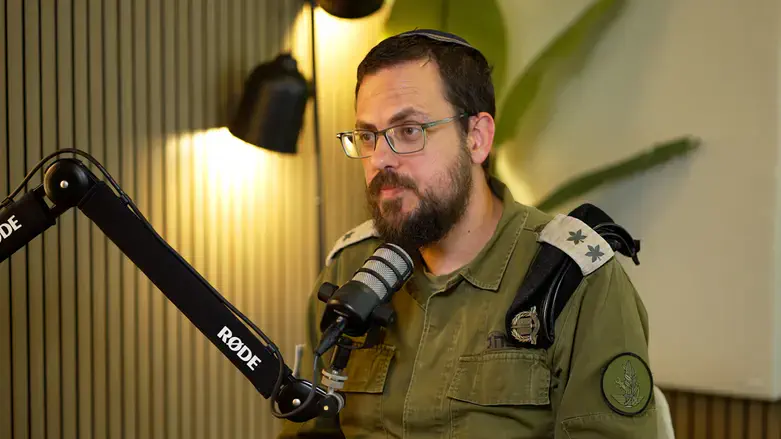
Three years have passed since the October 7th massacre, but for Lieutenant Colonel Rabbi Udi Schwartz, head of the Halacha Branch of the IDF Rabbinate, the memories remain painfully vivid.
"The sights we saw at Camp Shura during the first 48 hours of the war are sights that, even three years later, I find difficult to talk about," Schwartz told Arutz Sheva - Israel National News. "Those images still accompany me."
On the morning of October 7, Schwartz initially did not grasp the scale of the disaster unfolding across southern Israel. At around 8 a.m., the first urgent call came from the Air Force commander, who asked whether all Air Force rabbis should be sent to their units. "I asked him what happened," Schwartz recalled. "He told me, 'I don't know, something big.'"
From that point, the calls continued without interruption. The rabbinate received questions concerning emergency mobilization, Shabbat restrictions, equipment, and reservists who had not been called up in years.
After the holiday ended, Schwartz made his way to Shura, which would become one of the central locations for the identification and burial of those killed on October 7. "Before the war, when we said we served at Shura, almost nobody knew where it was," he said. "Today, when you say 'Shura base,' people stand in awe. I even say that it is a holy place."
Schwartz was assigned responsibility for one of the most sensitive stages of the process: the team responsible for approving the identification of human remains before they could be released for burial. "Not a single coffin left without the team signing off and fully approving the identification," he said. "There is no second chance in this matter. God forbid, you cannot knock on a family's door and tell them the wrong person has been identified."
The teams used every available method to establish identities, including fingerprints, DNA, dental records and intelligence gathered from numerous sources. The work was not only technically demanding. It was an extraordinary emotional ordeal.
"Everyone has a breaking point," Schwartz said. "Nobody worked like a robot. We understood how hard it was, but we knew that everything we were doing was for the families."
Some of the most difficult moments came not in the identification laboratories, he said, but when families arrived to say goodbye. "When a family comes to say goodbye for the last time to their son, and you stand there holding the hand of a father or brother and accompanying them through those final moments, you understand that our responsibility is not only to identify the fallen. It is to give the families absolute certainty."
Another immense responsibility involved determining the fate of hostages who had not returned. Under Jewish law and Israeli military regulations, the IDF Chief Rabbi can determine that a person has died even when remains have not been recovered. Such decisions carry enormous halachic, personal and national consequences.
"Immediately after Simchat Torah, we began dealing with this," Schwartz said. "We met with intelligence officials, medical experts, missing-persons professionals, and everyone who could provide information about the fate of each hostage."
In some cases, rabbinate teams were 95% or even 98% certain that a person had been killed, but that was not enough. "With 95%, you don't knock on a family's door," Schwartz said. "We waited two months, six months, and in one case more than a year, until we reached absolute certainty."
When the rabbinate representatives eventually entered those families' homes, they often had little to offer that could ease the pain. "At that moment, you have nothing to give them except your heart," he said. "You don't come on behalf of the rabbinate or on behalf of the army. You come as a person trying to stand beside a family during the darkest moment of its life."
Three years later, Schwartz says he felt a profound sense of closure when the remains of the final kidnapped victims were brought back to Israel for burial. "We promised the families that they would return," he said. "When we were able to bring them to burial in Israel, we felt that we had closed the circle. It was a moral, Jewish, and values-based duty of the highest order."
Yet Schwartz says that despite the immense pain, Israel must continue looking forward. "It will take us years to process what we went through," he said. "But from the depths of sadness and mourning, we must emerge stronger. The IDF continues forward, the State of Israel continues forward, and from all this pain we say: Am Yisrael Chai - The people of Israel lives."