

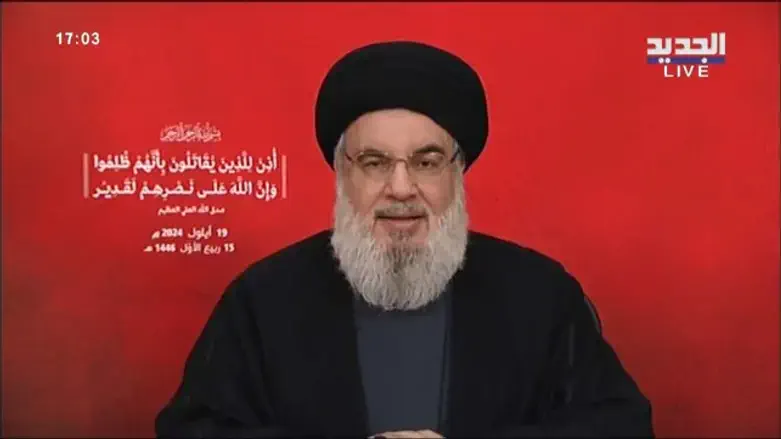
Two years after the assassination of Hassan Nasrallah, Hezbollah continues to grapple with the question that emerged immediately after his death: can a leader who spent more than three decades concentrating the organization’s political, organizational and military power in his hands truly be replaced?
Recent reports in Arab media suggest that the vacuum left by Nasrallah remains one of Hezbollah’s central challenges, while also pointing to changes in how decisions are made at the organization’s highest levels.
At the center of the discussion is Hezbollah Secretary-General Naim Qassem, Nasrallah’s longtime deputy. A report by the Saudi newspaper Asharq Al-Awsat, citing sources close to Hezbollah and its opponents, said Qassem has not fully filled the range of roles previously held by Nasrallah. The report described the issue as extending beyond the two men’s public profiles to the power structure that emerged after much of Hezbollah’s longtime leadership was eliminated.
Nasrallah led Hezbollah for about 33 years, transforming the secretary-general’s office into a central link between the organization’s political, organizational and military branches, its support base and Iran. Hezbollah’s post-Nasrallah leadership has become more collective and structured, while opponents claim that internal room for initiative has narrowed and Iranian involvement in decision-making has increased.
Qassem, who served as deputy secretary-general for decades, was chosen by Hezbollah’s Shura Council to succeed Nasrallah in October 2024. His supporters argue that he has helped reorganize the group and maintain its cohesion despite the loss of senior leaders. Political writer Qassem Qassir, who is described as familiar with Hezbollah’s positions, stated that the organization has reorganized its ranks and adopted a different approach in response to a changed political and military environment.
Qassir also said Hezbollah is now placing greater emphasis on Lebanon’s internal arena and southern Lebanon. While he acknowledged that the group is no longer the strongest political force in these regions, he said it remains a major actor in Lebanese politics.
Hezbollah’s opponents offer a different assessment. Jad Al-Akhawi, head of the Lebanese Democrats Coalition and a Shiite critic of the organization, argued that Qassem has not filled the role Nasrallah occupied. In his view, the challenge extends beyond public charisma to Nasrallah’s ability to combine political, military and organizational authority while maintaining a direct connection with Hezbollah’s supporters.
Another issue raised in the report is the extent of Iranian involvement in Hezbollah’s decision-making. Lebanese political activist and academic Mona Fayad claimed that internal disagreements have affected the organization’s leadership and that important decisions are increasingly being made in Iran, leaving less room for Lebanese decision-making. These claims were presented as Fayad’s assessment rather than independently established facts.
Recent reporting has also pointed to changes in Hezbollah’s internal structure. Muhammad Raad, head of the organization’s parliamentary bloc, said Hezbollah rapidly reorganized after the deaths of Nasrallah and his designated successor, Hashem Safieddine, with Qassem leading the process alongside other senior figures.
The result is an organization operating under conditions markedly different from those of the Nasrallah era. Hezbollah has reorganized its leadership and remains a major force in Lebanon, while Arab media reports continue to debate the extent of Qassem’s authority, the organization’s internal cohesion and the role played by Iran in shaping its decisions.
Two years after Nasrallah’s assassination, the question is therefore no longer simply who succeeded him, but how Hezbollah’s leadership structure has changed since the loss of the man who dominated the organization for more than three decades.