

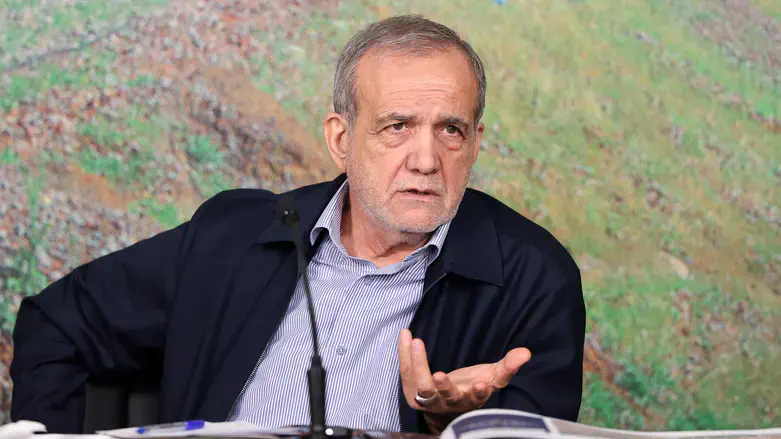
Iranian President Masoud Pezeshkian indicated Thursday that Tehran is prepared to pursue an agreement with Washington to bring the war to an end before the US midterm elections in November.
“We don’t want it to get to the midterm elections," Pezeshkian said during a brief meeting with NBC News and other media organizations on the sidelines of the United Nations General Assembly.
“We wish Americans to return to the MOU before the midterms," Pezeshkian added, referring to the memorandum of understanding reached by the two countries in June that outlined a temporary ceasefire. The arrangement later broke down.
The White House responded by rejecting the Iranian regime's record and defending President Donald Trump's policy toward Tehran. White House spokesperson Anna Kelly told NBC News, “The Iranian regime has murdered thousands of its own people, killed Americans overseas, executed acts of terrorism in the Strait of Hormuz, and launched indiscriminate attacks against its neighbors in the region."
“The President is courageously ensuring that such an evil country never possesses a nuclear weapon, which will make the entire world safer and more stable," Kelly added.
Pezeshkian also addressed the absence from public view of Iran's new Supreme Leader, Mojtaba Khamenei.
He said he had met Khamenei twice, including a meeting about a month ago that lasted seven hours, and said he saw “any issues with his health or physical appearance" during their encounters. The two reportedly sat on the floor using traditional pillows.
Khamenei has not been seen publicly since the war began on February 28. His disappearance came after his father, Ali Khamenei, was killed in joint US-Israeli strikes on Iran, followed by Mojtaba Khamenei's appointment as Supreme Leader.
His prolonged absence has fueled speculation regarding his health and whereabouts, including claims that he sustained serious injuries or died. CNN reported in March that Khamenei was injured on the first day of the conflict, allegedly suffering a broken foot, injuries near his left eye and facial lacerations.
Meanwhile, Reuters reported Thursday that American and Iranian negotiators in New York are discussing a phased arrangement that could ease the conflict. Under the proposal being examined, Tehran could potentially reopen the Strait of Hormuz in return for Washington lifting its economic blockade.
The strategic waterway has become a central point of leverage in the negotiations. The US is seeking unrestricted shipping through the strait, while Iran is seeking an end to the blockade and could also request access to frozen Iranian assets.
A senior Iranian official told Reuters that a gradual agreement may provide the most practical path forward. "One way forward would be to solve the crisis in stages.
The discussions come after Trump used his address to the UN General Assembly Tuesday to warn about the threat posed by Iran and reiterate that he would not allow Tehran to obtain a nuclear weapon.
"There is no better example of a danger that was allowed to gather strength at the world’s peril than the number one sponsor of terror, the Islamic Republic of Iran. From the first day I entered the political arena, I have been unwavering - I will NEVER allow Iran to have a nuclear weapon."
Trump said he had offered Tehran economic cooperation after taking office in return for abandoning its nuclear program and support for terrorism, but claimed Iran rejected the proposal. He also warned that Iran had developed a missile capable of striking Europe.
"Iran has created a missile that will allow them to strike Europe," Trump warned.
The president said he faces a major decision on how to proceed with Iran, while expressing confidence that a deal could be reached after the US midterm elections.
"I have a big decision to make. Will a deal be made with Iran that lets them rebuild and create a far greater country than it ever was before, maybe one of the greatest in the Middle East or even the world? Or do I annihilate the Islamic Republic and do it quickly, never giving them a chance to kill and destroy people and countries again? Do I drive them into hell with no chance of survival and no hope of future greatness for generations? But I believe we’ll make a deal right after the election, because it doesn’t make sense for them not to."