

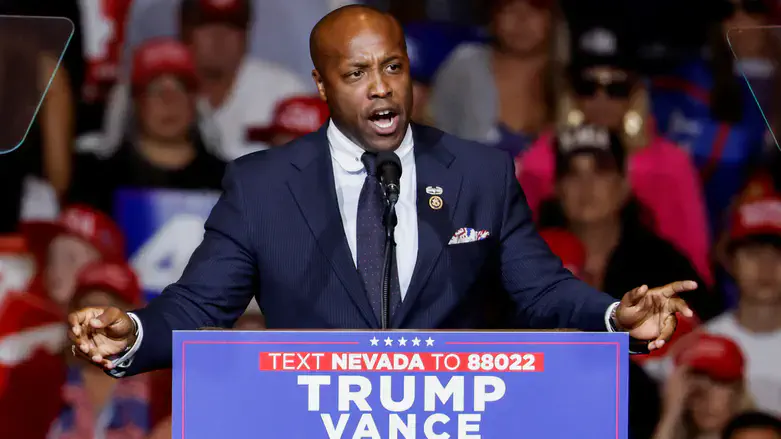
US President Donald Trump has nominated Texas Republican Rep. Wesley Hunt to become the next US ambassador to Saudi Arabia, sending the 44-year-old congressman's nomination to the Senate for confirmation, The Hill reported Monday.
Hunt is completing his second term representing Texas' 38th Congressional District and is scheduled to leave the House in January. He previously served as an Army officer and spent two years as a diplomatic liaison in Saudi Arabia.
In a statement, Hunt called Trump's nomination the “honor of a lifetime."
“Having served in the region both in combat as an Army officer and for two years as a diplomatic liaison in the Kingdom, I understand the strategic importance of the partnership between the United States and Saudi Arabia and the profound responsibility of this position," Hunt said.
“When confirmed, I will serve with humility and honor, advance his vision of peace through strength and deepen this vital partnership," he added.
The US has been without a permanent ambassador in Riyadh since Michael Ratney departed at the conclusion of the Biden administration. Jennifer Larson, a career Foreign Service officer, has served as interim head of the US Embassy in Riyadh since mid-August, succeeding Alison Dilworth.
Trump's nomination comes as his administration works to expand US-Saudi cooperation, including in the nuclear field. Last month, the administration submitted a 30-year nuclear cooperation agreement with Saudi Arabia to Congress that would allow American companies to develop the kingdom's civilian nuclear infrastructure.
Trump has made Saudi-Israel normalization a condition for the nuclear agreement to take effect. Speaking in the Oval Office two days after the agreement was signed, he said Saudi Arabia would need to join the Abraham Accords.
“I just say that in order to do it, they have to be a member of the Abraham Accords, which have been very successful. But it's time now that they do it."
Trump said concerns about Iran had previously hindered Saudi Arabia and other countries from joining the framework, but argued that Tehran's influence had since declined.
“They and others didn't want to do it because of the problem that they had with Iran. You don't have that problem anymore. You don't have a great power there anymore," continued the President.
“You have a problem, but the problem is disappearing day by day. They were the bully of the Middle East. They were not going to be that much of a bully anymore, probably," he said of Iran.
“At some point they'll join [the Abraham Accords]," the President continued, referring to Saudi Arabia. “They'll join, and they'll do their civil nuclear, no enrichment, it's civil nuclear."
The Abraham Accords were brokered by the United States during Trump’s first term and established diplomatic relations between Israel and several Arab countries. The United Arab Emirates and Bahrain signed the agreements in 2020, becoming the first Arab states to formally normalize relations with Israel since Jordan did so in 1994.
Morocco and Sudan later joined the framework, although Sudan's full ratification was delayed by internal instability. Kazakhstan became the latest member in January of this year.
Saudi Arabia and Israel had appeared to be moving toward normalization before Hamas' October 7, 2023 attack on Israel. Following the massacre, Riyadh put the US-backed normalization process on hold.