
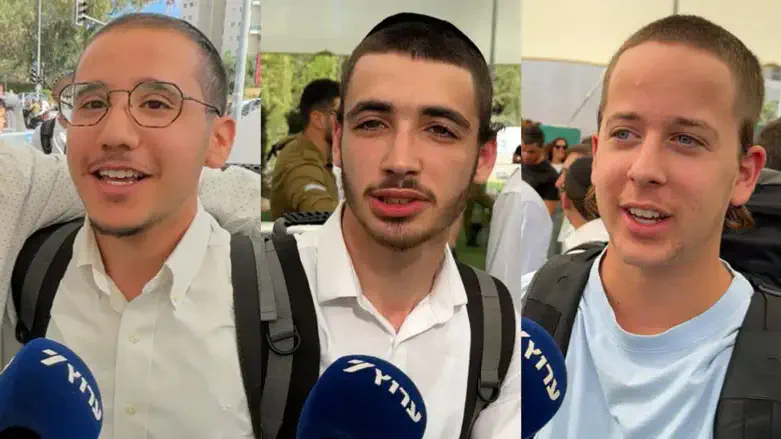
New haredi recruits arrived at the Tel Hashomer induction center accompanied by family members. Israel National News - Arutz Sheva spoke with them about their excitement and concerns, amid a small protest against enlistment by members of the Jerusalem Faction.
One recruit described his long journey toward enlistment: “I’m very excited. I’ve been waiting for this for a long time and worked very hard for it." He said the process required him to leave his comfort zone, but added, “I think this is where I belong. I think this is where I fit in."
Family members also expressed their excitement. One father said, “It’s a very moving morning. I was privileged to bring my firstborn son and entrust him to the IDF," noting that some haredim are enlisting and even choosing combat service.
Another recruit spoke about his friends who remained in yeshiva. “It varies. Some will enlist later, while others are continuing their studies in yeshiva." The sister of another recruit said there was natural anxiety alongside the excitement: “Like any new beginning, there’s some pressure and fear, but it’s a phase that you get through."
A father whose son enlisted in the haredi Hasmonean Brigade said he supports the decision. “Thank God, he enlisted in the Hasmonean Brigade. He’s serving in a combat role, in a haredi brigade, with the support of the rabbis." He added, “We believe in this path, that those who study less than full-time, and those who study less, should serve and enlist in the IDF."
One recruit stressed the importance of combining military service with his haredi lifestyle. “I want meaningful service, but at the same time I don’t want my spirituality to decline. I want to strengthen it and even increase it." Addressing those opposed to enlistment, he said, “I’m not against anyone. As far as I’m concerned, they’re also our brothers. If they have a problem with us, that’s fine. We accept their opinion."
Another father said he believes the haredi community wants to share the burden through a regulated legal framework. “The haredi community wants to be part of sharing the burden and serving, and of course we want this to be properly regulated by law," he said. In his view, those who are not studying should enlist.
A family member who said he serves in the reserves explained that military service does not conflict with his religious way of life. “Thank God, I will continue to pray, I will continue to study, I will continue my path in Torah while in the army." He added, “I came here willingly. I wanted to be a soldier, and I’m religious by choice. I know that in the end I’ll be religious in the army too, just as I’ll be religious outside the army."
He said his decision to choose combat service was deliberate. “I chose it. I chose the path of going to the army and a combat track. I’m happy about it. I want to do something for the country, for the army, for the land." He thanked those who worked to establish haredi military frameworks, including haredi Border Police units, the Hasmonean Brigade and Netzah Yehuda.
One parent said the Hasmonean Brigade allows soldiers to combine combat service with a haredi lifestyle. “We have a serious, meaningful haredi brigade, with Torah classes and rabbis." He added that the physical fitness requirements and operational demands remain unchanged.
One recruit also addressed concerns that his identity could be affected during his service, making clear that he has no intention of changing his way of life. Asked whether he would keep his sidelocks and black kippah, he replied, “Of course they’ll stay, because that’s who I am," adding that joining the army does not require him to change anything about his background or lifestyle.