
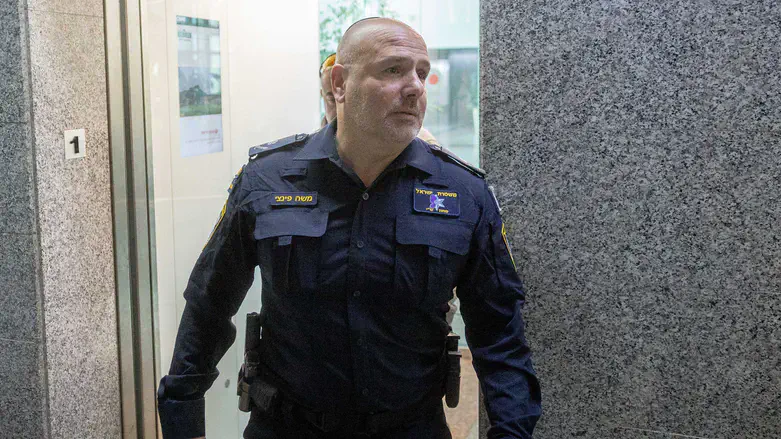
Police Judea and Samaria District Commander Police Commissioner Moshe Pinchi is addressing for the first time a plan to transfer civilian law enforcement powers in Judea and Samaria from the IDF to the Israel Police, following an order by Defense Minister Israel Katz to prepare the plan.
Pinchi is demanding that the Judea and Samaria Border Police be placed under the authority of the Judea and Samaria District as part of the move, and that the police receive additional funding, resources and equipment.
According to Pinchi, changes in Israeli communities in Area C require a corresponding change in the division of responsibilities between the military and police. He specifically pointed to the growth of agricultural farms outside established communities as a factor requiring an adjustment to the law enforcement response.
“The growth of the Israeli population in Area C of Judea and Samaria, the expansion of Israeli communities and the emergence of new forms of residences, including agricultural farms that have developed outside established communities, require the necessary adjustments and the transfer of responsibility for civilian matters and related law enforcement powers to the Israel Police," Pinchi said.
According to Pinchi, the move should be carried out “with the allocation of the necessary resources and personnel, the placement of the Judea and Samaria Border Police under the district, the deployment of forces and the delegation of the necessary powers to the police to carry out these missions."
Pinchi also called for making permanent the cooperation between the police, Shin Bet and Central Command as part of the “Mission Headquarters," which was established to address extreme incidents of violence in Judea and Samaria. He said there is a need to “institutionalize the inter-organizational partnership permanently" in accordance with the Prime Minister’s directive.
He said the joint framework has already proven effective in recent months “in the places and areas where it has operated since its establishment to confront rioters and extremists involved in violence." He linked the proposed changes to both the security and civilian challenges in the region.
“These are significant steps required to thwart terrorism and hostile terrorist activity, strengthen governance, improve services to civilians, strengthen the rule of law in Judea and Samaria, and allow the IDF to focus on its primary missions," Pinchi said.
His remarks come after Arutz Sheva-Israel National News reported last week that the framework under discussion for transferring civilian law enforcement powers applies only to Area C, and not to Areas A and B. Discussions on the matter have also highlighted the need for a significant increase in the Judea and Samaria District’s manpower, from its current force of approximately 1,500 officers to about 3,000.
The discussions also considered the possibility of transferring the Judea and Samaria Border Police from its current operational subordination to the IDF to the direct command of the Israel Police. Pinchi is now making the move an explicit requirement for the police to assume the expanded responsibilities.
The plan to transfer the powers was initiated by Coordinator of Government Activities in the Territories Maj. Gen. Yoram Halevi, who raised the need to redistribute responsibilities between the IDF and police. Defense Minister Katz subsequently instructed the IDF to prepare a plan to transfer civilian law enforcement powers involving Israeli communities and the Israeli population to the police.
When the directive was announced, Katz said: “The IDF’s role is to fight Palestinian terrorism, focus on defending the borders and communities against threats, address security threats to the settlement enterprise and the State of Israel, and not chase teenagers on the hills." He said the police would be granted the powers necessary to carry out the responsibilities transferred to them.