
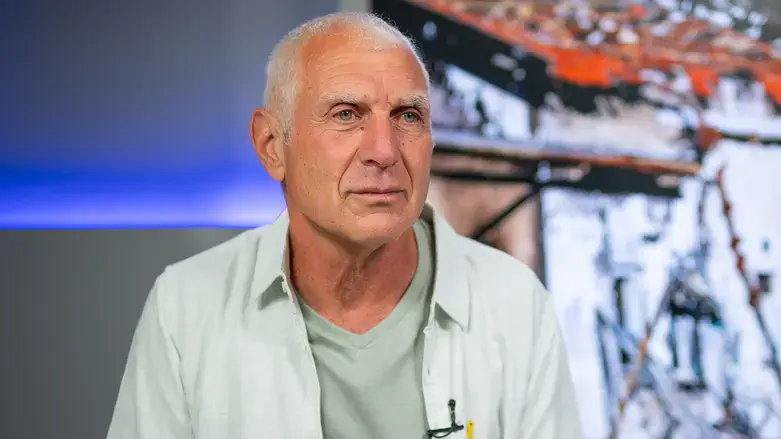
Following the Cabinet’s rejection of the Gaza Board of Peacel’s 15-point document, which includes a demand for IDF forces to withdraw from the Gaza Strip, Arutz Sheva spoke with Haim Yellin, a resident of Be’eri, former Knesset member and former head of the Eshkol Regional Council, about his feelings and concerns regarding the plan that may be taking shape over Israel’s head.
At the outset, Yellin notes that the very fact that this is a plan some are seeking to impose on Israel proves that “something is wrong here," as he puts it. If the plan were good for Israel, there would be no need to impose it. He says he wishes to share his perspective “as a resident who was there on October 7 and was evacuated from his home amid fierce fighting by IDF soldiers, some of whom also fell for us."
“The evil I saw is not an evil that anyone in the world can understand. It goes beyond an enemy. You can make peace with an enemy; with evil like this, there is no possibility of making peace or an agreement. You need to reach the situation the Prime Minister promised - total victory, where there will be no terrorism there. Now we have to deal with the reality of returning to the communities near Gaza when the homes are ready, but what reality are they returning to? The reality of October 6, when we cried out for years and warned that they were growing stronger?"
Yellin recalled the day the first mortar shell was fired at the communities near Gaza. Fuad Ben-Eliezer was Defense Minister at the time. Yellin went to him with the remains of the mortar shell and demanded that the building from which it had been fired be destroyed, warning that things would become very bad if this were not done. His warnings went unheeded, and in later years some dismissively referred to the projectiles as “flying objects."
“They can go from zero to 100 and repeat October 7 even if they control only 10% of the territory. The entire essence of this evil is to harm us, and now the question is how a terrorist organization is supposedly going to hand over its weapons out of some concern for Zionism and the people of Israel... It is obvious that this will not happen, no matter what they sign," Yellin stated.
In light of his comments, and the sense that Israel’s current leadership is more clear-eyed than in the past, we asked Yellin whether Israel can withstand international pressure demanding that it reach some form of agreement.
Yellin responded: “I commend Trump, who has done amazing things for the State of Israel, but I did not elect him. He is not my prime minister. He is the president of the citizens of the United States. We have a prime minister, and he is the one who must take care of our security. The government failed on October 7, and there cannot be an agreement in which Hamas remains there, regardless of whether they give up 80% of their weapons, missiles and tunnels. They will rebuild everything from scratch. From every Subaru, they will build a fighter jet to destroy us. This evil must be destroyed, either through military-diplomatic means or through changing education. But educating them will take at least two generations, and in the meantime they will only grow stronger, so that is not realistic."
He emphasized that there is a reason he did not choose to place himself in a position of governmental influence and decision-making in which he would be expected to provide a solution.
In his assessment, Israel missed two significant opportunities. The first came during the initial three months of the war, when it may have been possible to strike Gaza with greater force and destroy all of its infrastructure. The second came when an arrangement was proposed that would have included the return of all the hostages, followed by a resumption of the fighting.
Neither opportunity was utilized, he said, and he now fears reports that while Israel officially rejects the 15-point document, in practice it is accepting it.
The central objective that should now guide the Israeli government, Yellin said, is finding a way to restore a sense of security to residents returning to their rehabilitated communities.
“The most important thing now is to heal the people. Not a people fighting among themselves, left and right, as the politicians invented. When we become one fist and speak the same language, with the same tone and determination, the world will change as well."
Yellin concluded with a reminder: “We are still fighting, both in Lebanon and in Gaza," and expressed his great hope “that we will all be worthy of the fallen."
“Without the Kalmanzon family and all those who came to save us, the 34 who fell, we would not have been able to move forward. Hope is the best contagious disease there is, but for there to be hope, we need to be one people."