

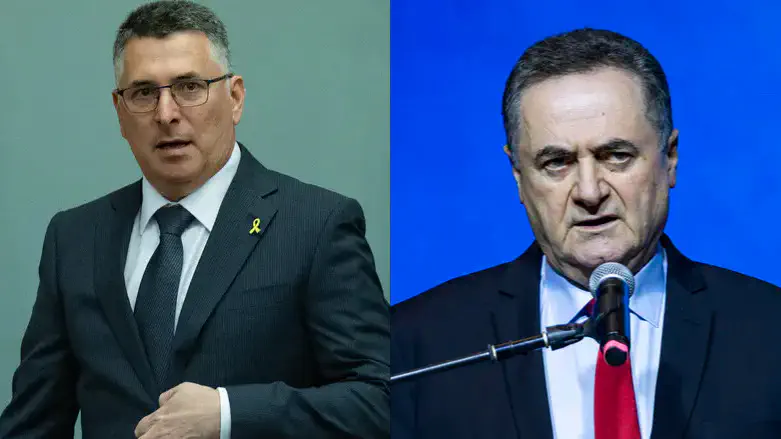
The Likud party issued a statement early Tuesday morning announcing that, alongside the Prime Minister's reserved slots, the party's secretariat will be asked to approve spots on the electoral list for Foreign Minister Gideon Sa'ar, Defense Minister Israel Katz, and Minister Haim Katz, Chairman of the Likud Central Committee - in addition to the new candidates expected to be brought in by the Prime Minister.
"The party tribunal ruled last week that the Defense Minister - who was already expected to reach the top of the slate - should be granted a reserved spot to allow him to focus on critical defense needs rather than politics during this period," the party stated.
Regarding Sa'ar, Likud noted that his placement stems from his party's merger agreement with Likud, while Haim Katz will receive a reserved spot by virtue of his role as Central Committee chairman.
On Monday evening, Prime Minister Benjamin Netanyahu announced the first candidate to receive a reserved spot on Likud's slate: High-tech entrepreneur and businessman Oren Dobronsky, who will be placed in the 11th position on the slate.
This marks the first slot revealed by Netanyahu ahead of the Knesset elections out of the eight reserved positions granted to him on the Likud list.
Likud welcomed Dobronsky's joining, describing him as a successful businessman, a leader in Israel's high-tech industry, and a right-wing figure widely recognized for his appearance on the reality television show The Sharks.
According to the party's statement, following the elections, Dobronsky is expected to spearhead artificial intelligence initiatives across various economic sectors, including education, medicine, and finance.
Two weeks ago, the Likud Central Committee approved all of Netanyahu's requests ahead of the general election. Among these were eight reserved slots requested by Netanyahu up to the 30th position on the slate, specifically at spots 3, 5, 9, 11, 15, 18, 26, and 29.
For Netanyahu, the composition of the party list has become a central focus ahead of the upcoming election, prompting him to recently consider far-reaching options - including the establishment of an appointing committee that would bypass party primaries altogether. Such a step represents an exceptionally rare departure for him since taking the helm of the Likud party.