
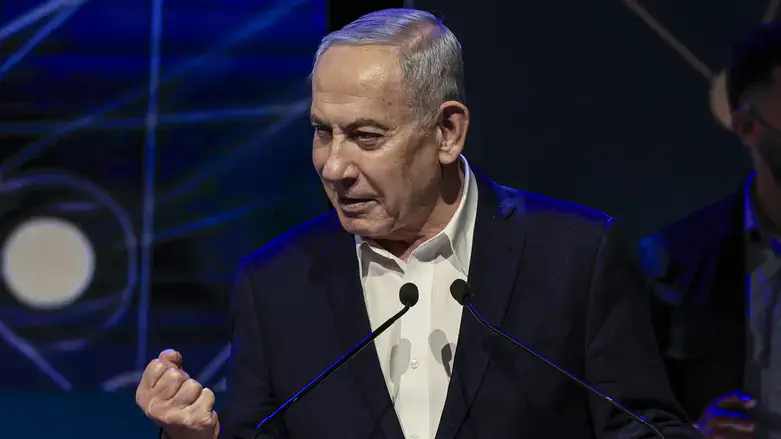
The Likud Central Committee on Monday evening approved all the requests submitted by party chairman, Prime Minister Benjamin Netanyahu, ahead of the upcoming Knesset elections. Following the final vote count, all measures brought before the committee secured the required majority.
Among the approved measures were eight reserved spots requested by Netanyahu within the top 30 spots on the Likud slate: places 3, 5, 9, 11, 15, 18, 26, and 29.
In addition, a clause spearheaded by Likud Central Committee Chairman, Minister Haim Katz, passed by a narrow margin of just six votes. The measure allows ministers, deputy ministers, and sitting MKs to compete for regional district spots on the party slate. The contrast in support for the two proposals was evident throughout the day; Netanyahu's request for reserved spots enjoyed broad backing among activists, whereas Katz’s initiative faced stiffer pushback - most notably from MK David Bitan.
Around 3,400 out of roughly 4,500 Central Committee members cast their ballots in what served as one of the most critical internal political tests ahead of the upcoming election campaign.
For Netanyahu, the composition of the party slate became a central concern heading into the race - so much so that he recently weighed more far-reaching options, including establishing a nominating committee to bypass primaries altogether, an unprecedented departure for him since taking the helm of Likud.
Behind the eight reserved spots lies a tense personal and political contest over who will occupy them. According to reports, one spot has been promised to Haim Katz himself. Some party insiders speculate the position may end up going to MK Eti Atiya, or that she might receive a separate reserved spot.
That possibility is already causing friction within party ranks, though most ministers and MKs have avoided a public clash with Netanyahu and Katz. Bitan, however, chose to mount an open campaign, accusing Katz of trying to "build a faction within a faction."
"This vote is critical to the future of Likud," Bitan warned. "It’s not just about this election cycle; it’s about the ones to come. Will Likud remain a democratic, close-knit movement where everyone gets along?"
Another reserved spot is earmarked for Minister Gideon Sa'ar as part of the merger with his New Hope party. MK Michel Buskila, recently appointed Deputy Foreign Minister, may also receive a reserved spot on Sa'ar's behalf.
Conversely, several senior Likud figures publicly rallied behind Netanyahu, urging committee members to pass his proposals. Minister Shlomo Karhi stated, "I call on you to join me at the ballot box and vote yes on the Prime Minister's proposals. We are facing a critical election for the future of the State of Israel, and we stand united behind the Prime Minister - all the way to victory, God willing."
Defense Minister Israel Katz joined the call, releasing a video asking committee members to "get out, vote, and support Prime Minister Benjamin Netanyahu's proposal."
Alongside the debate over ministers and MKs running in regional districts, Haim Katz’s initiative also restructures the regional map itself. Under the plan, several districts will be consolidated: spot 27 will be assigned to a combined Shephelah, Jerusalem, and Judea and Samaria district; spot 28 to a joint Tel Aviv-Dan district; spot 30 to the Galilee and Valleys; and spot 31 to the Negev. Committee members also formally approved the primary election regulations.
Hovering over the vote was a parallel battle over whether to hold primaries at all. Senior party officials had recently assessed that Netanyahu was trying to buy time, leaving open the possibility of canceling primary elections, citing the security situation.
However, the Likud internal court shut that door down. In its ruling, the tribunal decreed that primaries must take place - and that even if security conditions complicate standard voting procedures, the date could be pushed back or conducted via electronic voting instead.
Thus, at the end of a turbulent day at the polls, Netanyahu secured key levers to shape Likud's next legislative lineup, even as internal party maneuvering remains far from over.