

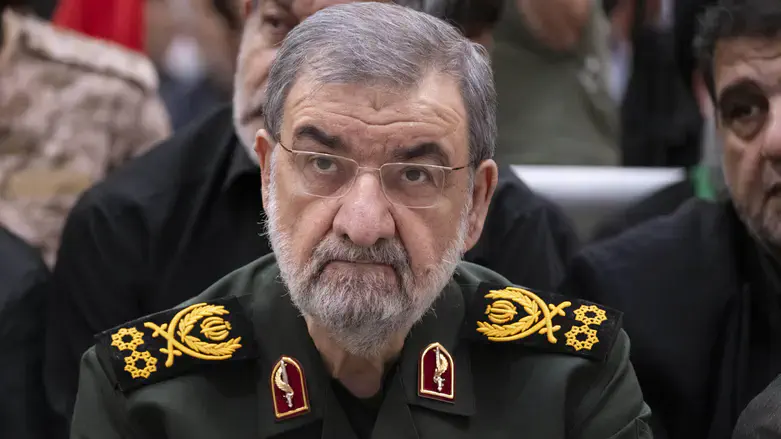
Former Revolutionary Guards commander-in-chief Mohsen Rezaei has been appointed secretary of Iran's top national security agency, the Iranian presidency announced on Sunday, according to an AFP report.
Presidency spokesman Mehdi Tabatabaei disclosed the leadership change via a post on social media.
“In light of the resignation of Mohammad Bagher Zolghadr from his position as secretary of the Supreme National Security Council and his appointment to new functions, President Masoud Pezeshkian has named Mohsen Rezaei as the head of this body," he wrote.
Rezaei, 71, commanded the Islamic Revolutionary Guard Corps (IRGC) between 1981 and 1997, a period spanning nearly the entirety of the Iran-Iraq war. He subsequently held several high-level political roles before serving as a military adviser to Supreme Leader Ayatollah Mojtaba Khamenei.
Rezaei succeeds Zolghadr, another former IRGC commander who had headed the security council since March. An official statement issued by the supreme leader’s office on Sunday confirmed that Zolghadr will transition into a role as political adviser to Khamenei.
Known for his hawkish stance toward Washington, Rezaei issued a sharp warning last month, asserting that continued US strikes would push Iran into an "offensive and destructive" posture and declaring that the approach of "both war and negotiation" is no longer viable.
He further warned that if US military actions persist, Iran’s forces will expand beyond retaliatory operations, leaving US bases and personnel unprotected regardless of political boundaries. He issued similar warnings in late April.
In prior statements, Rezaei voiced strong skepticism regarding diplomatic negotiations, accusing Washington of intending to derail talks between the two nations.
“The US is seeking to pass its warships through the Strait of Hormuz. In practice, the US is acting in a way that undermines agreements," Rezaei charged, adding, “Those within Iran who oppose negotiations must be patient - the US will sabotage the talks themselves; it is clear they will cause the negotiations to fail."
Rezaei has also asserted that maintaining authority over the Strait of Hormuz was “more important than dozens of atomic bombs".