

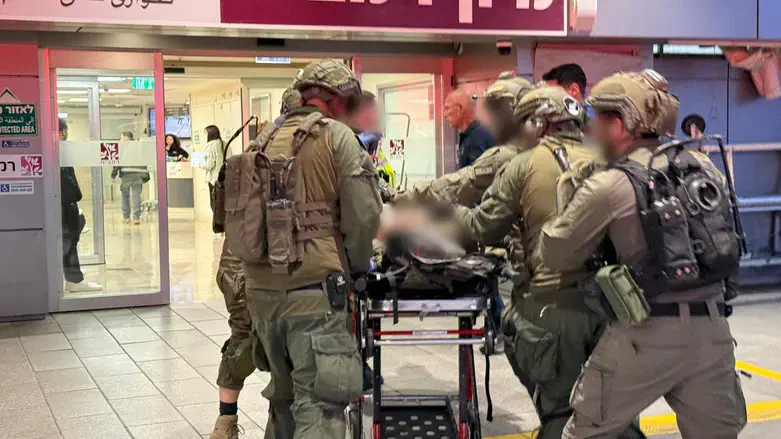
Didi Krieger, owner of the Trigger marketing company, has defended Rambam Health Care Campus following criticism of the hospital over its treatment of an IDF soldier who was critically wounded in southern Lebanon, after the medical center also responded to these allegations.
In a post published on social media, Krieger said he did not seek to challenge the feelings of the soldier's family, but wanted to share his own family's experience at the Haifa hospital.
“There is nothing harder than seeing your son, brother or father wounded, with his life hanging in the balance," Krieger wrote. “I do not know exactly what happened in this particular case, and I do not presume to judge the family's feelings. I am simply praying for the soldier's recovery and embracing his family."
Krieger recalled that about six months ago, his brother was critically wounded during Operation Roaring Lion and was brought to Rambam without a pulse or blood pressure and with both legs amputated.
He said that from the moment his brother arrived, the hospital's senior management mobilized to provide care.
“The hospital director herself came and summoned all the senior officials. Everyone wanted to know what his condition was, what could be done and how they could help," he wrote.
“They cared not only about his medical condition, but also about us-where we would sleep, what we would eat and how we would cope."
Krieger said that during his brother's hospitalization, he repeatedly saw wounded IDF soldiers receiving what he described as special attention from the hospital staff.
“It was clear to all of us that soldiers received special treatment there. Everyone wanted to be there for them," he wrote. “There was a tangible sense that the entire system was mobilizing for the wounded and their families."
He noted that the hospital was operating under particularly difficult conditions at the time, with medical teams working from a fortified underground parking garage while also taking in patients and services from other hospitals.
“The doctors, nurses and other medical staff worked without proper rooms, without privacy and without basic conditions," Krieger wrote. “And amid all of this they just treated patients, ran, saved lives and embraced families."
Krieger acknowledged that his family also experienced moments of waiting, frustration and a lack of information. However, he said, they understood that the difficulties were the result of the enormous burden on the hospital rather than a lack of willingness to help.
“I personally saw that there were more wounded people than medical staff," he wrote. “When a doctor is fighting for the life of a wounded patient in the trauma room, he cannot always leave to update the family. But the desire to do more was there all the time."
At the same time, Krieger stressed that he was not seeking to dismiss the concerns expressed by the family of the recently wounded soldier.
“I am not here to argue with a grieving family or dismiss their feelings. Quite the opposite," he wrote. “I am simply asking to add another perspective to the picture."
“Behind these doors are people who are doing everything they can for their wounded-for our wounded."
Krieger concluded by expressing his gratitude to the Rambam staff.
“I can testify about the people I met there-they did, are doing and will continue to do everything they can to save lives," he wrote.
“During the time when we needed them more than anything, they gave us far more than medical treatment. They gave us the feeling that someone was fighting alongside us. For that, I will be grateful for the rest of my life."