

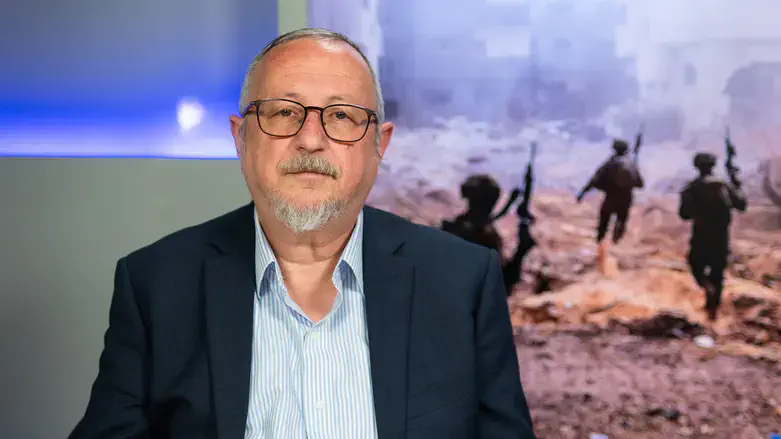
Bereaved father Yehoshua Shani, the father of the late Capt. Uri Shani, published a Facebook post calling for an investigation into the treatment of his nephew, who was seriously wounded during military operations in Lebanon.
"'Let every Hebrew mother know that she has entrusted the fate of her sons to commanders worthy of the task'-is that really so? What happened this Shabbat in the intensive care unit at Rambam demands an immediate investigation," Shani began.
He wrote: "Three days ago, my nephew, IDF soldier Eitan, was seriously wounded in Lebanon and was admitted to Rambam Hospital together with three of his fellow soldiers who were also seriously wounded. Since then, we have been living in constant fear for his life. Eitan was sedated and on a ventilator. Only yesterday afternoon did he regain consciousness, suffering from burns all over his body, pain, fever, and hallucinations. Then night fell. A new shift entered the ward. According to the family, every member of the nursing staff on duty spoke Arabic. At a certain point, all the families were removed from the ward and the doors were locked."
According to Shani, this caused great concern among the families.
"You have to understand the situation: four IDF soldiers seriously wounded in Lebanon, who had just returned from combat, were left alone behind locked doors, without their families, while the entire staff on duty spoke Arabic. I say this clearly: given the current security reality, this is a situation that, from the families' perspective, raises serious questions and creates a sense of insecurity. These feelings cannot simply be dismissed, nor can these questions be swept under the rug. The family members repeatedly asked to be allowed in-not to interfere with the staff's work, not to remain for hours, but simply to enter for a moment and make sure Eitan was all right. Time and again they asked, and time and again they were refused."
Shani said that when one family member eventually forced his way into the ward, he encountered what he described as a deeply troubling scene.
"At one point, David, Eitan's brother, decided he had to see for himself what was happening to his brother. He forced the door open and entered the ward. What he says he saw there is simply unbelievable. Eitan was not all right. According to David, his wounded brother was lying there begging for water, and at that moment no member of the staff was by his side to help him. An IDF soldier seriously wounded in Lebanon. Only hours earlier he had regained consciousness after being sedated and ventilated. He was suffering from burns, pain, fever, and hallucinations, begging for water, with no family member beside him. At that moment, no one approached him."
He continued, "Then Eitan whispered something even more serious to his brother. According to David, Eitan said that when the staff turned him over in bed, they did so brutally, 'like a sardine,' in Eitan's own words, and his head was slammed against the bed. Those are Eitan's own words to his brother. I am not prepared to let this pass."
Shani said that when David cried out over what he had seen, "instead of someone stopping to ask the simple question, 'What happened here, and why is a wounded soldier begging for help?' a security officer was called to deal with David, who had entered the ward to check on his brother. We also tried to involve Unit 2 (the IDF's hospitalized soldiers' liaison unit), but there was no representative available for the family."
Shani questioned why, in his view, more attention is paid to hospitalized terrorists than to wounded soldiers.
"There is something else that particularly outrages me. When a terrorist or security detainee is hospitalized, the State of Israel ensures that guards are posted over him, among other things to make sure no harm comes to him during his hospitalization. Yet here, four IDF soldiers seriously wounded in combat in Lebanon are lying in the hospital, while their families are forced outside the ward. They remain behind locked doors, without an IDF representative there for them, while, according to the family's testimony, the entire staff on duty speaks Arabic. We know how to post guards for a terrorist. Who is guarding our soldiers?"
He emphasized: "I am not claiming that every Arabic-speaking staff member poses a danger. Certainly not. But in the reality of war, when wounded and helpless soldiers are hospitalized after battle, the IDF's responsibility toward them does not end when the helicopter reaches the hospital. The IDF must ensure that they are protected, properly cared for, and that there is a military representative available to the family."
He asked: "Who is responsible for this failure? Who is responsible for the fact that the families of four critically wounded soldiers found themselves outside locked doors? Who was supposed to make sure the soldiers received assistance at every moment? Who checked what was happening behind those doors? And who on behalf of the IDF was supposed to be there for the soldiers and their families?"
Shani called on Rambam Medical Center and the IDF to launch an immediate, thorough investigation into the incident.
"I demand that all security camera footage from the ward and the hallways during the relevant hours be preserved immediately. I demand that it be determined exactly who was on duty, why all the families were removed and the doors locked, what response Eitan received when he asked for water, how he was treated and turned in his bed, where the staff members were during those minutes, and who was responsible for the shift."
He also demanded an answer to what he described as a difficult but necessary question: "Was the fact that the entire staff on duty spoke Arabic completely irrelevant to the incident, or is there something else here that requires investigation? I am not determining the answer in advance."
"I demand that the question be examined. Not every Arab staff member is responsible for what happened, and I am not casting suspicion on an entire community. But neither should the families of wounded soldiers be expected to ignore the situation and the fears it raised. These four young men were not injured on a recreational trip. They were wounded as IDF soldiers in Lebanon while defending the State of Israel. When they are lying wounded, in pain, and helpless in an Israeli hospital, the State of Israel owes them one basic thing: protection. I expect an investigation and answers-not in a month, not after the security footage has been erased, but now," Shani concluded.
Rambam Medical Center had not yet issued a response.