

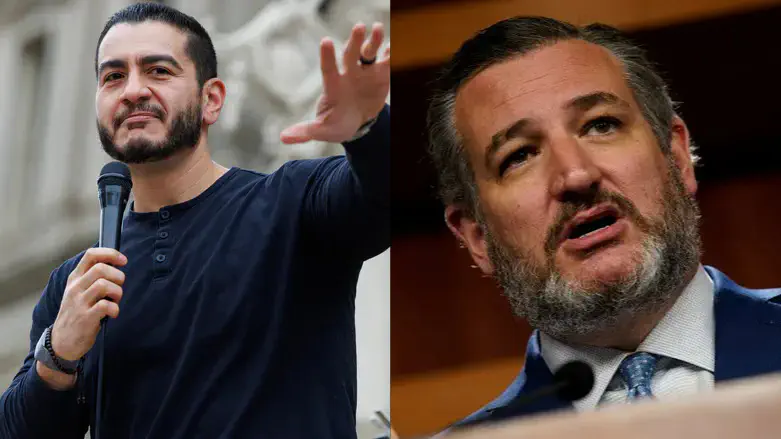
During a Wednesday hearing of a Senate Judiciary Committee subcommittee, Senator Ted Cruz (R-TX) accused Dr. Abdul El-Sayed, the newly crowned Democratic nominee for US Senate in Michigan, of maintaining connections to the Muslim Brotherhood, according to a report from JNS.
“Just yesterday, Abdul El-Sayed, the son-in-law of a leading member of several Brotherhood groups, won Michigan’s Democratic primary for US Senate," stated Cruz, adding, “Behind El-Sayed’s political rise sits a much older and more entrenched institutional network."
Kyle Shideler, a security analyst with the Center for Security Policy who testified as a witness, outlined alleged ties involving El-Sayed’s father-in-law, Dr. Tayeb Jukaku, to organizations Shideler described as affiliated with the Brotherhood, such as the Council on American-Islamic Relations (CAIR).
“This includes being the president at one time of CAIR Michigan," Shideler noted regarding Jukaku.
“Also his presence on the Islamic Society of North America’s founders committee, which is only for those most exclusively devoted to ISNA to provide significant amounts of funding."
Shideler further claimed, “There are other known Brotherhood members on that committee."
Jukaku operates as a nephrologist in Detroit and serves on CAIR Michigan's board of directors. A biography posted on the ISNA founders committee website explains that he became involved because the organization supported his “whole family in the formative years of our lives as Muslims" following his immigration to the United States from India.
In 2007, federal prosecutors designated CAIR as an unindicted co-conspirator during the Holy Land Foundation trial, where defendants faced convictions for financing Hamas and related terror offenses. CAIR, which describes itself as “America’s largest Muslim civil liberties organization", has never been formally indicted on criminal charges.
Originally formed in Egypt in 1928 as a pan-Islamic revival movement, the Muslim Brotherhood spawned branches across the Middle East, including Hamas.
In January, the United States designated the Egyptian, Jordanian and Lebanese branches of the Muslim Brotherhood as specially designated global terrorists, citing their support for the Hamas terrorist organization.
Around the same time, the State Department categorized the Lebanese chapter as a foreign terrorist organization while sanctioning its secretary-general, Muhammad Fawzi Taqqosh, alongside Treasury’s terrorist designations of the Egyptian and Jordanian arms.
Cruz presided over Wednesday’s session, titled “Hidden in Plain Sight: Confronting the Muslim Brotherhood Network in America," in his capacity as chairman of the Senate Judiciary Subcommittee on Federal Courts, Oversight, Agency Action and Federal Rights. Subcommittee Democrats boycotted the proceeding, arguing that the event served to unfairly target American Muslims.
El-Sayed’s ties to progressive factions and Islamic organizations are expected to remain a prominent focal point in the general election for a pivotal seat that could determine Senate control. The nomination followed a contentious Democratic primary where his opponent, Representative Haley Stevens (D-MI), accused El-Sayed of seeking to “blame all of your problems on Jewish Americans."
The primary outcome dealt a major blow to pro-Israel Democrats and the American Israel Public Affairs Committee (AIPAC), which poured substantial funds into the Michigan primary, making it one of the most high-profile intraparty clashes over Middle East policy in recent years.
Throughout his campaign, El-Sayed made opposition to American military assistance for Israel and criticism of its actions in Gaza central pillars of his platform, accusing Israel of committing genocide, calling for an end to unconditional military aid, and stating in an interview that the Israeli government operates "as evil as Hamas."
Also on Wednesday, President Donald Trump launched a direct verbal assault against El-Sayed.
“When I watch Abdul, he’s full of s--t," Trump stated during an appearance in Nevada, labeling El-Sayed a “man of hate" and alleging he harbors animosity toward Jewish people.
“He's a communist. And the polls were wrong again last night when they thought it would be a landslide victory for a hater of Jews and a hater of Israel," the President said.
Trump elaborated on his remarks: “This guy hates Jews. Somebody said, ‘Oh, that's a little strong’. No, he hates Jews and he hates Israel…He's a man of hate. And now he's going around saying, ‘No, I love everybody.’ He doesn't love everybody. Put him in office. You're going to find out what he loves."
Trump added that the primary winner “doesn't love Israel. He doesn't love Jewish people. He hates them. He hates them with a passion that burns in his heart."
Looking ahead to the November midterm election, Trump predicted that Republican nominee Mike Rogers, whom he called a "great candidate", would win the Senate seat.
“Actually, we do better against the communists, according to every poll. The poll says we do better against the communists. So he won. And so I think I'm happy. I put out a statement: Congratulations to the Republican Party."