

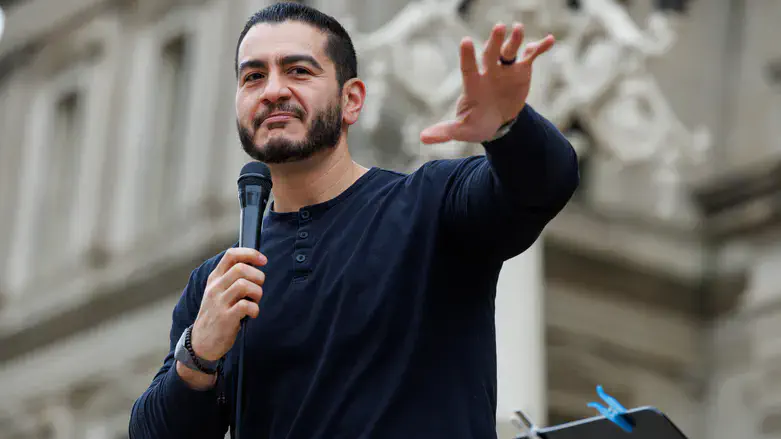
Abdul El-Sayed has won the Democratic primary for Michigan’s open US Senate seat, defeating establishment-backed Rep. Haley Stevens in a closely watched contest that became a major test of the Democratic Party’s growing divide over Israel.
El-Sayed, a former public health official backed by Sen. Bernie Sanders and Rep. Alexandria Ocasio-Cortez, prevailed in the state, which has a large Arab and Muslim American population, despite an enormous spending advantage for Stevens and her allies. More than $30 million was spent by a group affiliated with the American Israel Public Affairs Committee (AIPAC) to support Stevens and oppose El-Sayed.
The victory represents a significant setback for the party’s pro-Israel faction and for AIPAC, whose involvement in the race made the Michigan primary one of the most prominent Democratic contests over Israel in recent years.
El-Sayed made opposition to US military aid to Israel and criticism of Israel’s conduct in Gaza central elements of his campaign. He accused Israel of genocide in Gaza and advocated ending unconditional military aid to the Jewish state.
The Michigan race was particularly significant because of the state’s large Arab and Muslim American population and its role in the 2024 Democratic presidential primary’s “uncommitted" movement, which protested the Biden administration’s handling of the Gaza war.
El-Sayed also repeatedly attacked Stevens over her support for aid to Israel and the financial backing she received from AIPAC and other outside groups. Stevens and her allies ultimately spent nearly nine times as much on advertising as El-Sayed and his allied groups, according to AdImpact.
The contest drew prominent progressive figures to El-Sayed’s side, with Sanders and Ocasio-Cortez campaigning for him. His supporters portrayed the result as evidence that candidates critical of Israel and opposed to the influence of pro-Israel donors can win Democratic primaries even in a politically competitive state.
El-Sayed’s positions on Israel drew strong criticism from some Jewish leaders and Democrats. He faced scrutiny over his questioning of whether Israel should exist as a Jewish state, his characterization of the Israeli government as “evil" like Hamas, and his campaign appearances alongside social media personality Hasan Piker.
He also faced criticism for his response to the March 12 terrorist attack at Temple Israel in West Bloomfield. While condemning the attack, El-Sayed linked the assailant’s actions to Israeli airstrikes in Lebanon and the deaths of members of the attacker’s family.
El-Sayed rejected accusations of antisemitism, saying his critics conflated the Israeli government with the Jewish people and declaring his respect for Judaism and the Jewish people.
The primary victory now puts El-Sayed on course to face Republican Mike Rogers in November. The contest is expected to be among the country’s most competitive Senate races and could play a role in determining control of the Senate.