

The Bar-Lev Line did not collapse at the start of the Yom Kippur War because its sand embankments were not high enough, and the Security Zone in southern Lebanon did not come to an end because its outposts were insufficiently fortified. In both cases, argue Col. (res.) Prof. Gabi Siboni and Brig. Gen. (res.) Erez Wiener, the failure ran much deeper: Israel fell in love with a static defensive line while the enemy continued to learn, adapt, and seize the initiative.
In a new article, the two military experts focus on the "Yellow Line" established after the war in the Gaza Strip and along the Lebanese border, warning that if it becomes the cornerstone of Israel's security doctrine, it could lead the IDF into the very same mistakes that have cost Israel dearly in the past.
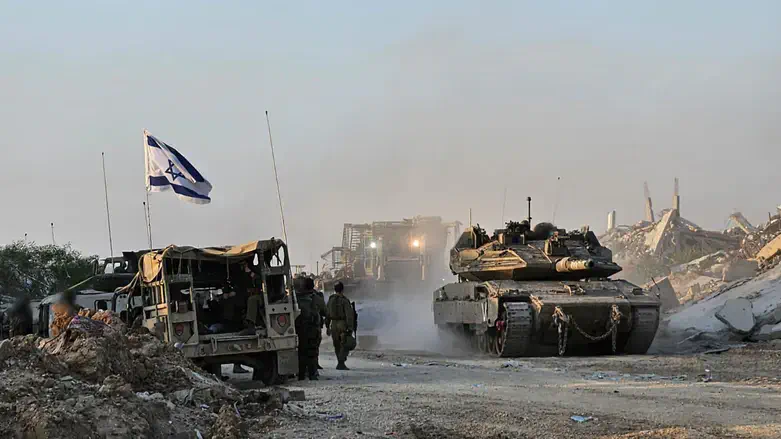
Since the ceasefire agreements, the Yellow Line has evolved from a series of concrete barriers marking the border into an extensive security system that includes trenches, earth berms, military outposts, and additional infrastructure. Its purpose is clear: to keep Hamas and Hezbollah away from Israeli communities and allow border residents to return to safer lives.
But according to the authors, this is precisely where the danger lies. They argue that while a physical barrier is an important tool, once it becomes the defense strategy itself, it begins to create an illusion of security. The enemy, meanwhile, does not stand still. It studies response times, identifies weak points, recognizes recurring patterns, and waits for the right opportunity.
They note that Israeli military history provides countless examples. On the eve of the Yom Kippur War, the Bar-Lev Line was regarded as impenetrable. In reality, it collapsed almost entirely within hours. Years later, the Security Zone in southern Lebanon developed into a vast network of outposts, supply routes, and defensive positions, until much of the IDF's effort was devoted to protecting itself rather than striking the enemy. The result, they argue, was that Hezbollah dictated the pace of the conflict while Israel was gradually worn down.
Likewise, the border fence surrounding the Gaza Strip-considered before October 7 to be one of the world's most advanced security barriers-failed to prevent Hamas' attack. The failure, the two emphasize, was not the technology itself, but the belief that the barrier could replace intelligence, initiative, and maneuver warfare.
Siboni and Wiener do not oppose the construction of the Yellow Line itself. On the contrary, they believe there is sound logic in creating a security zone that distances the enemy from Israeli communities. However, they insist that the line must not become a permanent defensive position that also locks Israeli strategic thinking into place.
Instead, they advocate a different security doctrine-a mobile defense zone. Under this concept, IDF forces would not be limited to passively manning outposts, but would move continuously, vary their operational patterns, conduct proactive raids, gather real-time intelligence, and prevent the enemy from learning their routines.
According to the authors, security is not measured by the number of concrete layers or the depth of a trench, but by whether the enemy knows what the IDF will do tomorrow morning. Once routines become predictable, the advantage shifts to the other side.
They also point to an example from Judea and Samaria. In their view, residents of agricultural outposts provide a model of continuous presence in the field. They know every path, every terrace, and every change in the terrain, making it more difficult for hostile elements to operate without being detected. The authors are not suggesting that this model be copied directly to Lebanon or Gaza, but believe that the underlying principle-maintaining control through presence and movement rather than through static fortification-should also guide the IDF's security doctrine.
The article also distinguishes between the two fronts. Although both are referred to as the "Yellow Line," the challenges are fundamentally different. In Gaza, the IDF faces an enemy operating in a densely populated urban environment filled with tunnels and underground infrastructure. In southern Lebanon, the challenge is entirely different: mountainous terrain, dense villages, commanding high ground, and Hezbollah's sophisticated concealment capabilities. As a result, they argue, the same operational doctrine cannot simply be applied to both theaters.
One of the article's strongest warnings concerns long-term attrition. The longer the military remains in these security zones, the greater the pressures will become-both domestically due to casualties and internationally because of growing criticism. If the Yellow Line becomes permanent, it could recreate the same dynamic that led Israel into years of attritional warfare in southern Lebanon.
The authors therefore move on to practical recommendations. First, they call for redefining the security zones by distinguishing between a forward security area, where offensive and flexible operations would be conducted, and a rear holding area, where permanent forces would be stationed to protect Israeli communities. At the same time, they stress that Israel must not rely solely on physical barriers, but should integrate intelligence, drones, unmanned systems, engineering capabilities, precision firepower, and mobile reserve forces.
They also recommend continuously changing operational patterns-including patrol routes, operating hours, observation points, and intelligence-gathering methods-to prevent the enemy from building an accurate picture of the IDF's routine.
Their most controversial recommendation concerns the future of the security zones. According to the authors, these areas should not be viewed merely as temporary military zones but, over the long term, could also include a civilian presence and Israeli communities alongside the military mission. They acknowledge that significant diplomatic obstacles currently exist but note that U.S. recognition of Israeli sovereignty over the Golan Heights also once appeared impossible before becoming reality decades later.
Ultimately, Siboni and Wiener's central message is straightforward but pointed: Israel cannot afford to fall in love with a single defensive line again. Whether it is the Yellow Line, a fence, an outpost, or any other obstacle, these are important tools-but they can never replace strategic thinking, initiative, and maneuver.
According to the authors, if the Yellow Line serves as the starting point from which military operations are launched, it could strengthen Israel's security. But if it becomes the endpoint of Israel's security thinking, it risks becoming another chapter in the chain of failures that has already exacted a heavy price from the country.