

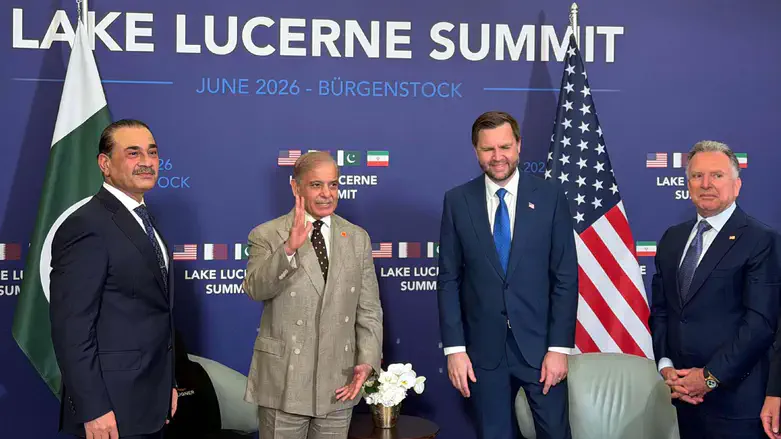
Despite the current political stalemate, Pakistan is pursuing behind-the-scenes diplomatic channels to help de-escalate mounting friction between Washington and Tehran, according to a high-ranking Pakistani official with direct knowledge of the multi-party exchanges.
Speaking via telephone to The Guardian on Monday, the official stressed that Islamabad's standing proposal to help bridge communications between both powers remains fully active.
“We are actively involved in efforts to resolve US-Iran tensions," the official stated to The Guardian.
“Our offer to facilitate contacts has not changed. The understanding reached earlier remains intact, and we continue to engage both sides," the official added.
As part of these mediation efforts, Pakistan’s military commander, Field Marshal Asim Munir, has maintained direct contact with top American leadership, including US Vice President JD Vance and Special Envoy Steve Witkoff, to head off further regional escalation.
“Field Marshal Asim Munir has been in contact with JD Vance and Steve Witkoff," the official confirmed, adding, “These have been substantive discussions focused on regional stability and de-escalation."
Simultaneously, Islamabad has preserved open communication links with leadership in Tehran. The official noted that Munir held extensive, hours-long discussions with Iranian Foreign Minister Abbas Araghchi.
“Pakistan has channels open with both Washington and Tehran and believes dialogue remains the only viable path to avoid a wider regional conflict," the official said.
While withholding specific details regarding the substance of the talks, the source emphasized that Pakistan occupies a unique position as one of the few nations holding the trust of both foreign capitals. This standing allows Islamabad to quietly promote diplomatic dialogue during a period of heightened geopolitical strain.
The comments came as US President Donald Trump said on Monday he is prepared to authorize a large-scale military strike against Iran but stressed that he would rather avoid such an operation if Tehran agrees to a deal preventing it from obtaining nuclear weapons.
"I think we're going to maybe get something, but I want to give them every last chance before decapitation," Trump stated. "Very tough to do what we have planned, still planned. We'll see what happens, but it's a very, very tough thing to do."
The president emphasized that despite military preparations, his preference remains diplomacy.
"I think I'm very proud of the fact that I will give people a chance," Trump said. "This is a big move to do an attack that big on a country. I'd rather not do it."
Earlier in the day, Trump accused Iran's leadership of being "unbelievably duplicitous" after Tehran denied that it is holding negotiations with the United States.
In a post on Truth Social, Trump wrote that Iranian officials had sought a meeting and that discussions had already begun, with additional talks scheduled.
"Iranian leadership is unbelievably duplicitous! They ask for a meeting, some would say 'beg,' talks begin, with more scheduled in the immediate future, and they say, openly and proudly, that they're not having any discussions, that nothing is being talked about, and they're only dealing with 'Oman,'" Trump wrote.
Trump announced in a post on Truth Social on Saturday night that he had agreed to cancel a planned attack on Iran, but added that the Islamic Republic must agree to a deal swiftly.
On Sunday, the President told reporters that talks between Iran and the United States would resume on Monday.
“I was asked to [call off the strikes] by Saudi Arabia, the UAE, by Qatar, and by Iran. We are all set to go, at about this time right now. It would have been a massive attack," Trump said.
“When the allies asked to call it off, you gotta say, ‘Well, let's see.’ The allies think there is a deal. There is a deal on Hormuz, and it will be a deal on the denuclearization of Iran."
Asked what will happen next, the President replied, “We are talking to them. It begins tomorrow afternoon. It would save a lot of lives."
He was asked whether there is a deadline for Iran to come to an agreement and said, “We will see. Would I rather make a deal? I am not looking to kill people. Because people die. A lot of people die. We don’t want that."