

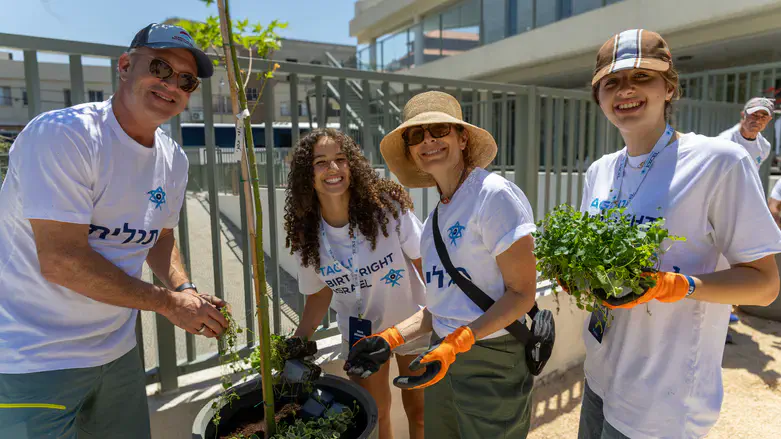
Exactly two years after the Hezbollah terror attack that killed 12 children, the Druze community of Majdal Shams will receive eight therapeutic gardens.
The initiative, announced Monday, kicks off a major community healing project in Majdal Shams, Israel's northernmost village, home to a Druze community that was once under Syrian control. It is made possible by a donation from the The David and Meredith Kaplan Foundation, through the Birthright Israel Foundation; the Birthright Israel Volunteer Program, a joint initiative with the Jewish Federations of North America (JFNA), will bring approximately 1,000 volunteers to Majdal Shams in the coming months to take part in the effort.
The project will establish eight therapeutic educational gardens across four local educational institutions, creating spaces of healing, growth, and hope for the Druze community.
The project carries deep significance for Majdal Shams. On July 27, 2024, twelve children from the village were killed when a Hezbollah rocket struck a local soccer field - a tragedy that devastated the close-knit community and left a lasting mark on its schools and families. In the two years since, residents have turned to gardening and connection with nature as vital tools for rehabilitation and collective healing.
Since the beginning of July 2026, Birthright Israel volunteers have been on the ground in Majdal Shams building the first of these therapeutic gardens. On Friday, July 17, a mission trip group was welcomed at Elementary School B by Dolan Abu Saleh, Head of the Majdal Shams Municipality, who spoke about the impact the volunteers are making on the community. Audible booms across the border in Syria during his remarks underscored the complexity of daily life in the village's easternmost neighborhood.
Following the mayor, Jihan Safdi, Principal of Elementary School B, addressed the group about the aftermath of the 2024 attack, in which she personally lost six of her students. She spoke about how gardening and nature-based programming have become central to the community's healing process over the past two years.
After the welcome remarks, mission participants joined 25 Birthright Israel Excel volunteers to plant greenery, arrange gravel, build planters, and lay paving stones at the Resilience Center, which borders the soccer field where the 2024 attack took place.
Speaking to the group, Abu Saleh reflected on the deeper significance of the moment, describing what he called a "dual realization" that took hold among the Druze of the Golan following the October 7, 2023 attacks: a recognition that their security is inextricably tied to the State of Israel, and a definitive break from fundamentalist Islam, which the community now views as a force with which it shares no connection.
"The turning point for the Golan Druze began on October 8, 2023," Abu Saleh said. "On October 8, we accepted the Jews and Israelis as our home. Now, the Jews finally accepted us. We arrived first; you met us there."
"The demand from diaspora Jews to serve in Israel keeps growing. Every volunteer we send strengthens the bond between world Jewry and Israel. Majdal Shams shows what that looks like on the ground, and we are grateful to the The David and Meredith Kaplan Foundation for making this project possible. We want to bring tens of thousands more volunteers over the next few years," said Elias Saratovsky, President and CEO of Birthright Israel Foundation.
The Druze community of the Golan Heights occupies a uniquely sensitive position in the region. Numbering roughly 25,000 people concentrated in four villages - Majdal Shams, Buq'ata, Mas'ade, and Ein Qiniyye - the Golan Druze trace their presence in the area back centuries, predating both the modern State of Israel and the modern Syrian state. Following Israel's capture of the Golan Heights in the 1967 Six-Day War and its formal annexation in 1981, most Golan Druze retained strong family, cultural, and historical ties to Syria, and for decades many declined to accept Israeli citizenship, identifying instead as Syrian nationals living under Israeli control. The October 7, 2023 events have reshaped calculations of safety, belonging, and loyalty on both sides of the border.