

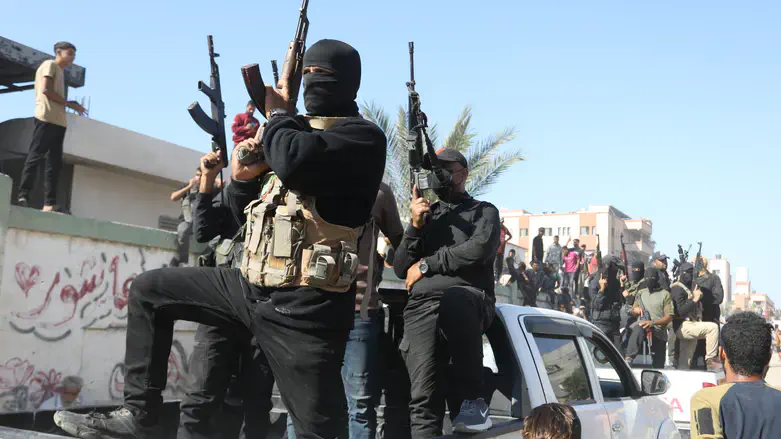
Nearly three years after the October 7 massacre, a long-term ceasefire in the Gaza Strip appears to be taking shape amid growing momentum toward an agreement with Hamas. Israel's Channel 13 News revealed Thursday evening that Hamas has asked U.S. President Donald Trump for a 10- to 15-year "hudna" (long-term truce) in Gaza.
According to the report, Hamas leaders drafted a letter in English that was sent to the White House. In it, they tell President Trump that they are prepared to honor an agreement and disarm, but request a long-term ceasefire under which Israel would refrain from attacking Gaza, cease targeted killings of senior Hamas officials, and begin a gradual withdrawal of its forces from the Strip.
Israeli officials have rejected the proposal, describing it as a Hamas "spin." They argue that its terms do not correspond to the Trump framework agreed upon in October of last year.
Israeli sources said the proposed agreement "has no chance" of being accepted, describing it as a "desperate attempt" by Hamas to buy time. They added that Hamas is primarily trying to avoid being declared in violation of Trump's agreement, since such a breach would allow Israel to resume military operations in Gaza.
Earlier Thursday, Channel 13 disclosed additional details of the proposed agreement. Under its terms, Hamas would commit to surrendering its weapons gradually over several years but would not commit to handing over its heavy weaponry.
In addition, Arab states would pay millions of dollars in "retirement compensation" to Hamas officials who would be replaced by a technocratic committee.
For its part, Israel would commit to a long-term ceasefire, including an end to targeted killings in the Gaza Strip. The IDF would not withdraw from the "Yellow Line" security zone but would gradually evacuate certain areas.
American, regional, and Palestinian sources told Channel 13 that such an agreement amounts to a "fiction," arguing that Hamas is unlikely to surrender all of its weapons to a third party it does not trust. The proposal also contains no commitment to disclose or dismantle Hamas's tunnel network.
A senior Israeli official said, "The issue of Gaza did not come up at all during the meeting between Prime Minister Netanyahu and President Trump. Israel demands the complete disarmament of Hamas, including the removal of all weapons from Gaza and the full demilitarization of the Strip as a precondition for any process."
"The 15-point document in question does not adequately address these demands, and Israel has conveyed its reservations on the matter to envoy Tony Blair. There will be no Israeli withdrawal from the Yellow Line in the Gaza Strip before Hamas is fully disarmed and the Strip is completely demilitarized."
As previously reported, two regional sources confirmed to Channel 13 earlier Thursday that advanced talks are underway regarding a Hamas declaration that it will disarm and relinquish control of the Gaza Strip to an International Stabilization Force.
According to the sources, discussions are also taking place regarding a signing ceremony in Egypt that could be held within the coming days.
The negotiations are being conducted in Cairo, where a senior Hamas delegation is currently located, under the sponsorship of Egyptian intelligence and with mediation by Qatar and Turkey.
One source said disagreements remain over what were described as "minor" issues and that the administration of U.S. President Donald Trump is pressing for an announcement to move forward. According to the source, Hamas would agree to transfer its weapons to a third party that is not the Palestinian Authority. An announcement could come within days.
The recent progress has reportedly resulted from heavy pressure exerted by Egypt and Qatar, primarily in an effort to satisfy the White House. A signing ceremony is expected to take place either today or tomorrow, depending on whether outstanding issues-including Israel's ability to resume military operations in Gaza and the authority of the stabilization force-can be resolved.
National Security Minister Itamar Ben Gvir sharply criticized the emerging agreement.
"With Nazis, you speak only through the sights of a rifle-and in no other way," Ben Gvir said. "You do not commit to ending the targeted killings of terrorists or sign agreements with the devil, who has made our destruction his banner-not through a third party, not through mediators, and not through any other entity. Period."
"After the October 7 massacre, the Prime Minister must make clear even to our closest friends that the only solution in Gaza that Israel is willing to support is encouraging emigration and destroying Hamas-no other solution."
Yisrael Beytenu chairman Avigdor Liberman also criticized the proposal.
"Any agreement with Hamas is a return to the same conception that led the State of Israel to the October 7 massacre. Instead of agreements with Hamas, Hamas must be destroyed," he said.
On Sunday, the Security Cabinet approved the entry into the Gaza Strip of the International Stabilization Force established at President Trump's initiative. The decision passed unanimously, with only Minister Ben Gvir voting against it.
A senior Israeli official added, "The initial approval for the International Stabilization Force was established in Trump's 20-point plan, which led to the release of all the hostages. Israel insists that the IDF will continue to hold the Yellow Line, and there will be no withdrawal whatsoever until Hamas has been completely disarmed and the Gaza Strip fully demilitarized."
"At this stage, the force consists of approximately 200 personnel from friendly countries such as Uganda and Morocco," the official said.
The official further stated, "Today, the Security Cabinet approved granting immunity under the Law on Immunities for International Organizations to the ISF, which will operate in full coordination with the IDF in areas beyond the Yellow Line that are not under IDF control."
"In practice, the entry of any ISF personnel will require the specific approval of the Prime Minister, the Defense Minister, and the Foreign Minister. The Cabinet also determined that Israel will decide which countries may contribute forces. Only countries with which Israel has peace agreements and that do not act against the State of Israel or its officials in the international arena will be permitted to participate."