

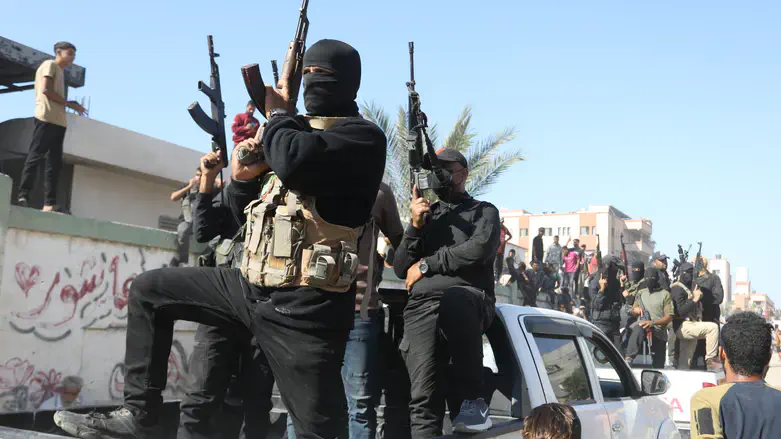
The negotiations in Egypt, being mediated by Egypt, the United States, and other international actors, are further along than they have been in the past, according to sources with knowledge of the details. At the focus of the discussions are the disarmament of Hamas, the mechanism to administer the Gaza Strip, and security arrangements that will go into effect after the fighting ends.
The Board of Peace stated that the discussions are proceeding, and the road map being discussed includes total disarmament of all weapons, both light and heavy, as well as the dismantlement of tunnels, arms caches, and manufacturing facilities. It further stated that at the conclusion of the process, Hamas will have no part in ruling the enclave, not overtly and not behind the scenes, and that the civil administration will be transferred to a committee that will operate based on the principle of "one authority, one law, and one weapon."
A source associated with Hamas portrayed a slightly different reality. According to him, understandings were reached regarding an 'agreed upon draft' for dealing with the weapons, which includes them being handed over and stored under a mechanism that both sides would accept. He also claimed that there is progress on the issue of the staff of the civil frameworks in Gaza, but assessed that the main roadblock is the Israeli government's demand that Hamas be fully disarmed.
On the other hand, sources with knowledge of the negotiation's details reject this interpretation, claiming that the current framework leaves no room for compromise. According to the sources, if the deal is signed, it will demand the full disarmament of all of Hamas's military capabilities, including light weapons, heavy weapons, tunnels, and manufacturing infrastructure, while creating strict supervision and verification mechanisms. "The direction is positive," one of the sources stated, "But there are no tricks or compromises."
An American official privy to the negotiations also claimed that Hamas is trying to portray the understandings differently so that they do not seem like a surrender. According to him, the wording that is being discussed is clear and does not open to interpretation, with the demand for Hamas's complete disarmament remaining unchanged.
At the same time, Palestinian Arab sources reported that a joint statement on progress in the talks could be released as early as Thursday. According to the reports, the announcement is expected to include a roadmap comprising around 15 points, including provisions on regulating the issue of weapons, establishing a Palestinian committee to administer the Gaza Strip, and the continued operation of civilian institutions.
Alongside the issue of disarmament, one of the main unresolved disputes remains the question of Israel’s presence in the Gaza Strip. Hamas is demanding that any arrangement include a full Israeli withdrawal, an end to targeted killings, and the full implementation of previous commitments. Israel, on the other hand, maintains that any withdrawal will be conditional on an effective security mechanism to prevent Hamas from rebuilding its military capabilities.
According to current assessments, the coming days will be decisive in efforts to reach an agreement, as American and other international mediators continue working to narrow the gaps between the sides and formulate a framework that would end the fighting and shape the new reality in the Gaza Strip.
A senior Israeli diplomatic official stressed that the issue of Gaza did not come up at all during the meeting between Prime Minister Benjamin Netanyahu and President Donald Trump.
According to the official, “Israel is demanding the complete disarmament of Hamas, including the removal of all weapons from the Gaza Strip and the territory's full demilitarization, as a precondition for any process. The reported 15-point document does not provide an adequate response to these demands, and Israel has conveyed its reservations on the matter to envoy Tony Blair."
He added: “There will be no Israeli withdrawal from the Yellow Line in the Gaza Strip before Hamas is disarmed and the Strip is fully demilitarized."
National Security Minister Itamar Ben Gvir criticized any possibility of negotiations with Hamas, saying that “the only way to speak to Nazis is through gun sights-and no other way." According to Ben Gvir, Israel should not commit to halting the targeting of terrorists or sign any agreements, “not even through a third party or via mediators."
Ben Gvir added that, following the October 7 massacre, the prime minister should make clear that “the only solution in Gaza that Israel is prepared to support is encouraging emigration and the destruction of Hamas, no other solution."