
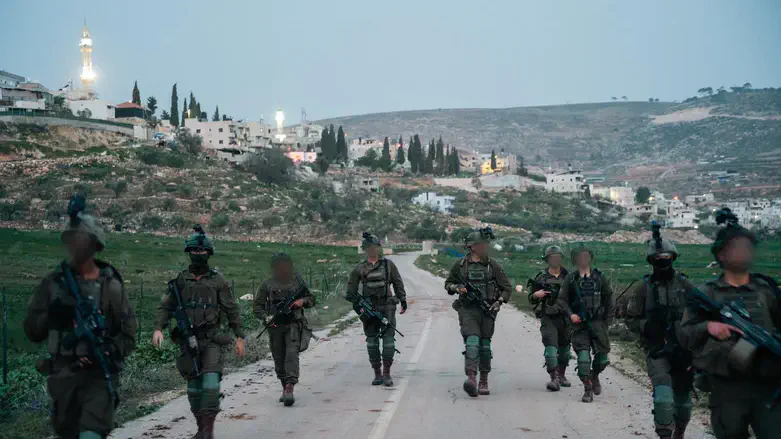
As Israel’s security establishment works to curb the growing wave of terror attacks in Judea and Samaria, Brig. Gen. (res.) Erez Winner, chairman of the Israel Defense and Security Forum (“HaBitachonistim"), argues that the challenge is not merely operational - but stems from a broader strategic and conceptual failure.
According to Winner, terrorism in the region did not suddenly erupt in recent days, but is rather the result of a prolonged process that has been unfolding for months, while Israel has been responding too slowly and failing to address the underlying causes.
“Everyone is talking about a new wave of terror," Winner told Arutz Sheva-Israel National News. “But I believe that this is not a new wave. For many months, there have been attempts to set farms on fire, poison livestock, and attack shepherds. The recent incidents simply received greater public attention, but this reality has existed for a long time."
Winner said that the October 7 massacre brought about a dramatic shift in the IDF’s operations in Judea and Samaria. “There was shock, and the IDF responded with force, primarily through reserve forces. We did not ignore any incident - not even a single stone-throwing attack. This determined policy significantly reduced the level of violence and friction."
However, he argued that the improvement in security conditions eventually led to complacency. “Once the situation calmed down, we eased off the pressure. At the same time, the Palestinian Authority’s incitement campaign continued unabated - through the education system, the media, and public discourse."
Winner also believes that the debate surrounding the expansion of Israeli communities in Judea and Samaria has contributed to the escalation. “The stronger the communities became, the more intense the Palestinian incitement against them became as well. At the same time, there is a broad campaign focused on ‘settler violence,’ promoted by Israeli organizations together with international NGOs and various UN bodies. All of these factors create an environment that fuels further violence."
He called for a return to a more proactive security policy. “We must restore the firm approach that characterized the period following October 7 - not only through raids and arrests, but also through civilian measures. Ultimately, we are judged by the response we elicit from the other side."
According to Winner, the Palestinians view control of the land as a central objective, and Israel must respond accordingly. “If Abu Mazen has already declared that the Oslo Accords are dead, there is no reason that only Israel should continue operating as though those agreements still exist. We must understand that the Palestinian Authority is not a partner, but a hostile actor."
Winner accused the Palestinian Authority of continuing to incite and support terrorism. “This is an armed authority that incites terrorism, supports terrorism, and funds terrorism. And yet there are still those who continue to advocate strengthening it - and even returning it to power in Gaza. It is time to call things by their proper name."
He added that dozens of Palestinian Authority security personnel have been involved in terrorist activity over the past two years, and argued that Israel must stop viewing the PA as a security asset.
Winner said the central lesson of October 7 is the danger of ignoring warnings. “Before October 7, there were people who warned about Hamas, but many dismissed them as extremists or alarmists. In hindsight, they were proven right. We must not repeat the same mistake with the Palestinian Authority."
Addressing claims that a shortage of manpower is the main obstacle, Winner rejected that argument. “The issue is not the number of forces, but the way they are used. We are spreading too few soldiers across too large an area. When forces operate offensively, with focus and initiative, they can achieve far more even with fewer personnel."
He proposed concentrating efforts in specific areas, strengthening Israel’s presence on the ground, and deploying forces in a more targeted manner in cooperation with local communities. “We do not need to do everything at once. We can begin in one area, or launch an operation to collect illegal weapons in a single city. The important thing is to make a decision and begin acting."
Winner concluded with a stark warning: “The real threat facing the State of Israel is not only Gaza, Lebanon, or Iran. It is also the hundreds of thousands of weapons smuggled into the region, the criminal organizations, and the Palestinian Authority. If we fail to address this in time, October 7 may prove to have been only a preview of what is still to come."