

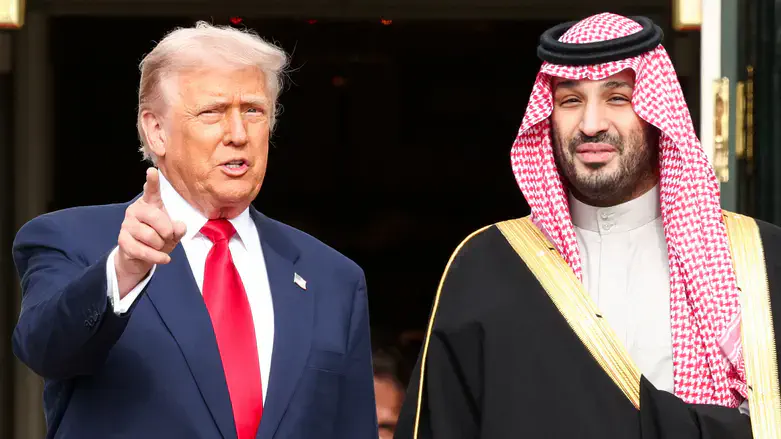
A 30-year civilian nuclear agreement with Saudi Arabia has received formal approval from US President Donald Trump, administration officials confirmed to The Wall Street Journal on Tuesday.
The multi-billion-dollar deal guarantees American firms a commanding position in establishing the kingdom's atomic infrastructure while preventing rival foreign nations from securing the contract, according to the report.
Under a central term of the arrangement, American companies could construct a uranium enrichment plant in Saudi Arabia if an upcoming joint feasibility evaluation validates the initiative. US officials maintain that active American oversight will prevent the program from turning toward military applications.
Expected to reach Capitol Hill shortly, the pact faces significant skepticism from legislators apprehensive about dispersing nuclear capabilities across a turbulent Middle East, noted the WSJ. Overturning the deal would require Congress to pass a joint resolution by a veto-proof two-thirds majority - a formidable hurdle for opponents.
The framework was sanctioned late last week and is set for signature Wednesday by Energy Secretary Chris Wright - who previously met with Saudi Energy Minister Prince Abdulaziz bin Salman during an April 2025 regional trip - and his Saudi counterpart.
Riyadh has consistently argued that an atomic framework is crucial to leverage its unproven uranium deposits for domestic energy demands. Transitioning to nuclear power would allow the kingdom to preserve more crude oil for foreign export, raising state revenue.
Though Saudi leaders stress that their goals are non-military, Crown Prince Mohammed bin Salman warned in 2018 that his nation would pursue atomic weapons if rival Iran successfully built one.
Monitoring mechanisms will face close scrutiny from US lawmakers assessing whether the agreement prevents weapons development amid current Middle Eastern conflicts. American enterprises will supply the initial energy reactors, occasionally drawing on international subcontractors.
Once construction progresses, a two-year US-Saudi assessment will weigh whether domestic enrichment makes commercial sense over importing processed fuel. If local enrichment is approved, Americans would construct the processing site under a classified "black box" protocol designed to shield sensitive technological secrets.
US officials insist that direct American supervision will keep enriched materials from being repurposed into weaponry and prevent spent reactor fuel from being reprocessed into bomb-grade plutonium. Should Washington decline to proceed after the joint study, Saudi Arabia is barred from attempting enrichment independently or with other global partners for a decade.
Opponents contend that equipping Saudi Arabia with atomic technology - particularly enrichment or reprocessing capabilities - threatens to trigger regional arms proliferation.
Intergovernmental inspection protocols remain another friction point. Saudi Arabia rejected the International Atomic Energy Agency’s "Additional Protocol," which grants inspectors broader oversight permissions. While Trump administration officials claim tailor-made safeguards for US-built facilities are sufficient, detractors argue the measures fail to address potential unannounced nuclear activities operating outside the US-assisted network.
The transaction also marks a distinct foreign policy shift. The Biden administration sought a similar nuclear arrangement with Riyadh, but made it contingent upon Saudi Arabia establishing formal diplomatic relations with Israel. Those normalization negotiations stalled following the October 2023 Hamas attack on Israel and the subsequent war in Gaza.
Although President Trump continues to encourage Arab states to sign the Abraham Accords, he has decoupled Israel-normalization from the nuclear deal.