

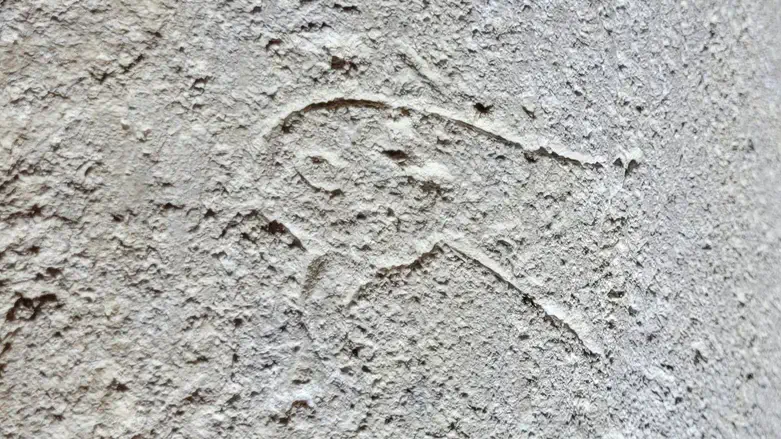
During an archaeology and preservation conference for Judea and Samaria, an exceptional archaeological discovery was revealed in the Cave of the Patriarchs in Hebron. The find prompted a cross-continental research journey and uncovered a possible link between the site and the Spanish royal house in the 12th century.
The study began with an examination of chisel marks in the Isaac Hall of the Cave of the Patriarchs, a structure from the Crusader period that is currently used for Muslim prayers.
Over the past years, nearly 200 chisel marks have been documented at the site, but one of them-an uncommon mark shaped like a bird’s head-attracted the researchers’ attention.
The researchers, Chaim Shakolnik, archaeology coordinator, and Gershon Bar-Kochva of Orot Israel College and Afateh College, found no parallel to the mark in any site in the Land of Israel or in other structures across the Crusader kingdom.
The search for the source of the symbol ultimately led to the city of León in northwestern Spain, where the exact same mark was discovered in a number of churches and additional 12th-century buildings.
According to the researchers, at that time the city of León was ruled by Queen Urraca, considered one of the strongest women in medieval Europe. Historical sources say she viewed herself as a successor to Sarah, the matriarch, and developed a spiritual connection to the patriarchal stories. Her daughter, Sancha, continued this line, and at a certain stage, remains attributed to Abraham the Patriarch came into her possession.
The findings now raise a possibility that artisans from Spain, and perhaps even under the patronage of León’s royal house, were involved in the Crusader construction and renovation works carried out in the Cave of the Patriarchs.
The researchers note that the connection between the unique chisel mark found in Hebron and the marks located in structures connected to the Spanish royal house opens a new research direction regarding the historical and religious ties that formed around one of the oldest and holiest sites in the Land of Israel.