

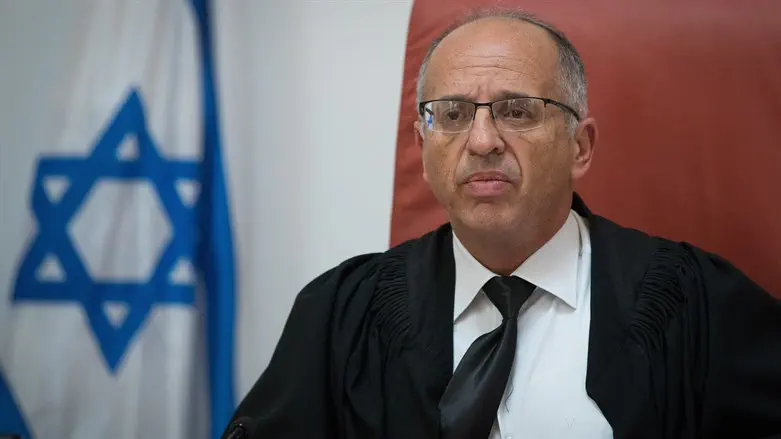
The High Court justices hearing petitions against the election of attorney Michael Rabello recommended that the Knesset consider holding a repeat vote for the position of state comptroller.
The High Court justices hearing the petitions against the election of attorney Michael Rabello recommended that the Knesset consider holding another vote to elect the state comptroller. Justice Noam Sohlberg, who headed the panel, said he would give the parties until Sunday to respond on the matter.
At the center of the hearing were claims that Likud Knesset members were required to document their votes behind the voting screen, allegedly compromising the secrecy of the ballot, as well as the claim that Rabello has a conflict of interest because he served as Prime Minister Benjamin Netanyahu’s attorney.
Rabello was elected about two weeks ago in a secret ballot in the Knesset plenum. In the first round, retired judge Yosef Elron received 60 votes compared with 57 for Rabello, but after neither candidate secured a majority of 61 Knesset members, a second round was held, in which Rabello won with 61 votes compared with 57 for Elron.
During the hearing, the justices focused on the question of the possible violation of ballot secrecy and its implications. Justice Noam Sohlberg clarified that this would be the core issue under discussion, while Justice Ruth Ronen questioned whether every instance of photographing a ballot necessarily leads to invalidating an election and raised the possibility that Knesset members who changed their votes between rounds had simply changed their minds.
Representatives of the petitioners argued that documenting the vote in the second round was intended to serve as a “loyalty test," and that the fact that no such documentation occurred in the first round strengthened the claim that an instruction had been given to photograph the vote. They added that a rule should be established banning cameras from polling booths, arguing that documenting votes creates group pressure that undermines the principle of secrecy.
Justice Ruth Ronen questioned whether the fact that seven Knesset members documented themselves only in the second round could serve as an indication that such an instruction existed. In response, the representative of the Knesset legal counsel said that the act of documentation itself does not prove that an instruction was given, and that after checking with the relevant parties, no evidence supporting the claim was found beyond rumors.
Justices Ruth Ronen and Gila Kanfi-Steinitz also challenged the conflict-of-interest claims against Rabilo, asking why a conflict-of-interest arrangement limiting his involvement in certain matters would not be sufficient. Rabello argued in his response that, in accordance with the law and the conflict-of-interest arrangement, he would be able to serve as state comptroller despite having been Netanyahu’s lawyer and having worked at the office of attorney David Shimron.
During the hearing, MK Tally Gotliv was removed from the courtroom after interrupting the proceedings for the third time, after Justice Sohlberg had previously warned her that it was her “final warning."
Justice Ronen also noted that invalidating an election due to a breach of secrecy could create an incentive to sabotage elections in the future, while representatives of the petitioners argued that the current case involved a broad-scale incident that justified invalidating the process.