

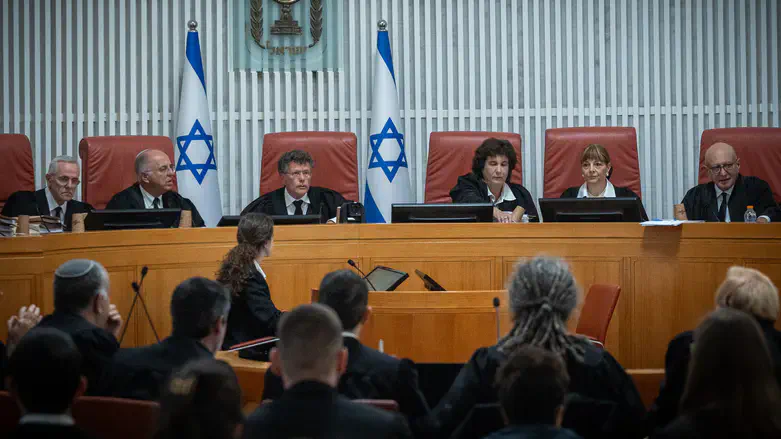
The High Court of Justice on Tuesday evening issued an interim order suspending the implementation of the law freezing the arrest of draft evaders and announced that its final ruling on the petitions challenging the legislation will be issued shortly.
Earlier in the day, the petitions were heard by an expanded panel of nine Supreme Court justices headed by Deputy Chief Justice Noam Sohlberg.
The petitioners include the Israel Hofsheet (Be Free Israel) movement, the Movement for Quality Government in Israel, the Brothers and Sisters in Arms organization, as well as MKs Yair Lapid and Avigdor Liberman. They argue that the law was passed through a flawed legislative process and violates the constitutional right to equality in a manner that does not satisfy the requirements of Israel's Limitation Clause.
The hearing took place under unusual circumstances after the government decided not to send a representative to defend the law it had enacted. Representing the Knesset was attorney Yitzhak Bart, legal counsel to the Knesset, who argued that "there is no choice but to strike down the law," saying the legislative process failed to comply with the requirements of the Basic Law: The Knesset and the Knesset's rules of procedure.
Justice Gila Canfy-Steinitz questioned how the Court should proceed when the Knesset does not defend legislation it passed. In response, Bart described it as "a unique and highly unusual situation," emphasizing that the Knesset's legal advisers are obligated to defend legislation only when it complies with the law. He added that the legal advisers had warned throughout the legislative process about the defects in the bill.
Attorney Aner Helman, representing Attorney General Gali Baharav-Miara, argued that the law is "defective and harmful," saying it fails to meet "even a single requirement of the Limitation Clause."
According to Helman, the law effectively prevents criminal enforcement against individuals who fail to report for military service and could even halt legal proceedings already initiated against them. He added that, at a time when the IDF requires thousands of additional soldiers, there is no justification for allowing the law to remain in force.
During the hearing, the justices challenged some of the state's arguments. Justice Yael Wilner asked why the discussion focused on wartime, questioning whether the law would not also constitute discrimination during peacetime. Justice Daphne Barak-Erez noted that the case concerns not the enlistment of yeshiva students itself, but rather the issue of criminal enforcement.
Later in the hearing, the Court allowed attorney Natan Rosenblatt, who was not a party to the case, to address the justices as a representative of the Haredi community. Rosenblatt argued that the Haredi public has faced a series of hardships in recent months and claimed that Haredim have been consistently discriminated against, adding, "We have never, not even once, received a favorable ruling from the High Court."
He continued: "In a Jewish and democratic state, is it appropriate to place a person before the dilemma of whether to obey the Torah or obey the law?"
Justice David Mintz interrupted him, saying: "Sir, with all due respect, I am restraining myself. I am listening to what you're saying, and I simply cannot believe what I am hearing. Is there a Torah prohibition against military service?"
Rosenblatt replied in the affirmative, saying: "Your Honor, as a religious man, knows that there is such a prohibition. All the leading Torah sages say so."
Justice Mintz responded: "That itself is apparently subject to very serious dispute. Not all the leading Torah sages. You are speaking from a sectarian perspective. What kind of statement is that?"