

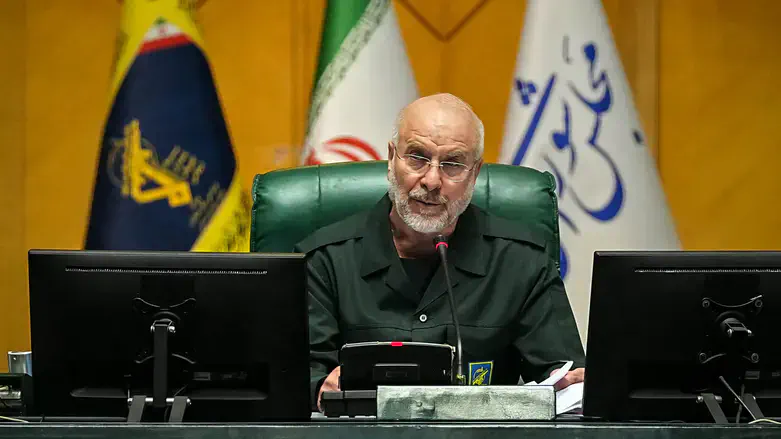
During a state television broadcast on Wednesday, Iranian Parliament Speaker and chief negotiator Mohammad Bagher Ghalibaf declared that Iran emerged triumphant in its recent armed conflict against the United States and Israel.
Characterizing the hostilities through an ideological lens, the legislative leader framed the fighting as a clash of ultimate values.
“The recent war was a war between the front of truth and falsehood," Ghalibaf said.
He insisted that the resistance managed to thwart the strategic goals of the nation's adversaries, asserting, “We did not allow the United States and Israel to achieve the nine goals they set out from the start of the war."
Reflecting on his approach to international relations, Ghalibaf noted that his willingness to engage in statecraft is rooted entirely in a position of leverage.
“When I talk about negotiation and diplomacy, I mean diplomacy of power," Ghalibaf said, adding that he supported negotiations that were themselves “a form of struggle."
The chief negotiator positioned himself as the ultimate skeptic of Washington's political establishment, noting that he directly communicated his deep reservations to US Vice President JD Vance. Ghalibaf recalled informing the American leader that he possessed “not the slightest trust" in him.
Addressing the geopolitical reality of the world's most critical energy shipping corridor, Ghalibaf referenced his previous public remarks concerning the vital maritime lane.
"During the war, I posted on Twitter that the Strait of Hormuz would never return to its previous conditions, and that remains true today."
Despite predicting a permanent shift in regional dynamics, the speaker simultaneously emphasized that Tehran has no intention of unlawfully disrupting international shipping networks.
"However, this does not mean that we intend to act in the Strait of Hormuz contrary to international law or maritime regulations - never. We will act within the framework of international law."
Earlier on Wednesday, the full document of principles reached between the United States and Iran was revealed, presenting a picture in which Iran secures numerous achievements while committing only not to develop nuclear weapons.
The agreement sets a fixed period of 60 days for drafting a final arrangement.
In the meantime, the United States commits to lifting the naval blockade and removing any other interference or restrictions it has imposed on Iran, as well as distancing its forces from the region.
Iran agreed to ensure the safe passage of commercial vessels, free of charge, for only 60 days, from the Persian Gulf to the Gulf of Oman and in the opposite direction.
Additional American commitments include formulating a final, agreed-upon plan worth at least $300 billion for Iran’s economic reconstruction and development, canceling all types of sanctions imposed on the regime in Tehran, including those from the UN Security Council, the Board of Governors of the International Atomic Energy Agency, and sanctions imposed by the US administration.
The United States also committed to immediately issuing a waiver that would allow the export of Iranian crude oil, petroleum products and their derivatives, as well as all related services, including banking transactions.