
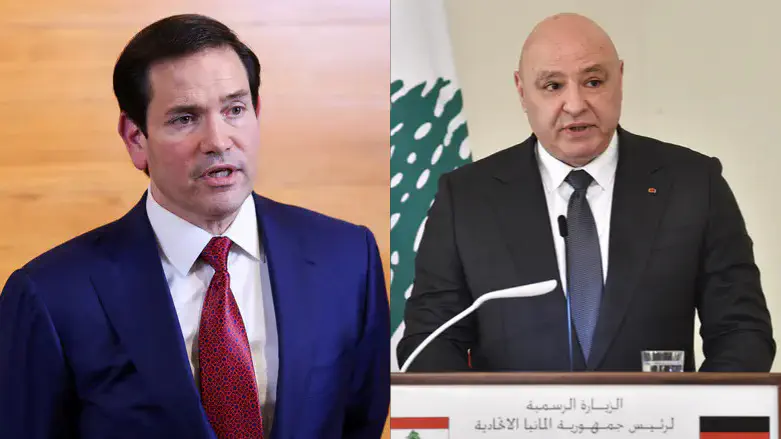
US Secretary of State Marco Rubio held a direct phone consultation with Lebanese President Joseph Aoun on Friday. The dialogue materialized concurrently with the Pentagon hosting US-mediated, face-to-face military negotiations between delegations from Israel and Lebanon.
Following the diplomatic call, US State Department spokesperson Tommy Pigott summarized the administration's stance on the regional dynamic.
“The secretary commended President Aoun’s courage and vision in pursuing direct negotiations with Israel, even as Hezbollah continues its attempts to derail those talks at the expense of the Lebanese people," Pigott stated.
According to the spokesperson, Rubio pinned the blame for the regional conflict squarely on the Iranian-backed terrorist group.
Rubio “reiterated that Hezbollah is entirely responsible for the ongoing fighting and emphasized the need for Hezbollah to immediately cease its attacks and provocations to enable de-escalation," stated Pigott.
“The secretary reaffirmed that the United States fully supports the government of Lebanon as it works to seize a historic opportunity to deliver peace, reconstruction and a better future for its people," he added.
Official readouts from the Lebanese presidency revealed that Aoun emphasized a firm operational sequence to the American Secretary of State during their conversation. Aoun told Rubio that implementing a ceasefire with Israel was “the essential entry point for transitioning to any other issues."
Meanwhile, Israeli and Lebanese defense officials opened a new session of US-brokered security talks at the Pentagon on Friday. Washington officials characterized the defense meetings as a core pillar of a comprehensive strategy to pacify the volatile border and preempt further escalation.
The US has hosted several rounds of talks between Israeli and Lebanese delegations in recent weeks.
After the initial April 23 meeting which was attended by Israel’s Ambassador to the US, Yechiel Leiter, and Lebanon’s Ambassador to the US, Nada Hamadeh Moawad, President Donald Trump expressed hope that peace between Israel and Lebanon would be possible this year.
Trump also said he hopes to host a meeting between Prime Minister Benjamin Netanyahu and Aoun in Washington within the next few weeks.
However, Aoun has made clear that a high-level summit with Netanyahu is currently out of the question, stressing that the cessation of hostilities must be the primary focus before any direct political engagement can be considered.
Aoun also recently stressed that Israel’s complete military withdrawal from southern Lebanon is a “non-negotiable" prerequisite for an agreement.
Meanwhile, Hezbollah continues to violate the ceasefire in Lebanon which has been extended by Trump. The group has been firing rockets and attack drones towards northern Israeli communities and IDF soldiers operating in southern Lebanon.
The IDF has retaliated by striking Hezbollah targets and eliminating senior members of the terrorist organization.
IDF Spokesperson Effie Defrin on Thursday said the IDF continues to intensify operations against Hezbollah in Lebanon while working to protect northern communities and address the growing drone threat.
According to Defrin, since the beginning of the ceasefire, the IDF has eliminated “more than 800 terrorists in Lebanon," in addition to “more than 2,500 terrorists" eliminated since the start of Operation Roaring Lion.
(Israel National News' North American desk is keeping you updated until the start of Shabbat in New York. The time posted automatically on all Israel National News articles, however, is Israeli time.)