

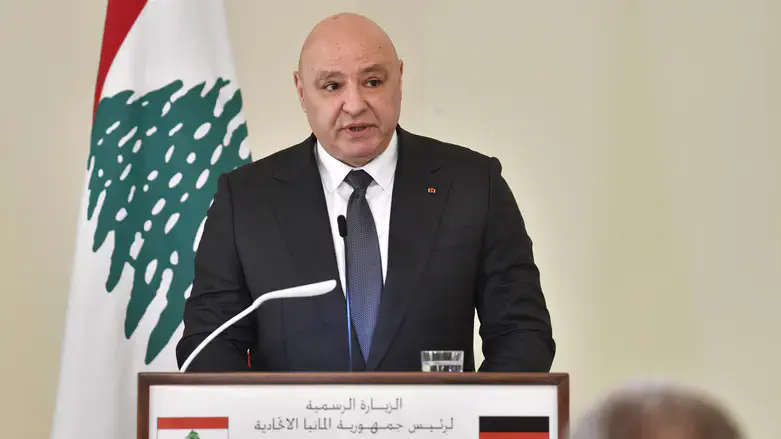
The Lebanese presidency announced on Monday that President Joseph Aoun has formally requested the United States to intervene and pressure Israel to halt its military activities in southern Lebanon, Reuters reported.
The appeal comes as the IDF intensifies its operations against Hezbollah terrorist infrastructure in the border region, as the organization continues to violate the ceasefire.
During a meeting with US Ambassador Michel Issa, President Aoun emphasized the urgency of a total cessation of hostilities.
According to a statement from the presidency quoted by Reuters, Aoun "stressed ... the necessity of pressure on Israel to halt fire and military operations and the destruction and bulldozing of homes".
The presidential meeting also served to review preparations for an upcoming third round of diplomatic talks between Israeli and Lebanese representatives. These high-level negotiations, facilitated by the United States, are scheduled to take place in Washington on May 14 and 15.
The delegation from Beirut will be led by Simon Karam, a former ambassador to Washington. President Aoun met with Karam on Saturday to provide specific directives for the mission. These talks represent the most significant direct contact between the two nations in decades, following two successful rounds held last month involving the respective ambassadors to the US
After the April 23 meeting which was attended by Israel’s Ambassador to the US, Yechiel Leiter, and Lebanon’s Ambassador to the US, Nada Hamadeh Moawad, President Donald Trump expressed hope that a ceasefire between Israel and Lebanon would be possible this year.
Trump also said he hopes to host a meeting between Prime Minister Benjamin Netanyahu and Aoun in Washington within the next few weeks.
Aoun has made clear that a high-level summit with Netanyahu is currently out of the question, stressing that the cessation of hostilities must be the primary focus before any direct political engagement can be considered.
The decision to engage in face-to-face dialogue with Israel has exposed deep fractures within Lebanon. While many citizens and officials criticize Hezbollah for unilaterally dragging the country into a devastating conflict, the terror group has remained defiant, demanding that the government cancel the negotiations entirely.