

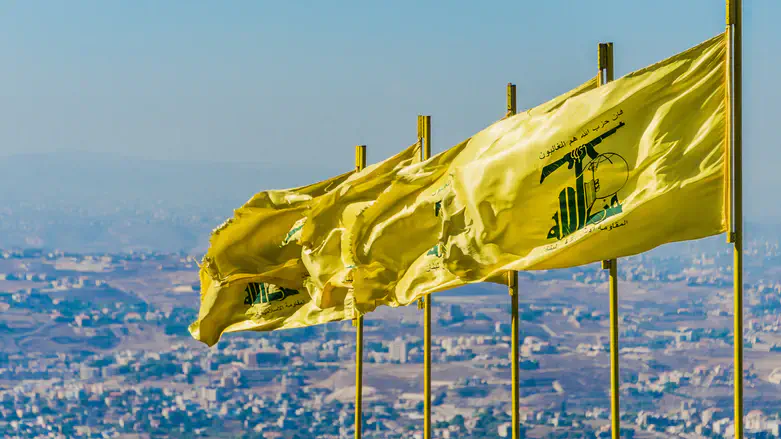
The United States Department of the Treasury on Thursday unleashed a sweeping round of counterterrorism sanctions targeting nine high-ranking individuals in Lebanon who have actively sabotaged regional peace initiatives and obstructed the mandatory disarmament of the Hezbollah terrorist organization.
According to an official statement from the Treasury’s Office of Foreign Assets Control (OFAC), the blacklisted individuals comprise a network of Hezbollah-aligned operatives deeply embedded across Lebanon’s parliament, conventional military, and national security infrastructure.
Washington asserts that these figures have systematically abused their positions within the Lebanese state to insulate and expand the Iranian-backed terror group’s grip over vital sovereign institutions. The continuous militant operations and coercive extortion practiced by Hezbollah have effectively paralyzed the legitimate Lebanese government, rendering it unable to enforce national sovereignty or strip the terrorist organization of its illicit arsenals.
“Hezbollah is a terrorist organization and must be fully disarmed," said Secretary of the Treasury Scott Bessent. “Treasury will continue to take action against officials who have infiltrated the Lebanese government and are enabling Hezbollah to wage its senseless campaign of violence against the Lebanese people and obstruct lasting peace."
The targeted sanctions were executed under the authority of Executive Order 13224, a robust American counterterrorism mechanism. The federal action builds upon decades of US pressure, noting that the State Department originally designated Hezbollah as a Specially Designated Global Terrorist under this executive order in October 2001, following its 1997 classification as a Foreign Terrorist Organization under the Immigration and Nationality Act.
The Treasury Department exposed how Hezbollah weaponizes its political faction to defy state authority and block disarmament mandates. Four prominent members of the Lebanese legislature were explicitly cited for utilizing their public platforms to spearhead the radical group's agenda at the expense of the Lebanese populace.
Among those sanctioned is Mohamed Abdel-Mottaleb Fanich, who commands Hezbollah’s executive council and oversees the administrative restructuring required to maintain the group's permanent armed presence. Fanich, a founding member of the terror organization, previously secured a seat in parliament under Hezbollah’s Loyalty to the Resistance Bloc and once served as the nation's Minister of Youth and Sports.
Joining him on the blacklist is Hassan Nizammeddine Fadlallah, a Hezbollah member of parliament since 2005 who previously helped establish the U.S.-designated Al Nour Radio and held a senior directorship at the notorious Al-Manar TV propaganda network. Ibrahim al-Moussawi, the current chief of Hezbollah’s Media Committee and an elected lawmaker, was similarly designated alongside Hussein Al-Hajj Hassan, a veteran member since 1982 and parliamentarian since 1996 who has served as a primary legislative bulwark against disarming the organization. All four politicians face sanctions for directly acting on behalf of, or being controlled by, Hezbollah.
The American sanctions also dismantled the treasonous partnerships shielding the terror group, exposing deep infiltration within Lebanon's legitimate defense forces and alliances with external actors.
A primary target of the designation is Mohammad Reza Sheibani, Iran’s ambassador-designate to Lebanon. Sheibani was recently declared persona non grata and expelled by Beirut after the Lebanese Foreign Ministry caught him violating fundamental diplomatic norms to facilitate the hostile operations of Iran’s Islamic Revolutionary Guard Corps (IRGC).
Furthermore, the US targeted Ahmad Asaad Baalbaki and Ali Ahmad Safawi, two prominent security figures within the Amal Movement - Hezbollah's chief political and military ally. Baalbaki, Amal's Security Director, allegedly deployed joint forces with Hezbollah to terrorize domestic political opponents. Safawi, who commands the Amal militia in southern Lebanon, operated as Baalbaki's direct subordinate, actively taking operational orders from Hezbollah to execute combined military strikes against Israel.
The Treasury Department also uncovered illicit intelligence-sharing pipelines inside Lebanon’s state-funded security apparatus. Brigadier General Khattar Nasser Eldin, the National Security Department Chief for the General Directorate for General Security (DGS), and Colonel Samir Hamadi, the Lebanese Armed Forces (LAF) Intelligence Directorate Dahiyah Branch Chief, were both sanctioned for leaking critical intelligence to Hezbollah during the ongoing military conflict over the past year.
The logistical implications of the OFAC designations are severe. All assets, property, and financial interests belonging to the nine individuals that fall within US jurisdiction or enter the possession of American citizens are immediately frozen and must be reported to federal authorities. Any corporate entity owned 50 percent or more by these blocked individuals faces identical restrictions.
The Treasury Department warned that foreign financial institutions risking exposure to these individuals could face devastating secondary sanctions, including the total termination or strict restriction of their US correspondent bank accounts. While the agency noted that the ultimate goal of these measures "is not to punish, but to bring about a positive change in behavior," Washington made it clear that strict civil and criminal liabilities will be imposed on any global entities attempting to evade or violate the blockade.
(Israel National News' North American desk is keeping you updated until the start of Shavuot in New York. The time posted automatically on all Israel National News articles, however, is Israeli time.)