

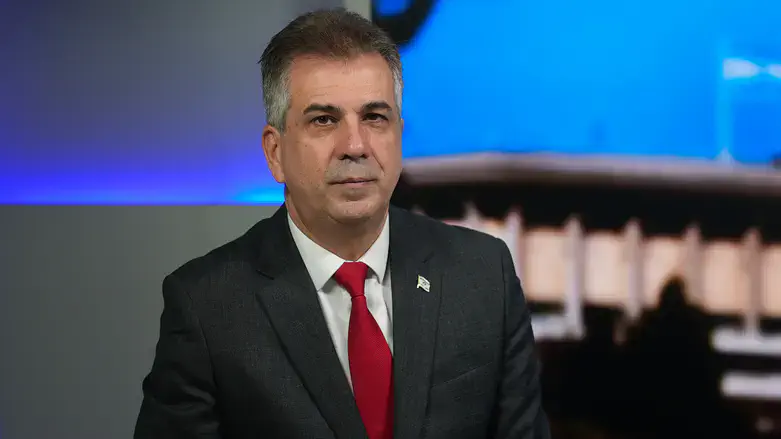
Energy and Infrastructure Minister Eli Cohen is convinced that the campaign against the Iranian axis of evil is at a critical turning point.
In an interview in the Arutz Sheva-Israel National News studio, he stated, "The equation is very simple - if Iran does not accept the dictates of the United States, there will undoubtedly be a military strike. Iran is no longer in a position to keep dragging its feet. We are seeing Trump’s actions regarding the closure of the Strait of Hormuz, which are leading to an economic collapse. Iran has been hit very hard militarily, and Trump is determined to achieve the war’s objectives - either diplomatically or through military action."
When the minister was asked about the potential price the Israeli home front might pay in the event of such a direct confrontation, he replied, "The State of Israel has already proven that it knows how to defend itself, and furthermore, how to strike back with precision and lethality."
At the beginning of the war, questions were raised regarding the readiness of the electricity and energy sectors for blackout scenarios or massive strikes on critical infrastructure. Minister Cohen, who is responsible for these systems, dismissed the claims, highlighting a successful risk management strategy that proved itself in the moments of truth.
"We made sure to increase stockpiles, we ensured diversification, we ensured fortification, and emergency teams were ready. We did sustain hits, yet despite this the citizens of Israel lacked for nothing, not even for a single second. Not electricity, not gas, not water, and not fuel," he stressed.
For Cohen, Israeli strength is reflected not only in the fortification of infrastructure but also in the weakness of the enemy.
"We assess that the regime in Iran is standing on shaking ground. They talk a big game, but their leader is hiding for fear of being assassinated. I think there is no doubt today as to who the strongest power in the Middle East is. I expect the regime in Iran to collapse. The only question is when it will happen."
Cohen confirmed that American economic sanctions are a particularly effective tool in this campaign. "First of all, the blockade is doing its job. I have no doubt that if it continues, it will cause the very economic collapse that will spark the seeds of revolution against a regime that has murdered them, tyrannized them, and denied them rights."
In the energy sector, the sanctions and tensions in the Persian Gulf are accelerating the development of alternative strategic solutions for Israel and countries in the region. "At this very moment, work is already underway on an alternative route," the Energy Minister revealed. "There are ongoing talks today with countries that will be revealed as soon as the war ends. It must be remembered that in our region, alliances and connections are built on interests, and Israel is only taken seriously when it is strong. Israel is currently strong security-wise, economically, and technologically."
On the Lebanese front as well, as far as Cohen is concerned, the objectives are clear. "We will complete the operation in Lebanon. Let’s not forget that there is no actual ceasefire. Our soldiers are working to neutralize the threat of terrorists infiltrating communities near the border fence, as well as the anti-tank missile threat. We are committed to dismantling Hezbollah."
The minister's connection to the fighting on the northern front stems not only from his role in the cabinet but from a personal connection. "I am both in the cabinet and a worried father, because my son is serving in Lebanon. I am very proud of him and his friends. We all need to salute them. We must give everything to those combat soldiers who go out to fight for the future of the Nation of Israel."
Regarding the future of the Gaza Strip, the cabinet member presented a firm and uncompromising line, ruling out a withdrawal and mandating an increased military foothold until absolute control is achieved. "In Gaza, at the end of the day, we will have full control. It is impossible without it. A month and a half ago, we controlled 53% of the Strip's territory, and today we control 60%. The day will come when we control 100% of the Gaza Strip's territory."
On the domestic political front, Minister Cohen assessed that the political system is in the final stretch ahead of elections, primarily due to the deadlock over the Draft Law. "I estimate that the chance of passing the Draft Law over the next two to three weeks is low, and therefore my assessment is that elections will be held on September 1st."
The minister expressed great confidence ahead of election day and blasted the leaders of the opposition and their political intentions to rely on the Arab parties. "It is going to be difficult, but I believe in the people of Israel. In the past, the opposition tried to hide the fact that they intended to form a government with the Arabs. This time, they are coming out and saying it publicly."
Cohen stressed that alongside the war, the core goals of the national camp must continue to be advanced. "We are not perfect; there are things to fix. We need to complete the judicial reform, which we all understand the importance of. We want a Jewish state, we need to address the cost of living - and it is all for the people of Israel."
Regarding the various initiatives to establish new right-wing parties headed by figures like Yuli Edelstein, Gideon Sa'ar, or Moshe Kahlon, the minister warned against wasting precious votes that would harm the national camp: "We must not lose right-wing votes in an election campaign that is so important and critical."
One of the achievements he is proudest of is the energy and infrastructure revolution in Judea and Samaria, which he defines as "de facto sovereignty" on the ground.
"I am proudest to be a partner in a cabinet that approved more than 50 new communities. I see Zionism, and we are connecting them to electricity and water. There is no greater privilege than settling the Land of Israel in general, and Judea and Samaria in particular."