

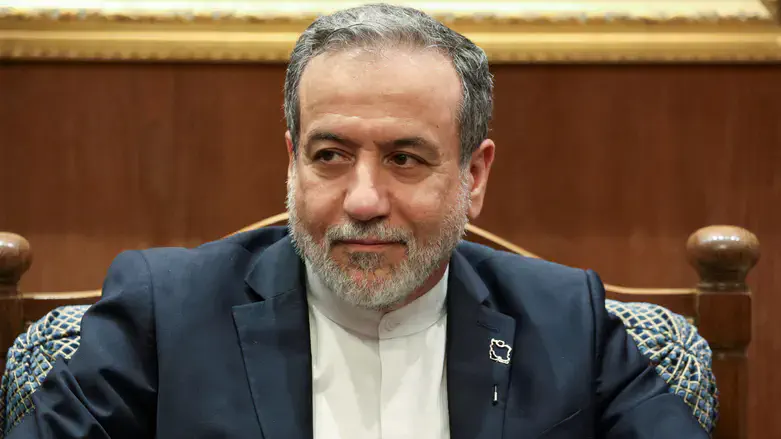
Iranian President Masoud Pezeshkian and Parliament Speaker Mohammad Bagher Ghalibaf are seeking to remove Foreign Minister Abbas Araghchi from his position, Iran International reported.
According to the report, which quoted two sources familiar with the matter, Pezeshkian and Ghalibaf believe that Araghchi is following instructions from Iranian Revolutionary Guard chief Ahmad Vahidi on matters relating to nuclear talks - without informing Pezeshkian. Thus, in the opinions of Pezeshkian and Ghalibaf, Araghchi is no longer acting as a cabinet minister as much as he is acting as an aide to Vahidi, who is reportedly the most powerful figure in the IRGC.
The sources said that Araghchi has acted for two weeks without informing Pezeshkian and in full coordination with Vahidi; Pezeshkian has told sources close to him that he will fire Araghchi if this behavior continues.
The report also said that the IRGC had usurped Pezeshkian's authority, insisting that this was a necessary move due to the war.
The report dovetails with a Reuters report earlier this week, which said that the Islamic Republic no longer operates under a single, dominant clerical authority, marking a departure from the system that has governed the country since 1979. In place of a centralized leadership, power has increasingly shifted toward senior figures within the Islamic Revolutionary Guard Corps (IRGC) and other security institutions.
Mojtaba Khamenei, who was elevated after his father’s death despite being seriously wounded in the initial strikes, formally occupies the highest position. However, individuals familiar with internal discussions indicate that his role is largely limited to endorsing decisions rather than directing policy.
Sources cited by Reuters describe a wartime leadership structure in which authority is concentrated within a smaller group tied to the Supreme National Security Council, the Supreme Leader’s office, and the IRGC. This grouping now plays a central role in both military operations and broader strategic decision-making.
A senior Pakistani official involved in mediation efforts between Iran and the US said the absence of a unified command structure has slowed responses during negotiations. According to the official, it can take several days for Tehran to reply to proposals.